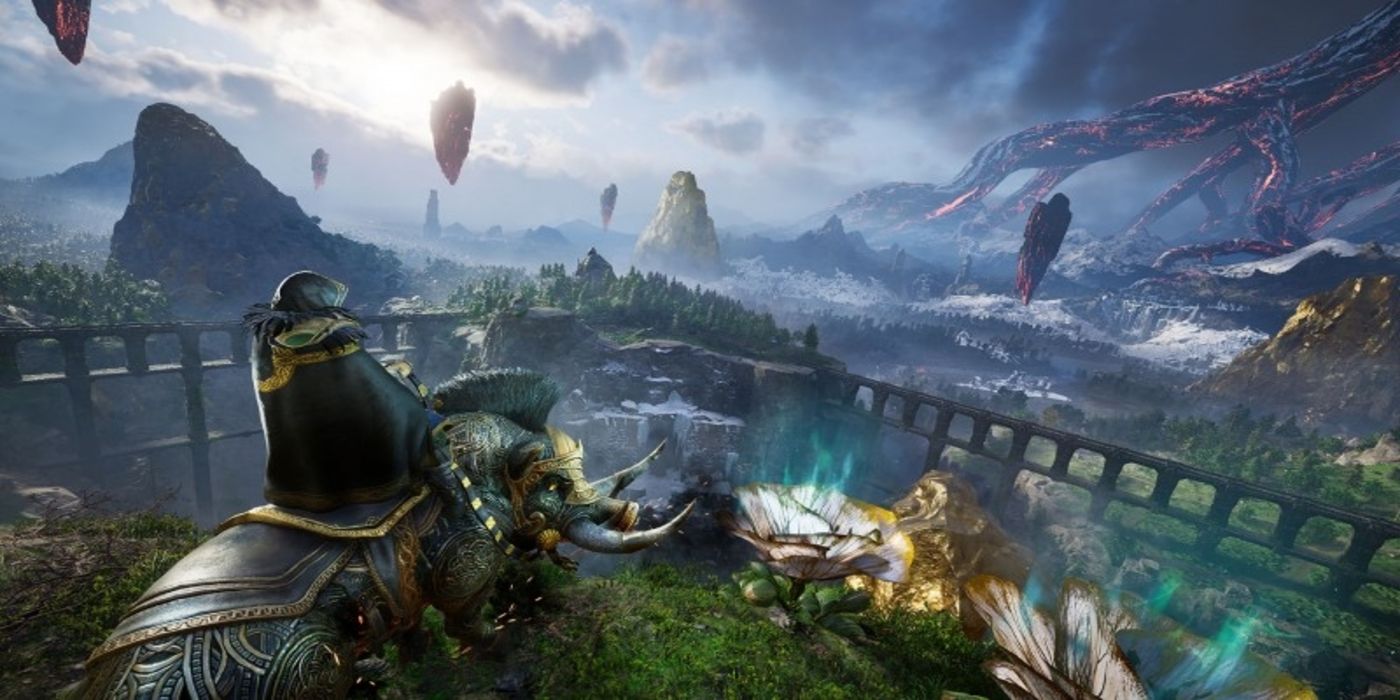
The wildly successful Assassin’s Creed Valhalla has just released its Dawn of Ragnarök, its latest expansion. Ubisoft decided to take a different approach to this Assassin’s Creed Valhalla expansion compared to the two that were released for the Valhalla season pass, Wrath of the Druids and The Siege of Paris. Historical maps are out, paving way for some more Norse lore.
In the largest Assassin’s Creed expansion to date, players journey to Svartalfheim, one of the Nine Realms in Norse Mythology. Before this point, players have been able to explore two other Realms: Asgard and Jotunheim. Both were included in the base game and explored the story of Havi/Odin. While these two arcs aren’t necessarily important to Eivor’s journey, they do help players understand Vahalla‘s ending. Svartalfheim does draw some similarities to the previous realms players have seen. However, it isn’t a carbon copy.
Each of the Norse Realms can be entered by drinking one of the potions Valka has concocted in the Seer’s Hut. Each Realm has a recommended power level; Asgard is 90, Jotunheim is 190 and Svartalfheim is 340. Players that either haven’t reached 340 in the base game or haven’t unlocked the Seer’s Hut can start Dawn of Ragnarök through the main game menu. However, players won’t be able to carry over any items, weapons, or armor to the main game.
Just like all the areas within Valhalla, Svartalfheim allows players to loot wealth, hunt down artifacts, and find all the blue-marked mysteries. These new mysteries that haven’t been seen before and include “Dwarves in Distress,” “Mythical Memories,” and “Dwarven Altars.” The “Dwarven Altars” are similar to the Altars in Valhalla, but they differ from the ones in Asgard and Jotunheim as they don’t require the area’s wealth as the offering.
Each realm is as visually beautiful as the next. Asgard is a bright hue of color, including the rainbow road that is the Bifrost. Jotunheim is snow-covered. Ubisoft made no exception when it comes to the color plate of Svartalfheim. The map goes from luscious greenery to the dark reds of Surtr’s fire, making it just as aesthetically pleasing as the other regions. The roots of Yggdrasil, commonly known as the World Tree that connects the Nine Realms, take up a section of the map, just as they are seen in Asgard and Jotunheim.
Despite being a Norse Realm, Svartalfheim does have its differences compared to Asgard and Jotunheim. Being a standalone DLC, the map of Svartalfheim is significantly larger. It is split up into four different regions, Gullnamar, Svaladal, Vangrinn, and the smaller region of Eitri.
In Asgard and Jotunheim, Havi and their peers’ main enemy was the Jotnar. Svartalfheim introduces Muspels, a faction of the Jotnar with even hotter heads. Being a specially made DLC, Havi is given extra powers through a device called the Hugr-rip. These powers are exclusive to the land of Svartalfheim. Some areas can only be reached by flight, but Power of the Raven allows Havi to be transformed into said bird to get to those out-of-reach places. Power of Rebirth allows for the resurrection of fallen foes to help fight by Odin’s side.
Like the arena in Assassin’s Creed Odyssey, Havi can take part in battles called the Valkyrie Trials, defeating waves of enemies. What makes these battles unique is that they re-enact battles in which Havi has previously taken part. This means players may come up against foes they have already beaten. Overall, Svartalfheim is a great land for those that loved the other realms. It’s full of rich Norse mythology, stunning vistas and a whole bunch of extra content to keep those fans of the Asgard and Jotunheim arcs happy.
About The Author
