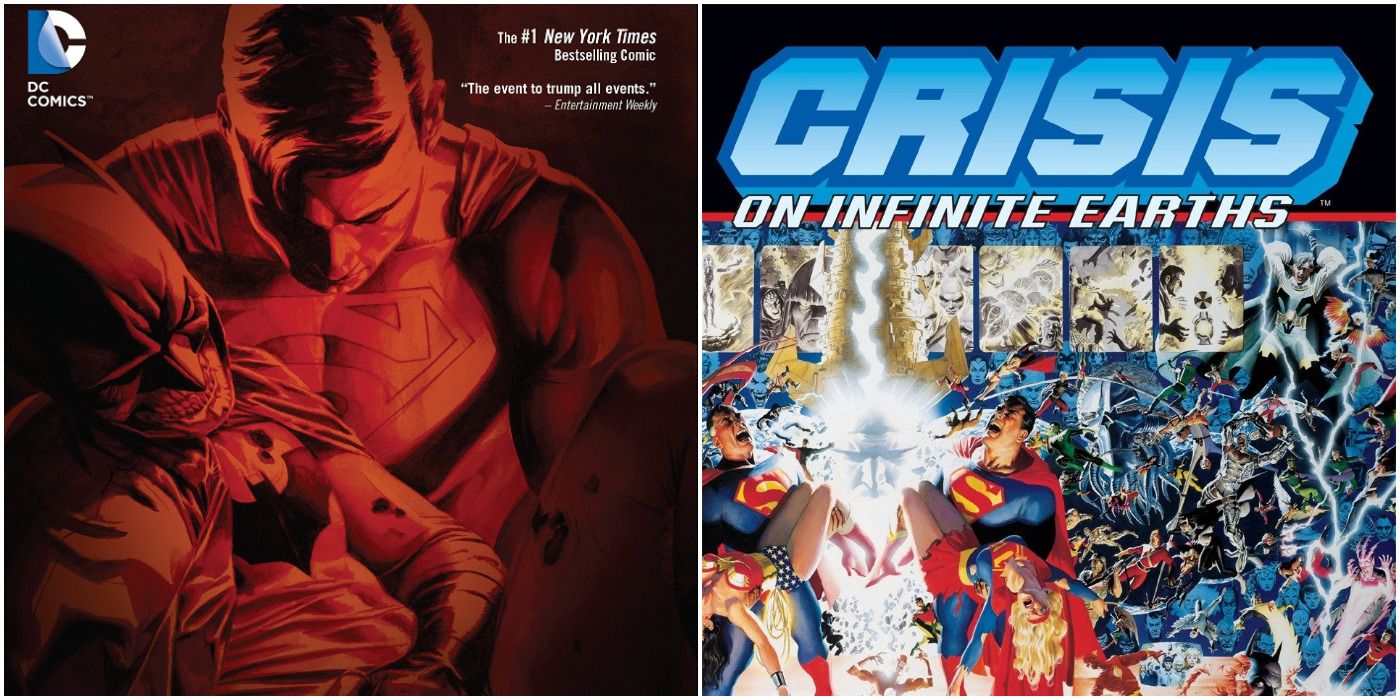
For DC fans, there’s one word that always means something big for them — “crisis.” Since the Justice League/Justice Society crossovers of the Silver Age, when each one used the word in their title, it has become a staple of the publisher’s lexicon, and they went huge with 1985’s Crisis On Infinite Earths. Since then, DC has used the term as a signifier for a massive event, often involving the Multiverse in some way.
With the upcoming Dark Crisis event, it’s time to take a look back on the various Crisis events to see how they stack up against each other. These are some of DC’s biggest stories, and fans have some rather contentious opinions on them, to say the least.
7 Identity Crisis Has Some Good Ideas But Has Aged Poorly
Identity Crisis has gone from beloved to downright ignored, at best. When it was first released, writer Brad Meltzer and artist Rags Morales’s superhero mystery was the talk of the comic industry with a legion of fans. However, its brutal treatment of Sue Dibny has cast the whole story in a very bad light. Beyond that, the story’s ending and resolution to its mystery were always very disappointing.
Identity Crisis does have some great ideas in it, as the whole Justice League mindwipes subplot is easily the best part of the comic. It also has the best argument for why Deathstroke is a great villain, and issues four and five are complete heartbreakers. It’s a book that is definitely not the sum of its parts, as the good parts are completely outweighed by the most terrible parts of the comic.
6 Zero Hour: Crisis In Time Fizzled Out Completely
Zero Hour: Crisis In Time is the forgotten Crisis event. Writer/artist Dan Jurgens, along with artist Jerry Ordway, was one of the DC’s biggest talents in the ’90s. On the tenth anniversary of Crisis On Infinite Earths, he was tasked with fixing some of the problems left over by CoIE. Zero Hour definitely has its moments, but overall, it actually makes a lot of things worse and enacts few lasting changes to the DC Universe.
The book did introduce some great new characters, like Impulse and Jack Knight, and led to the popular Abnett/Lanning Legion Of Superheroes/Legionnaires reboot. It also ruined Hawkman for over a decade and basically didn’t make enough of an impact to really matter that much in the long run. It’s also kind of hard to reread, as so much of it depends on DC continuity of the time. It has some okay moments, but it’s not great.
5 Heroes In Crisis Could Have Been A Lot Better
Heroes In Crisis is better than it gets credit for, but it does deserve a lot of the ire it gets. Written by Tom King with art by Clay Mann and Mitch Gerads, it centers on a murder mystery at Sanctuary, a place where superheroes go for help with mental issues. These are all great ideas, and the pair of Booster Gold and Harley Quinn setting out to solve the mystery with help from Blue Beetle, Barbara Gordon, and Poison Ivy works rather well.
The problem comes in the reveal of the murderer, Wally West. Wally West has a legion of fans, and DC’s mistreatment of him throughout the 2010s angered many fans, with Heroes In Crisis compounding that. Wally’s fans were outraged by the story, and even non-fans of the character didn’t like it. This one part of the plot soured what is otherwise a very good story.
4 Death Metal Is A Crisis In Everything But Name
Death Metal, by writer Scott Snyder and artist Greg Capullo, does all of the things that a Crisis event should, but it doesn’t have the name attached to it. However, Wonder Woman’s struggle against Perpetua and the Batman Who Laughs plays into many of the same tropes of the past multiversal Crises. It even brings up Crisis energy to refer to a multiversal power source. The book ends with the Multiverse getting ever bigger and leads into the current DC status quo.
Death Metal is full of huge moments, has some great tie-ins, and ends the Batman Who Laughs storyline, something everyone can be happy about it. It’s often the comic equivalent of a popcorn movie, but in the best possible way.
3 Infinite Crisis Continued The DC Renaissance Of The 2000s
The 2000s were a great time for DC, and Infinite Crisis, by writer Geoff Johns and artists Phil Jimenez, George Perez, Ivan Reis, and Jerry Ordway, was the victory lap. It’s one of the best events books of the 21st century and did a great job of paying homage to Crisis On Infinite Earths, delivering a suitably massive story and bringing about some big changes to the DC Universe.
While these changes were mostly just reversing things that Crisis On Infinite Earths itself retconned, Infinite Crisis led to a new era for the publisher. It reshuffled the deck for DC, leaving nearly every hero and villain in a great place. Infinite Crisis is endlessly re-readable and stands head and shoulders above so many other event books of its time.
2 Final Crisis Is The Smartest Crisis
Final Crisis is writer Grant Morrison’s superhero opus. Joined by artists J.G. Jones, Carlos Pacheco, and Doug Mahnke, Morrison pit the heroes of the DC Universe against Darkseid while a hidden threat lurked in the Multiverse, one more insidious than any of them can imagine. Final Crisis is chock full of all of the great things about Morrison’s writing, the biggest being the metatextual significance of the story.
The subtext of the work is what makes it so powerful; Morrison was railing against editors and the companies that controlled comic universes — as exemplified by the Monitors — and reveling in the purity of superheroes and their battle against evil. It’s a comic that reveals more and more to readers the more it’s read. It’s an unfolding onion of a story. It works on both a surface level and as a deeper piece of work that critiques the comic industry itself.
1 Crisis On Infinite Earths Is The Granddaddy Of Them All
Crisis On Infinite Earths is one of the greatest event books of all time. Writer Marv Wolfman and artist George Perez, with an assist from artist Jerry Ordway, created something special with this book. They took the nascent event book and codified it for the future, creating the perfect all-powerful big bad for the heroes to fight and giving fans something that was unprecedented in the comic industry — lasting change. Crisis recreated the DC Universe and ended the Silver Age at DC forever in one fell swoop.
Wolfman and Perez were able to do something amazing with Crisis. They juggled multiple universes of characters and the timelines of those universes and made a story with a cast of hundreds that somehow did right by all of them. They even remembered that the villains wouldn’t just be doing nothing while the big bad attacked. It’s an amazing achievement and set the pace for every event book that came after it. It’s the most important DC story of all time and possibly the most important comic of the last forty years.
About The Author
