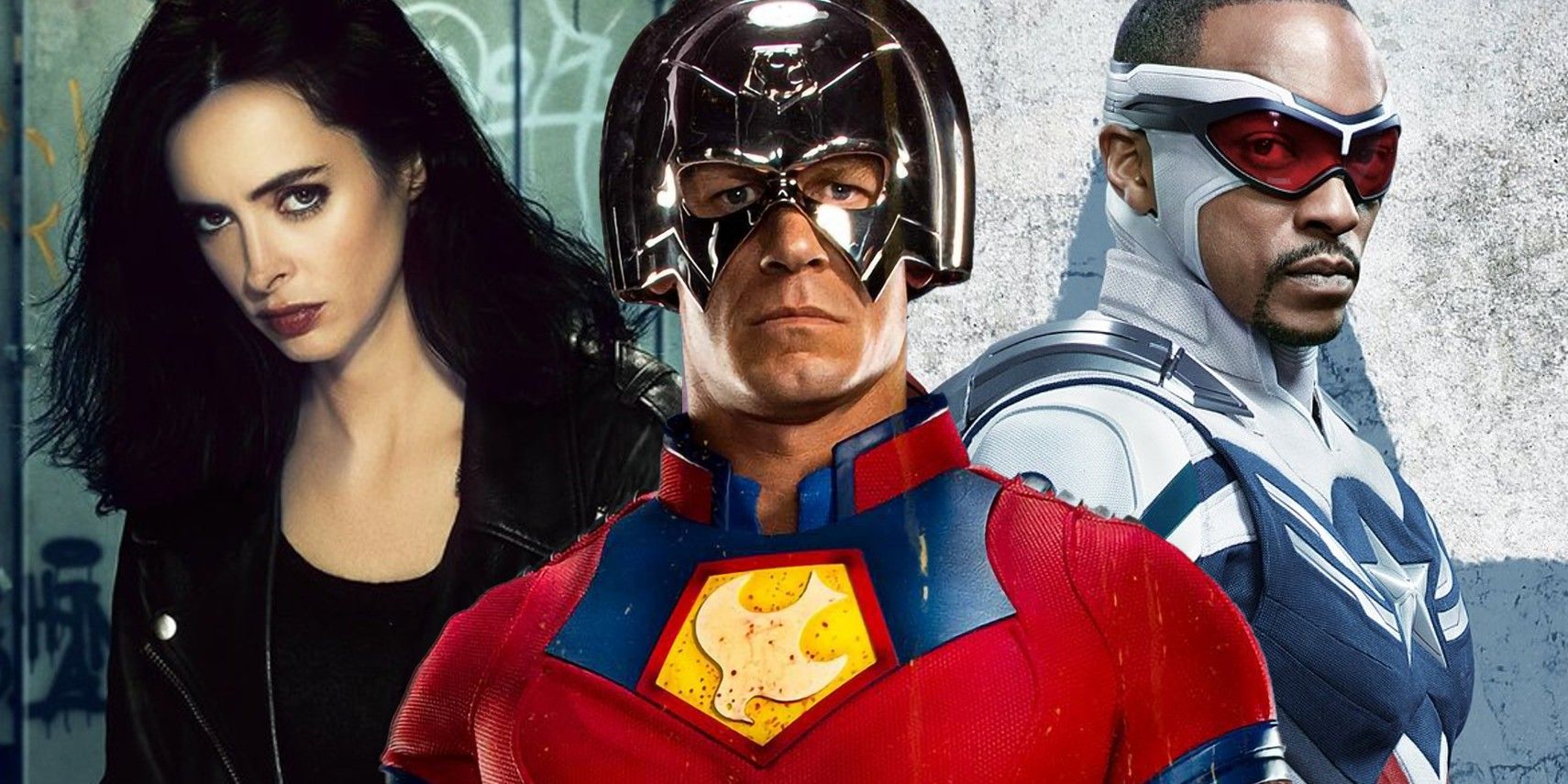
After stealing the show in The Suicide Squad, John Cena returned as Peacemaker in his own HBO show. Premiering in January 2022, Peacemaker stars John Cena in the titular role, Jennifer Holland as Emilia Harcourt, Steve Agee as John Economos, and Danielle Brooks as Leota Adebayo.
Peacemaker was a massive success, with many even claiming it to be the best superhero series to date. Because of this, comparisons to the Marvel Cinematic Universe’s serialized offerings were unavoidable. Opinions are subjective, but there are some things that Peacemaker clearly did better than its closest Marvel counterparts.
10 Peacemaker Made Good Use Of Its Edge And R-Rating
An R-rating alone doesn’t automatically guarantee quality but it’s a breath of fresh air that’s appreciated whenever a superhero property uses it. After dominating the genre for roughly 20 years, the MCU’s PG-rated limits can get repetitive, which is part of what made the shamelessly crass and gory Peacemaker so refreshing.
What really makes Peacemaker a good example of adult-oriented superhero entertainment isn’t the mere presence of sex and violence, but how they’re used. Peacemaker never crossed the line for shock value’s sake, and it had fun with its vulgarity. In contrast, Netflix’s Marvel shows used their R-Ratings to be taken seriously, not exactly for entertainment.
9 Peacemaker’s Action Is Simpler, But More Impactful
Just like in The Suicide Squad, the action of Peacemaker is scaled back. The sporadic fights were comprised of scuffles and gunfights, where computerized effects were only used when necessary. As a result, Peacemaker’s fights had a uniquely gritty feel to them that complimented the series’ grounded tone and story.
Contrast this to the Disney+ MCU shows, where effects-heavy setpieces clashed with what were advertised as smaller-scale character pieces. If these displays of CGI weren’t distracting, they overstayed their welcome. The Netflix MCU shows may not have had much CGI like Peacemaker, but they tended to go overboard in terms of overlong fights.
8 Peacemaker’s Side-Characters Actually Mattered
One of the best things about Peacemaker was its well-balanced cast. Besides his beloved pet eagle Eagly, Peacemaker had a small ARGUS team and the bloodthirsty Vigilante on his side. Peacemaker’s allies got their time to shine and grow on audiences, while villains like the Butterflies and White Dragon made good use of their limited presence.
Marvel shows typically have larger casts than that of Peacemaker’s, and they all suffered for it. Hawkeye, for example, had a host of new and reoccurring MCU characters but they ended up fighting each other for screen time. The most affected were the glorified cameos like Wilson Fisk and Yelena Belova who, while fun to watch, weren’t all that necessary.
7 Peacemaker Wasn’t Afraid To Get Dark And Ugly
Every now and then, MCU shows would reflect current events but usually only glossed the topic’s surface. For example, The Falcon And The Winter Soldier didn’t dive into the darkest aspects of racism, refugee crises, terrorism, and more because doing so would subvert the MCU’s family-friendly appeal too much.
Rather than follow this toothless approach, Peacemaker made its politics clear. For one, Auggie Smith’s (aka White Dragon) bigotry was obvious and Peacemaker had to unlearn his father’s hateful ways. Conversely, John Walker’s (aka US Agent) zealous nationalism in the comics was toned down so that he wouldn’t be too unlikable.
6 Peacemaker Was A True Villainous Protagonist
From The Suicide Squad all the way to Peacemaker’s first season finale, Christopher Smith was not likable. He’s a reforming supervillain with a lot of growing up to do. That being said, it’s because of his imperfections and irredeemable past that he was such a compelling character who audiences quickly latched on to.
Peacemaker was not afraid to commit to Christopher’s villainy and force him to change himself, which can’t be said for his MCU counterparts. For example, Loki and Wanda, whose series bent over backward to assure audiences that they weren’t so bad, made their quick redemptions seem deserved regardless of what they did before.
5 Peacemaker Didn’t Need DC Comics Or DCEU Lore To Work
To fully appreciate and make sense of most Marvel shows, a viewer ideally should have a certain amount of foreknowledge of the MCU and Marvel comics. For example, Agents Of S.H.I.E.L.D. is heavily reliant on the lore of the MCU and Marvel Comics, while Hawkeye is deeply rooted in Clint Barton’s past actions and sins from his MCU appearances.
This isn’t an inherently bad thing, but this can alienate newcomers and casual viewers who just want a superhero story, not another piece of the Marvel puzzle. Peacemaker, meanwhile, only makes the broadest references to DC Comics or the DCEU, making it more accessible to anyone who just wants to enjoy the series.
4 Peacemaker Rightfully Ignored The Shared Universe’s Bigger Picture
Since they’re part of the MCU, every Marvel movie and show looped back in some way to The Infinity Saga and what comes after. For example, Loki was both a sequel to The Avengers and the start of the multiverse that will play a big role in Phase 4. Problem is, Loki’s journey of personal discovery was occasionally interrupted by this worldbuilding.
Similarly, Peacemaker was the sequel to The Suicide Squad but unlike Loki, it didn’t bother tying itself to its predecessor and shared universe. Instead, it stuck to its small corner of the DCEU, where it was free to be itself without worrying about continuity. In effect, Peacemaker got a fully realized and stand-alone season-long character arc.
3 Every Episode Of Peacemaker Pushed The Story Forward
One of the biggest problems with Marvel shows is that many of them could’ve worked as two-hour movies. Around half of every Marvel show feels like repetitive filler that artificially prolongs the season. A good example of this is The Punisher – an otherwise straightforward revenge-driven vigilante story that ran in circles for 26 episodes.
Peacemaker, in contrast, didn’t waste an episode. Instead of setting up the next big twist or guest appearance, each episode was a fully realized chapter in a larger narrative. This led to a tightly paced episodic show where every event built up to the raid on the Cow’s hideout, as opposed to a movie pitch that was padded out to justify serialization.
2 Peacemaker Told A Complete Story In One Season
An enduring criticism of the MCU is that every installment feels more like a tease for the next big phase than a stand-alone story. An egregious example of this is WandaVision, which undermined its tragedy by setting up Wanda for Doctor Strange In The Multiverse Of Madness instead of giving her sins in Westview a proper resolution.
While Peacemaker’s debut ended on some cliffhangers and was recently greenlit for a second season, it still wrapped up its story properly. Unlike a Marvel show (especially one on Disney+), Peacemaker’s concern was giving its titular character a retroactive origin story and finishing it, not setting him up for future DCEU adventures.
1 Peacemaker Had A Distinct Creative Voice Behind It
Simply put, Peacemaker’s first season is an eight-hour James Gunn movie. Eight hours worth of Gunn’s signature blend of schlock and humanity may not exactly be for everyone, but this is what gives his first streaming series an edge over all of the MCU’s shows. It’s obvious that Gunn made Peacemaker, rather than a committee.
Meanwhile, MCU series are indistinguishable. Despite the talent behind them, Marvel shows overlap stylistically and blend with the broader MCU. Netflix’s shows were all the same kind of gritty, while Disney+ shows are long MCU movies. Peacemaker, conversely, is clearly a writer/director’s brainchild that left a very distinct mark on its shared universe.
About The Author