For far too long, Western culture has categorized animated fiction as children’s entertainment. And while this stigma has largely dissipated in recent decades, especially in the past few years, there are still those in the general public who assume anime is for teenagers and teenagers only.
But that’s never been the case in Japan, where anime and manga have always been pitched to a wide range of demographics. When it comes to romance anime, plenty of series are teen romances, slice-of-life love stories set in high schools. But that’s just one small ray on the romance anime spectrum, and other romance anime are destined to leave a bigger impact on adults.
9 Spice And Wolf Is Deeply Nuanced
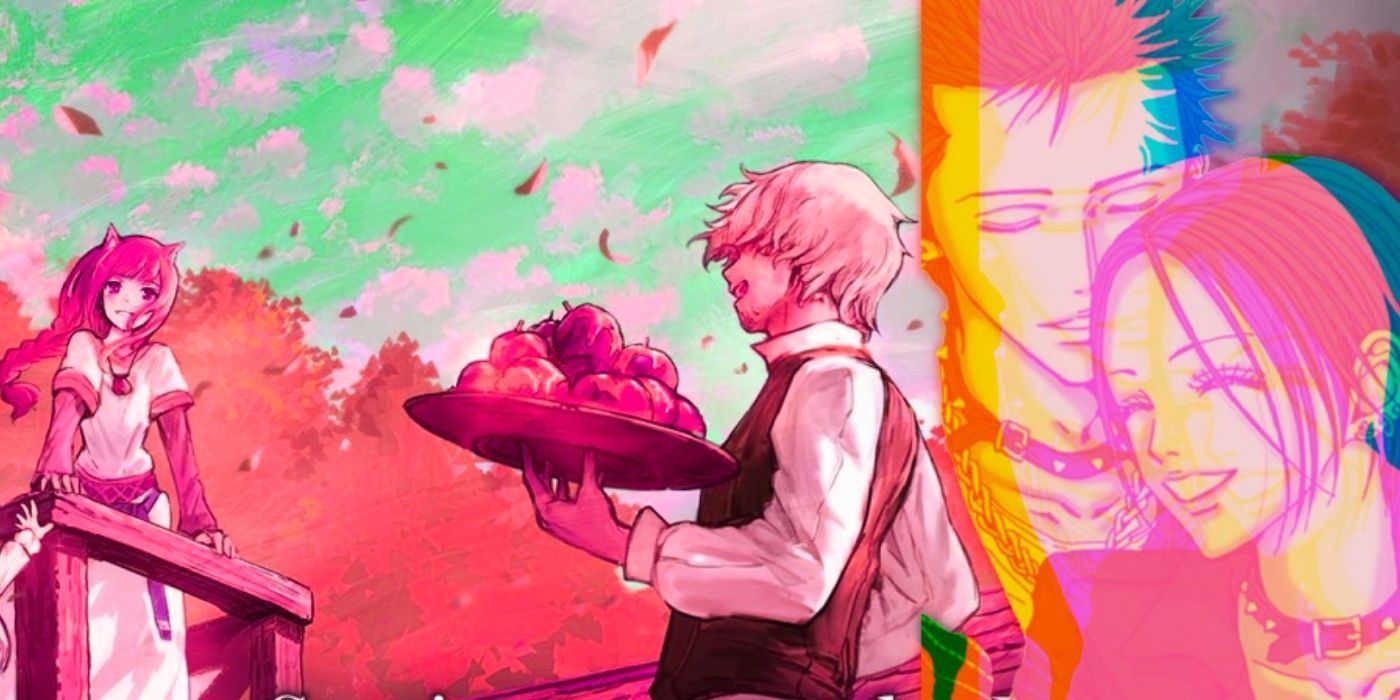
From the outside, dismissing Spice and Wolf is all too easy. An anthropomorphic heroine who’s naked the moment she meets an older man seems like painful grounds for fetish material. But Spice and Wolf has more in common with Mushishi than it does with Dragon Maid. This is high fantasy with a nuanced approach to worldbuilding, a show about economics and making a living rather than fighting medieval monsters.
While most fantasy series focus on swords and magic, kings and queens, and knights and dragons, Spice and Wolf focuses on peasant life and the tribulations of ordinary people who happen to live in a fantasy realm. The romance between Holo and Lawrence is the slowest of burns, and when they fall in love, it’s entirely believable because it has taken time, shared experience, and gradual understanding to happen.
8 Reality Is Challenging, And So Is Nana
Nana has never lost its allure. With every decade that passes, the Ai Yazawa classic enchants a new generation of fans. The series is so raw and so relatable that it has more than earned its status as a beloved cult classic, despite its likely indefinite hiatus.
Two girls named Nana meet in Tokyo with stars in their eyes, each hoping to make her dreams reality. They’re so hopeful when they collide on a train and become roomies, the world seemingly within their grasps. But real love isn’t always dreamy, and Nana‘s cast confronts everything from drug addiction to unplanned pregnancy, from broken trust to suicide. Nana isn’t for the faint of heart, but neither is the world. Adults know better than anyone that some things are destined to crumble. That is why Nana is able to resonate so well with older audiences.
7 Welcome To The NHK Addresses Thwarted Dreams
While not all kids grow up fostering mighty ambitions, a vast majority do, and children deemed “gifted” are especially laden with high expectations from kindergarten onward. This leads to entire generations of people who feel that they’ve squandered their presumed potential the moment they reach adulthood, flummoxed the moment they face failure. The label of being “gifted” is a damning, misleading one, unfairly placed and misplaced.
In the case of Welcome to the NHK, interpreted failure is tied to mental illness as well, as vicious an opponent as any. As kids, success and failure seem black and white. But adults have to face the truth – life is complicated and hard, and no one can possibly live up to every expectation and expect to find happiness. Few series contend with these ideas with as much charm, humor, and self-deprecation as Welcome to the NHK.
6 Wotakoi Features Actual Adults Working Actual Jobs
Otaku are a diverse bunch, but no otaku is exempt from growing up. So often as children, people are expected to outgrow their interests or shift them to more socially acceptable hobbies and habits, but such expectations can be devastating. Given societal pressure, many adults in Japan and elsewhere feel the need to hide their true interests from the world, especially in the workplace.
Wotakoi focuses on the relationships between adult otaku of several stripes. Narumi is a true fujoshi, Hirotaka is a hardcore gamer, and Hanako is a secret cosplayer. They all work in an office together, trying to balance what they truly love with an image that’s more socially acceptable. The title says it all: love really is hard for otaku, but that doesn’t make it impossible.
5 Howl’s Moving Castle Is An Ode To Self-Worth
A child will be as entertained by Calcifer’s antics, Sophie’s resolve, and Howl’s tantrums as any adult. Even so, many of the best aspects of Howl’s Moving Castle become more apparent as its audience ages.
Sophie’s initial lack of self-esteem and her gradual acceptance of herself is all too relatable for any viewer past their prime, and so is the curse that transforms her prematurely into an old woman. Howl’s fits of self-pity are also painfully relatable, the culmination of challenges against his fragile self-image. These are flawed, often impetuous characters who nonetheless try to do what’s right. Sophie and Howl don’t change each other; they help each other be the best versions of themselves. That’s a dream anyone can aspire to, at any age.
4 Fruits Basket Has More Depth Than Its Surface Implies
A series about cute kids who turn into zodiac animals when they’re hugged by the opposite gender sounds like pure adolescent fluff, but Fruits Basket is anything but vapid. The series deals with the resonating impact of trauma, the dooming nature of unwanted inheritance, and the damning aspects of harmful traditions. When entire generations must inherit a curse that will determine the trajectories of all their lives, nothing good can come from such an inheritance.
Breaking the Sohma curse is a labor of love but also of defiance. Adults watching Fruits Basket are likely to recall the curses that afflict their own families, dismantled only by love and sacrifice.
3 Given Exists For Those Who Have Loved And Lost
There’s no doubt that teen audiences have widely embraced Given. This story of love and music would appeal to almost any demographic, and the tragedy at the heart of the story is also appealing to teens, confronted with death, self-harm, and love for the first time.
But loss is a more familiar experience for adults, and death becomes an increasingly stronger force in life as people grow. Watching Given as an adult is likely to stir memories of youth that are painful, but the story, like those experiences, isn’t without hope. Older viewers watching Mafuyu grieve know what Mafuyu doesn’t – he will get through this pain, because he must, as everyone must at some point. These characters can love and lose and love again because that’s a large piece of what living is.
2 My Love Story Is Wholesome, Medicinal Fluff
While not all young otaku are fixated on aesthetics, teens tend to admire characters who are beautiful. When a shojo lead is handsome or a heroine is pure fanservice, younger fans are often those most smitten. After all, it’s easier for a younger viewer to imagine a romantic scenario with an idolized partner than it is for adults who’ve learned that reality is rarely so flawless.
Ore Monogatari disdains the notion that love is tied solely to conventional beauty. For older viewers, the series is almost medicinal, a much-needed respite from the usual romance standards. These lovable characters don’t need a makeover; they see the strengths already present in one another, and the weaknesses too, and embrace them as a whole.
1 Princess Jellyfish Refuses To Pigeonhole Its Characters
While younger generations care less about gender than any before them, this shift has been gradual. Many people are still plagued by what it means to be a “real boy” or a “real girl,” fighting a battle they never signed up for. As if in quiet protest, Princess Jellyfish exists at the juncture between low self-esteem and proud acceptance, its cast caught between who they want to be and what society expects them to be. A series about a household of oddball otaku girls and the drag queen who takes a shine to them is simultaneously completely unique and completely believable.
These characters know who they are and have realized what too many adults do – the challenge isn’t knowing, but navigating how the person you are fits into the world around you. Princess Jellyfish makes that balance seem not just possible, but vital.
About The Author
