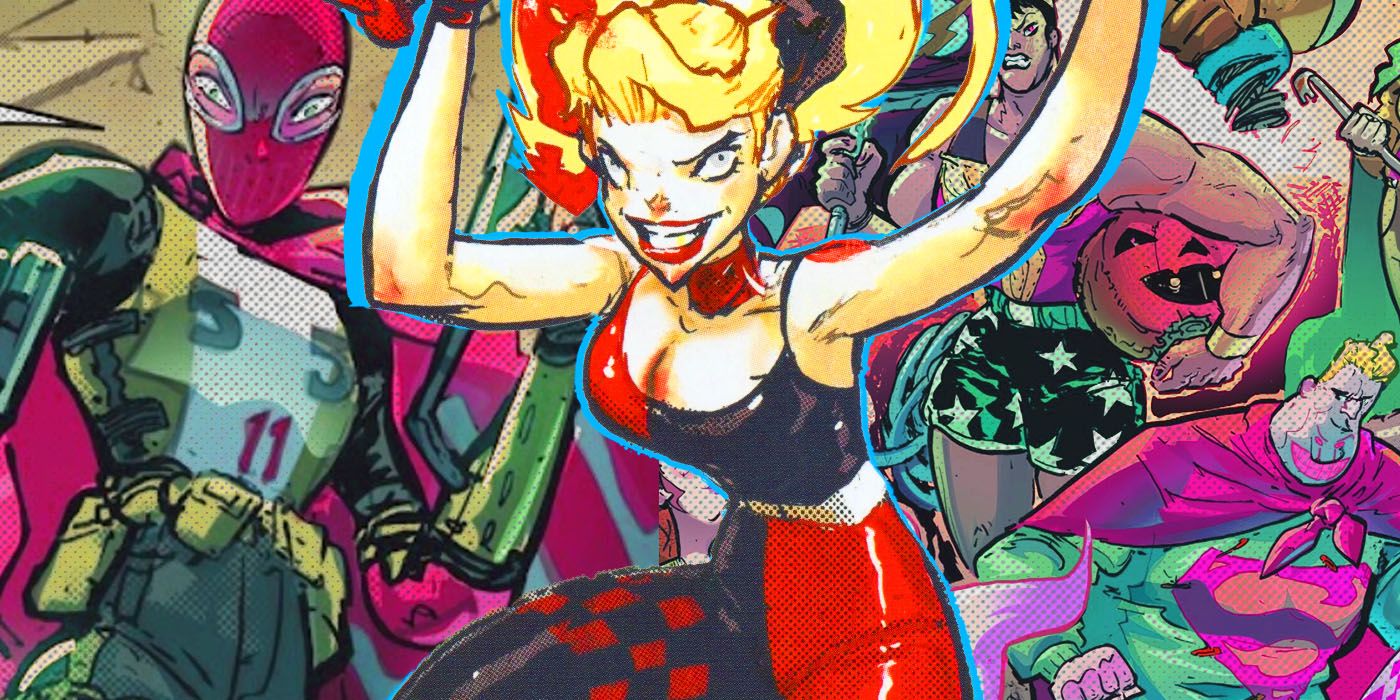
WARNING: The following article contains spoilers from Harley Quinn #12, on sale now.
For months now, the villain known as Keepsake has been moving in the background to confront Harley Quinn. In Harley Quinn #12 (by Stephanie Phillips, Riley Rossmo, Ivan Plascencia, and AndWorld Design) however, he is finally defeated by her. The honor of his death did not go to Harley, but someone else. This mysterious individual, known as Verdict, saved Keepsake’s life to aim him at Harley like a weapon.
Since he failed though, she killed him, now prepared to face Harley herself. It’s a shocking turn of events, as Keepsake was built up as Harley’s nemesis, only to be replaced by Verdict. In many ways though, it makes sense that Keepsake was nothing more than an opening act.
Right from the start, Harley never truly took Keepsake seriously. She never assumed he wasn’t a threat, but he did not have the personal connection to her to make him her nemesis. At the best of times, he was an annoyance for her, but one she could handle. Based on all the buildup and his plans though, it did seem like he was destined to stick around a little longer before Harley finally threw him behind bars. So when Verdict killed him it came as something of a shock. In the context of what these villains represent to Harley however, this transition makes perfect sense.
Keepsake’s entire gimmick is that he uses items from other Gotham villains he has served, using relics of the past as his present arsenal. In short, Keepsake is unable to separate himself from the past, holding onto it and acting as though he is something distinct from them. This is something that Harley has been trying to distance herself from for some time now. Her past as a villain, little more than an extension of the Joker, is something she wants to put behind her in favor of a better future. Though she hasn’t realized it yet, Keepsake represented the past version of her that is gone now. So his death occurred to bring in the next great challenge to Harley’s heroic evolution.
Verdict appears to be someone motivated by a warped sense of justice. She kidnapped and murdered a man who was acquitted of killing a child. While the courts couldn’t find enough evidence to convict him, Verdict took matters into her own hands. She judged him guilty and mutilated him, extracting an eye which she sent to the dead child’s family, most likely as a reference to the phrase “an eye for an eye.” This shows a personal commitment to her idea of justice as opposed to any grudges she may have. Now, she has set her sights on Harley Quinn, deeming her a false hero.
Harley in the meantime has been grappling with feelings of illegitimacy. She feels as though her past disqualifies her from being a hero, despite everything she’s done proving otherwise. If Keepsake was the part of herself that she finally moved past, then Verdict is the voice in her head saying she isn’t a hero. Though none of them realize it, the villains Harley has faced are the steps she needs to further her own personal growth. So really, Verdict taking over as Harley’s next enemy makes perfect sense in the context of her being a foil to Harley’s journey.
About The Author
