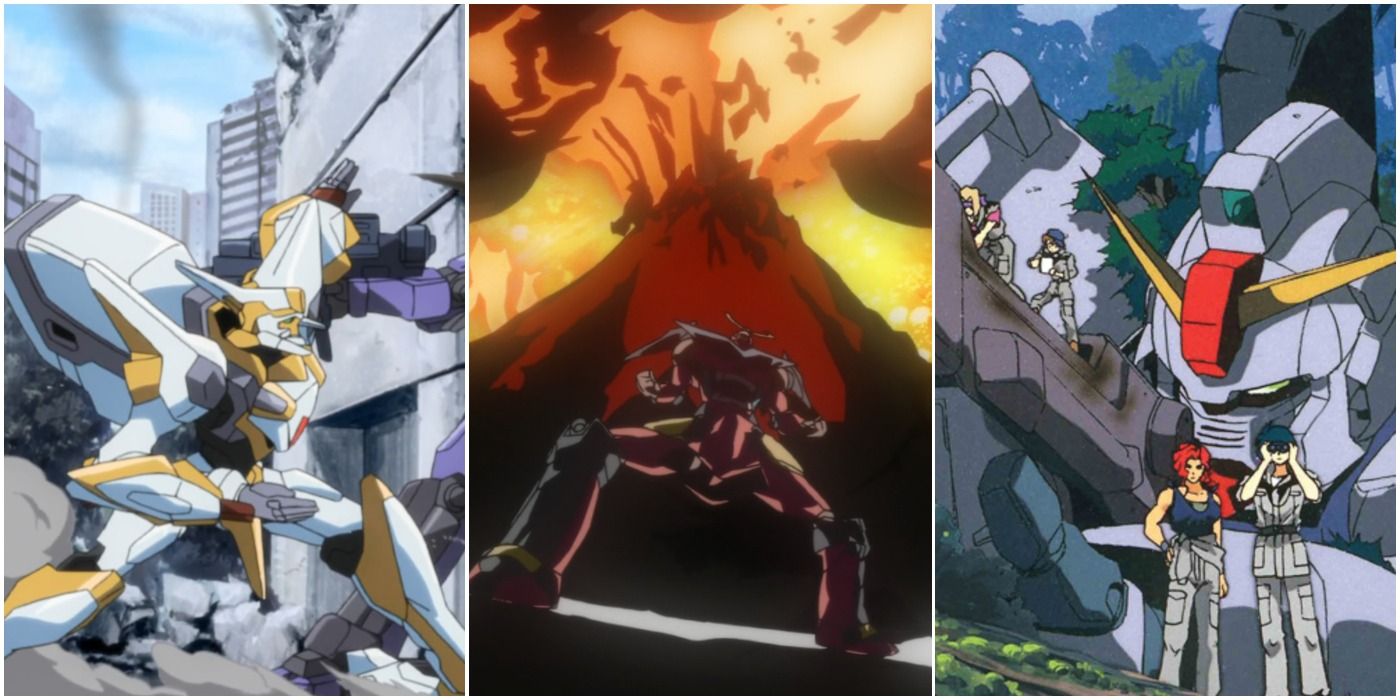
One of the many reasons anime has become such a successful and universal medium is because it truly feels like there’s a series out there for everyone. Anime is a medium that frequently trades in extremes which has led to some groundbreaking series both in terms of storytelling and animation. There are a wide range of anime genres that resonate with audiences and receive a lot of attention, but giant robot mecha material has always been at the forefront of anime.
Mecha series aren’t going anywhere, but they’re also so prominent that it can be difficult to tell which of these series are actually worth the investment. Mecha anime represent some of the biggest mainstream hits, but lots of shows have also connected with critics on a deep level.
10 Patlabor Blurs The Lines Between Mecha & The Police
Patlabor, otherwise known as Mobile Police Patlabor, is a brilliant combination of heightened mecha theatrics with gritty police drama. Patlabor was created by Mamoru Oshii, an essential name in the anime industry who’s responsible for classics like Ghost in the Shell and Blood: The Last Vampire. Patlabor operates in a believable version of the future that asks relevant questions rather than some of the more fantastical ideas mecha series get lost in. Patlabor is a creative and challenging addition to the mecha genre that resonated with critics. It’s also a series that was pushed into shameless commercial decisions for the purposes of selling toys, but doesn’t suffer as a result.
9 Mobile Suit Gundam: The 08th MS Team Looks At The Tortured Humans Within The Mecha
Yoshiyuki Tomino’s Mobile Suit Gundam is a beyond-prolific series that’s almost become emblematic of giant robot animation. Gundam has gone on to include a wide range of series, many of which are held in high esteem with both critics and audiences. The 08th MS Team is the series’ first OVA experiment and while mechas are prevalent, the 12-episode series is a more grounded story about human interactions and the horrors of war.
8 Code Geass Is A Gripping Exploration Of Power & Corruption
Many of the more modern mecha series benefit from the greater risks that they’re allowed to take since the genre is now so normalized. Code Geass begins in a familiar place where a mysterious mecha suit might finally be able to end the vicious, ongoing war.
The mecha madness and action sequences in Code Geass will satisfy fans of the genre, but it’s the slow, gradual transformation of Lelouch’s character from savior into tyrant where Code Geass truly flourishes. It’s an ambitious trajectory for a series’ protagonist that’s still talked about years later.
7 Neon Genesis Evangelion Uses Mecha & Monsters to Provoke Existential Attacks
There’s absolutely nothing wrong with a conventional mecha series that just specializes in exaggerated battles, but the genre is so established at this point that many series just use the mecha concept as a conduit for heavier subject matter. Neon Genesis Evangelion turns into an existential, apocalyptic dive into depression that’s unlike anything else in anime. Neon Genesis’ Evangelion’s reception was much more polarizing back during its original release, especially in response to the series’ ending, but there was still a loud enough voice that celebrated the mecha series for the dark, probing questions it asks its characters.
6 Tengen Toppa Gurren Lagann Is As Beautiful As It Is Compelling
Tengen Toppa Gurren Lagann is a beautiful example of how aesthetics and a distinct visual design can accentuate storytelling and action in powerful ways. Gurren Lagann is set in a future dystopia where humanity has been forced into refuge under the Earth’s surface. The discovery of the anime’s titular mecha allows two ordinary teenagers to become legendary leaders in a changed world. Gurren Lagann’s story doesn’t take any shortcuts, but the animation is truly on another level and a major highlight among critics. Gurren Lagann is technically a Gainax production, but the anime’s success is what led to the creation of the acclaimed Studio TRIGGER, whose work has used Gurren Lagann for visual inspiration.
5 FLCL Uses Mecha Tropes To Tell A Touching Coming Of Age Story
Many mecha series can get lost in huge wars that feel impersonal, so FLCL tells a more intimate coming of age story as a young boy, Naota Nandaba, begins to enter adolescence. FLCL is a dizzying mix of elements as Haruko Haruhara forever changes Naota’s life. The mecha are unique creations that stray from genre norms, much like Haruko.
Music is also a crucial part of the series and it’s hard to top the series’ score by The Pillows. At only six-episodes, FLCL doesn’t waste any time and while its two follow-up series weren’t as huge mainstream hits, they still made a positive impression with critics.
4 Macross Is A Mecha Classic That Takes Advantage Of Space’s Vast Nature
Super Dimension Fortress Macross is another totemic mecha series that pushes the genre to new places, but it’s also the perfect entrypoint for complete newcomers. Macross’ grandiose story revolves around the first human-alien war after a city-sized alien spacecraft crash lands on Earth. Macross gets a lot of mileage out of waging this war on Earth, yet with constant extraterrestrial presences as the sources of conflict. Macross has engaging characters and mech designs, but the reasons that critics held it up to a higher standard is due to the complex narrative that it creates and the massive scope of this space battle.
3 Full Metal Panic! Turns Mecha Into The Ultimate Bodyguards
Full Metal Panic! is an exciting reinvention of the mecha genre that mixes it together with romance and even magical girl tropes. Sousuke Sagara is the leader of MITHRIL, a powerful anti-terrorist military group, who need to focus their efforts on the protection of a precocious high school girl. It’s a rejuvenating change of pace to use extreme robots to protect a girl rather than an entire nation — plus the bond that forms between Sousuke and Kaname is electric. Full Metal Panic! will satisfy veteran mecha fans, but also appeal to those that have routinely rejected the genre.
2 Mobile Suit Gundam: Iron-Blooded Orphans Digs Into The Loss Of Innocence
The original Mobile Suit Gundam was a critical darling and it took some time for the franchise’s offerings to fall out of favor with critics. However, Iron-Blooded Orphans is one of the modern Gundam extensions that really won over critics with its character-driven and small-scale, scrappy storytelling. Iron-Blooded Orphans looks at budding mobile suit pilots who are out of their league, but make up for their lack of experience with endless optimism. Iron-Blooded Orphans begins in a strong place, but the grim casualties of war slowly invade these characters’ lives and provokes an even better story.
1 86 Uses Mecha As A Clever Allegory For Drone Warfare
Mecha series frequently present their powerful robots as analogous to humans and they function as deadly forms of armor in combat. 86 re-examines this paradigm by turning its mecha soldiers into the equivalent of drone warfare. Human characters wield mecha drone armies, which allows 86 to touch upon prescient and realistic issues that highlight the wasteful nature of war. 86 is also a tight story with only slightly more than 20 episodes, so there’s no opportunity for the series to dilute its compelling ideas or turn its characters into exaggerated stereotypes.
About The Author
