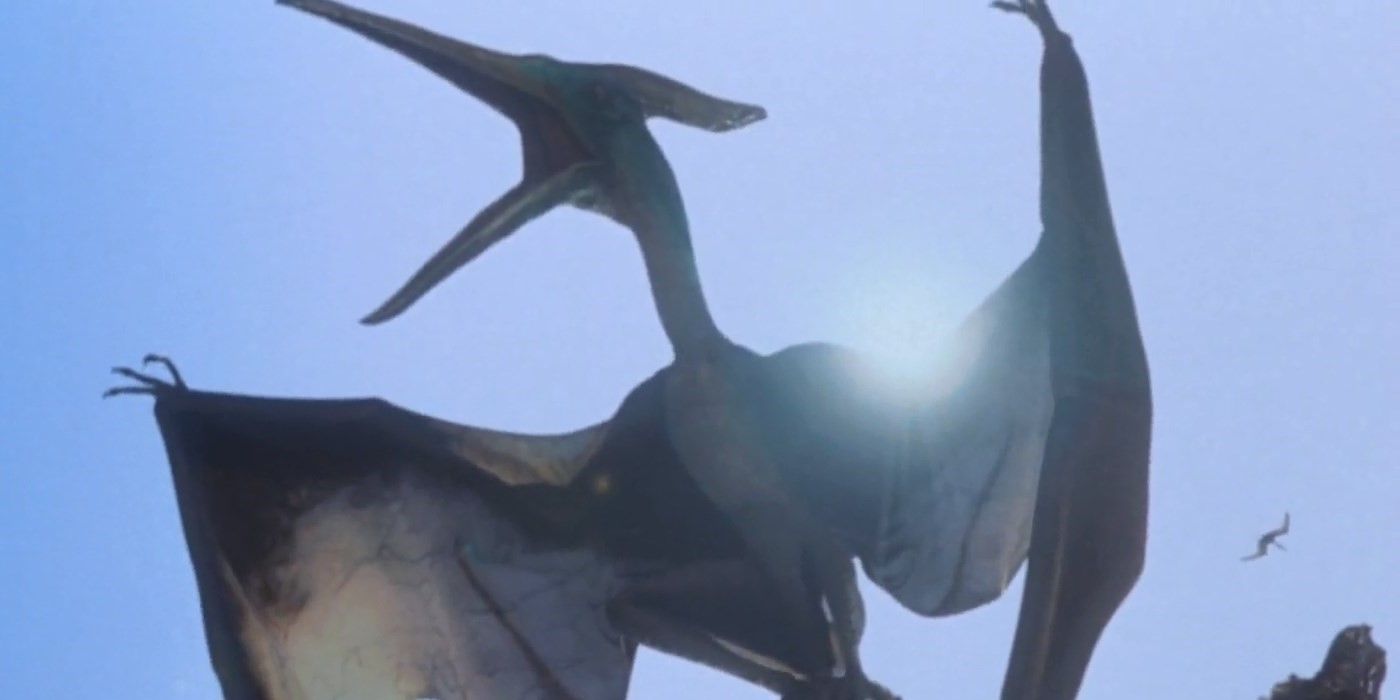
The Jurassic Park franchise has gone through its fair share of evolutions leading up to the climactic conclusion in Jurassic World Dominion. In that time, many dinosaurs have become fan-favorites and franchise icons. Some examples include the T-Rex and Velociraptors, more specifically Blue. While these species are nothing short of beloved, they aren’t the most important. In actuality, that role goes to the Pterodactyls that have been represented since the first film. That said, what makes these high-flying genetic creations more impactful than any of the other dinos?
In the first film, Dr. Alan Grant maintains that the dinosaur species is actually a long-lost ancestor to the birds. His main reasoning behind this was velociraptor habits and their skeletal structure, both resembling birds. More famously, he even pointed out that raptor means bird of prey. The first film doesn’t showcase Pterodactyls, but their ancestor, a Gull, can be seen flying alongside the chopper as the survivors are taken off of the island. Individually, the scene shows that no matter what they experienced, the real dinosaurs can be seen just outside as they’ve since evolved into something far more impactful.

The Lost World: Jurassic Park continued the idea these birds represented by having the final frame of the film cap off John Hammond’s speech about letting these creatures live on the island unbothered. He even quotes Dr. Ian Malcolm about how life will find a way, as a Pteranodon lands on a branch and spreads its wings. It’s a powerful moment and forever melds the idea of freedom and nature being left untouched, surpassing any semblance of law that humans can create.
This is further proven in Jurassic Park III, when the new batch of survivors are taken away on a military helicopter. As Dr. Grant peers outside, he doesn’t see a Gull. Instead, he sees a family of Pterodactyls flying away from the island and into the clouds. It marks the first time that the film’s final frame takes on a new meaning, as the belief that what the Earth has now should be enough instead transforms into an idea that these creatures are alive and if they’re ready to leave, they will at any point. Life hasn’t found a way yet, but it’s a foreboding warning that it will soon.

Jurassic World: Fallen Kingdom takes things full circle and cashes in on its warning from the third film. With the dinosaurs that survived Isla Nublar now being freed, while others are taken to be studied, Jurassic World has officially been created. The film ends with a family of Pteranodons flying against the sunrise to double down on this idea. The camera then cuts to Owen Grady’s face as Dr. Malcolm reminds the viewer that a new and dangerous world has been created. An after-credits scene then shows these Pterodactyls landing on the Eiffel Tower in Las Vegas, claiming it and the area as their own and confirming that now, life has finally found its way. These films ultimately prove the futility of controlling nature and how that control can and will work both ways.
Almost every film has ended with a shot of these creatures or their ancestors flying into the unknown. However, in the grand scheme, what is unknown to the viewers is more than known to the animals that are shown. The endgame looks to have always been that humanity will pay for its belief that it can create and control a force as powerful as dinosaurs and genetics. Living things have agency and a reason for existence, even if they’re manufactured. Pterodactyls represent this best of all because they can fly farther and higher than any other dino. These creatures represent the freedom of their species, and each film represents how they’re violently getting closer and closer to the freedoms coming in Jurassic World: Dominion.
To see life find a way, Jurassic World Dominion roars into theaters June 10.
About The Author