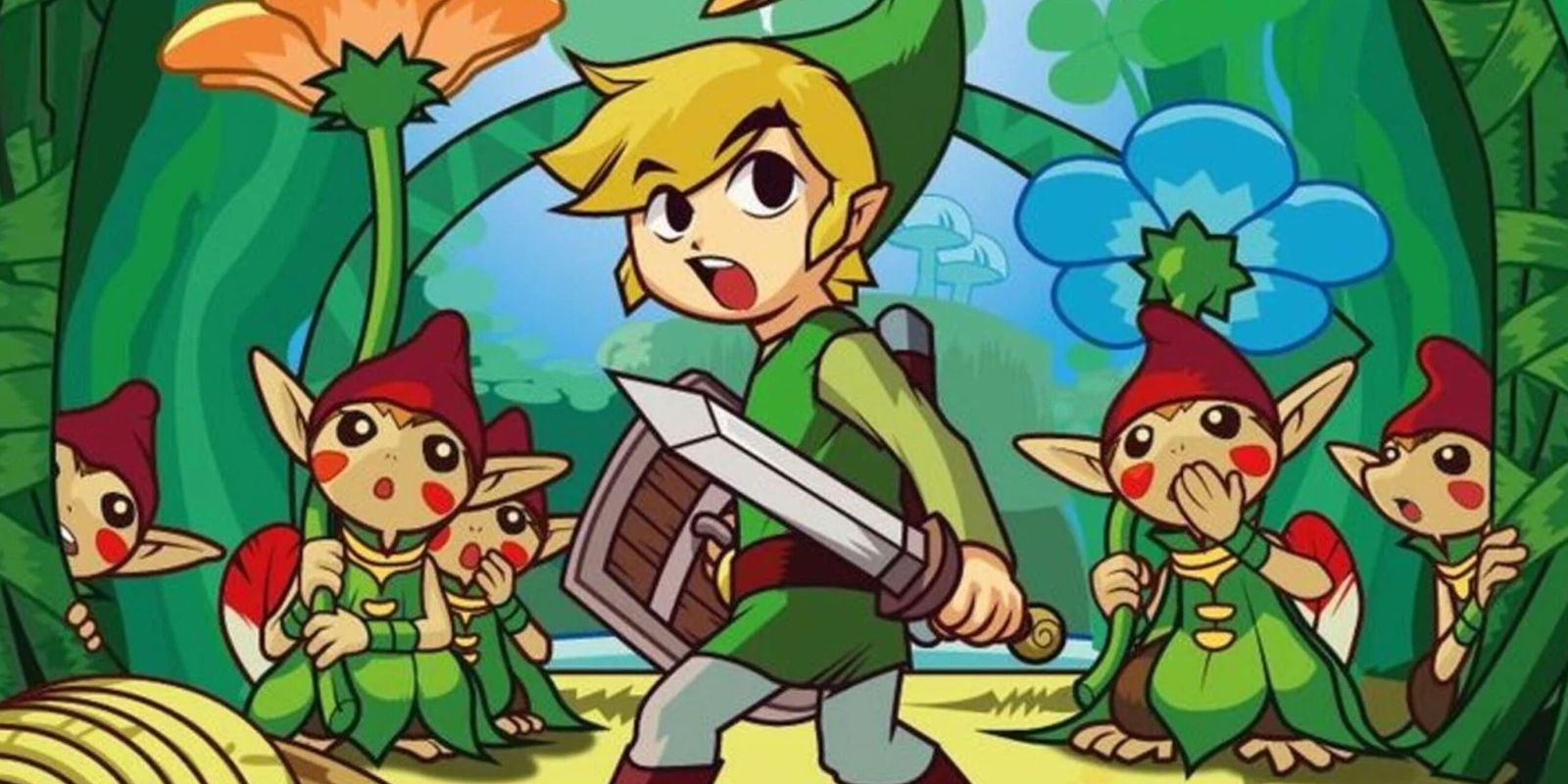
2004’s The Legend of Zelda: The Minish Cap is a stand-out among the handheld Zelda games. Despite its relatively low sales figures, particularly in comparison to the rest of the franchise, Minish Cap has a distinct charm and well-designed gameplay that makes the most of the Game Boy Advance’s limitations. Still, those limitations kept the title from its true greatness in the pantheon of Zelda games. A remake today could fix all of its flaws and bring it to a whole new generation of gamers.
The most notable gameplay mechanic of The Minish Cap is a sort of dual-world gameplay: Link can shrink down to the size of one of the sprite-like Minish. Switching between sizes to interact with and explore the game’s environment offers a fun new perspective on familiar and seemingly mundane elements of the game. Even a humble Octorok becomes a full-blown boss battle when Link is small enough to use leaves as platforms or drown in a shallow puddle.
As far as dungeons go, Minish Cap favors quality over quantity, making good use of every room and mechanic available. The game’s design is rock solid, providing Link with familiar items that are Zelda staples, as well as new and unique items with incredible utility. Nothing in Link’s inventory feels like a waste of space, and each new item offers a new way to interact with and explore the game’s overworld.
Minish Cap makes backtracking through the game’s relatively small map feel exciting and fresh every time. Even entering each dungeon presents its own set of creative challenges wherein the player must interact with the environment and make changes to it, like flipping over pots or growing vines in order to gain access to new areas. It forces the player to think about the world from two perspectives and learn how to manipulate the world in both of Link’s forms.
Despite its relatively short playtime, the game is brimming with personality. The Minish (or “Picori” as the Hylians call them) are a huge part of the game’s identity. They are cute little sprite-like creatures that love to be helpful, hiding in plain sight alongside the people of Hyrule. They live in hollowed out books, mushroom huts, the rafters of the bakery and even in their own tiny Minish towns.
Even Zelda gets some rare characterization in Minish Cap. While she spends most of the game trapped in stone, she is established in the game’s introduction as Link’s childhood friend. Link even gets the Small Shield as a gift from her. It adds a surprising amount of emotional significance to Link’s basic equipment, symbolic of Link’s bond with Zelda and his promise to save her.
Minish Cap‘s other noteworthy character is Link’s companion in the form of a living hat, Ezlo. He only interrupts gameplay with important explanations when entering new areas or completing essential tasks and can be consulted with the select button if the player gets stuck. Ezlo is a great balance of comic relief and actual utility within the game’s story. Defeating Vaati is just as much his responsibility as it is Link’s, and it’s his magic that allows Link to change size. All of this makes Ezlo an effective Zelda companion that doesn’t wear out his welcome like Fi or Navi.
Minish Cap also features a unique kinstone fusion system. It’s a fun, if flawed, mechanic that would only need a couple of fixes to truly shine. The excitement of matching kinstones with an NPC is that anything can happen as a result. It can open previously unreachable areas, manifest treasure chests, or inspire another NPC somewhere in the world to complete an action that allows progression or unlocks new features for the player. This makes the NPCs that populate Hyrule feel less like background elements, offering a way for Link to interact with them that benefits the player.
Where the kinstone system suffers is the burden it places on players. While the game only has a handful of necessary fusions that progress the main story, there are 100 in total, some of them unlocking valuable items like empty bottles and heart pieces. It can be a chore to track down each one and find the appropriate kinstone piece. A modern remake of the game could benefit from an in-game tracking system for the kinstone fusions, similar to the Bomber’s Notebook in Majora’s Mask. This, along with adjusting or cutting out the fusions that feel like unnecessary roadblocks would effectively refine this feature.
However, the worst optional objective in Minish Cap is the collectable statues. It’s tedious and not worth the effort. While this side quest is entirely optional, a remake would ideally find a way to make this collect-a-thon more rewarding and worthwhile, or just cut it out completely. All things considered, it’s a rather small flaw in an otherwise excellent game.
Minish Cap deserves to be remembered in the Zelda pantheon. It’s a must-play title for long time fans and newcomers alike, boasting unique mechanics. Offering chance to fight a villain other than Ganon is enough to make it stand out, and a remake could unlock its true potential with just a few minor changes.
About The Author