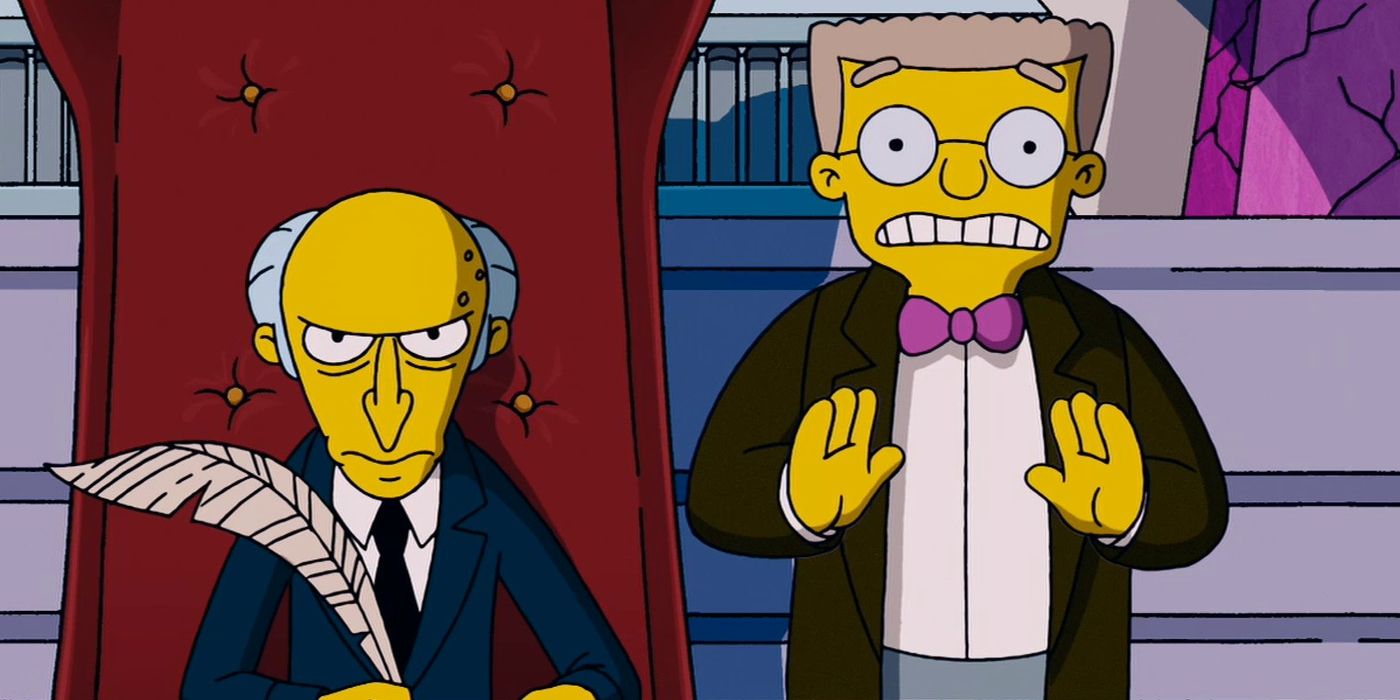
Having been on the air for over thirty years, The Simpsons has evolved and transformed repeatedly. Tone and style have changed over the course of the series, shifting from grounded to cartoonish at times to better reflect the period when it was produced. But along the way, certain characters have become radically different from how they used to be presented.
The Simpsons used to utilize Montgomery Burns as more than just a punchline in the early seasons, transforming him into a serious threat to Springfield whenever the show needed one. It’s a shame as Mr. Burns was one of the only Springfield residents who could genuinely infuse an episode with a sense of danger.
In the early seasons of The Simpsons, Mr. Burns was written with a genuine amount of danger. Any time Homer interacted with Mr. Burns, he was careful not to insult or enrage Burns out of fear he’d be fired on the spot. Burns’ greed and lack of concern for human life were used as punchlines but also had real malice. His wealth made him largely untouchable, and even his more human moments were punctuated by darker impulses. His longing to reconnect with his childhood in Season 5’s “Rosebud” saw him enrage the entire town by upending their food supply, while his decision to take back the power plant from a group of German investors in Season 3’s “Burns Verkaufen der Kraftwerk” came out of a palpable desire to be feared by the town.
As the Golden Age period of the show continued, Burns transformed into one of the show’s only legitimate threats. While Sideshow Bob was a more violent and vicious problem for the Simpsons family to contend with, Burns was terrifyingly casual about his villainy. Season 6 and 7’s “Who Shot Mr. Burns?” saw him gleefully parade around the town mocking the rest of the citizens over their failure to stop his plans — with his casual reveal of a gun suggesting he’d be content to shoot down anyone who confronted him. Perhaps his most dangerous moments came in Season 7’s “Raging Abe Simpson and His Grumbling Grandson in ‘The Curse of the Flying Hellfish'” when he tried to have Abe Simpson murdered and later kicked Bart into a safe as it fell into a lake — openly trying to drown a ten-year-old boy.
RELATED: Did The Simpsons Movie Forget The Name Of Moe’s Tavern?
But as The Simpsons progressed, the creators became more focused on the sillier aspects of Burns. This came at the same time as a number of other Flanderizations for the show’s cast. The nuanced elements of much of the greater Springfield citizenry became more one-note, turning the characters further into punchlines instead of people. For Burns, that meant removing much of the threat he posed and highlighting his age and fragility. While Burns could still be evil, his plans became more over the top. His out-of-date nature was increasingly emphasized over any real threat he posed to the town or its citizens. Even his attempts to showcase his evil side were usually undercut with jokes about his ineptitude, such as his failed attempt to trap the town with a giant glass dome in Season 22’s “The Full Monty.”
Burns became increasingly buffoonish as the seasons wore on. Notably, he’s even had a softer side exposed in these seasons — while he’s still unapologetically evil, he expresses regrets at his failed romances and ventures in Season 15’s “C.E.O. D’oh.” He developed a genuine rapport with his loyal assistant Smithers, as opposed to the casual cruelty he treated him with throughout the early seasons of the show. He’s even shown an appreciation for others, such as his fanboy reaction to discovering Abe’s wrestler past in Season 24’s “Gorgeous Grampa.”
Especially since the series is still willing to go to darker places, Burns’ transformation into a walking punchline is particularly disappointing. It’s similar to the arcs of numerous characters in The Simpsons — but comes with the additional sting of depriving the show of one of the few characters who genuinely infused the comedy with stakes.
KEEP READING:The Simpsons Boss Shares Details About The Early Abandoned Spinoff
About The Author
