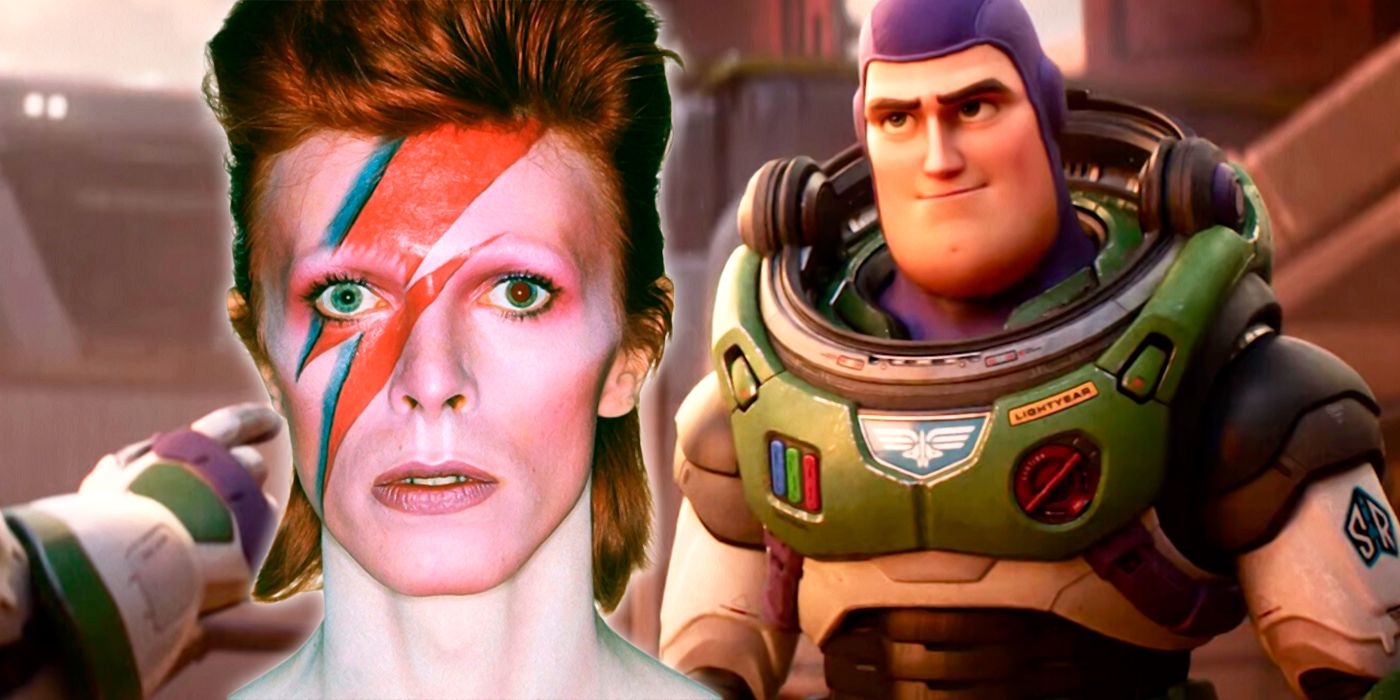
With every Lightyear trailer released, David Bowie‘s “Starman” has asserted itself as the movie’s theme song. The 49-year-old rock hit might not be an obvious choice for a family sci-fi film, but a quick look at recent work in the genre shows that his music is inescapable. Bowie’s songs might be decades old, but he remains the go-to choice for sci-fi. Moreover, his status as the singer of choice for aliens and spacemen comes from an incredibly human place.
The late rock star may have peaked in mainstream popularity in the 1970s and ’80s, but one only has to look at any sample of genre fiction to see that his impact has endured. “Life On Mars” was sung by Jessica Lange on American Horror Story and featured on the soundtrack for The Martian. James Gunn said he was the only artist whose music made the shortlist for both Guardians of the Galaxy movies while Rick and Morty‘s “Goodbye Moonmen” was such a faithful parody that some thought it was actually by Bowie. The cynic might say that these needle drops are because the creatives behind them grew up during Bowie’s height of popularity. But perhaps there’s a deeper kinship there with a man who was himself a sci-fi storyteller.
Bowie was a huge sci-fi fan and infused major moments in his career with the genre. His 1969 hit “Space Oddity” was not only named after Stanley Kubrick’s 1968 sci-fi classic but was timed to coincide with the first moon landing. He attained superstardom as “Ziggy Stardust,” presenting himself as an alien rock messenger. Ziggy and his Spiders from Mars filled songs such as “Moonage Daydream” with space-age psychedelia. Though Bowie infamously “killed off” Ziggy in 1973, he never stopped “Loving the Alien.” His first film role in The Man Who Fell to Earth was an alien who comes to Earth to save his planet. He continued its story in a stage musical sequel, Lazarus, made decades after he failed to get the rights for a 1984 musical. The musical premiered shortly before his death alongside Blackstar, an album filled with allusions to sci-fi touchstones such as A Clockwork Orange.
The genre may have appealed to Bowie because it gave him a way to talk about alienation. Using far-out imagery borrowed from his sci-fi favorites, Bowie gave voice to people who felt like they didn’t fit in. It’s no surprise that “Starman’s” melody borrowed from The Wizard of Oz‘s “Over The Rainbow,” a beloved anthem for outcasts wishing to escape. Bowie’s strung-out vocals and experimental instrumentation create a distinct sound that sometimes seems robotic yet is always achingly sincere. It’s telling that he’s rarely covered on soundtracks. Most use his original versions because there’s a depth in them that can’t be recreated.
Sci-fi isn’t the only genre to cling to Bowie. For instance, any Licorice Pizza trailer inevitably features “Life On Mars.” His work remains the perfect complement to any work featuring loners venturing into the unknown. It’s a universal human feeling, whether it’s a space ranger going beyond infinity or a young person struggling to keep their water bed business afloat.
The target audience for Lightyear might not have heard of David Bowie. Many kids who see it may not have even been born while he was alive. But that feeling of yearning for a place where homo sapiens can become “homo superior” hasn’t gone away. Bowie’s music continues to strike the same nerve for new audiences as the sci-fi stories he soundtracks. As long as Hollywood tells stories about reaching for the stars, there will always be a Starman’s music waiting in the great big musical sky for them.
About The Author
