There have been several versions of Dungeons & Dragons spread across several game lines, each with its own strengths and weaknesses. Fifth Edition is the current one, and it’s responsible for the explosion in the game’s popularity in recent years; however, it’s by no means perfect and has noticeable flaws.
Some D&D fans still swear by 3.5, the updated version of the Third Edition ruleset that defined the early years of Wizards of the Coast’s ownership of the game, claiming that it provides a deeper experience. Both options are more than valid, but there are some areas where 5e has a clear advantage over 3.5, in both presentation and playing.
10 It Is Far More Approachable
One reason many assume 5e has exploded in popularity – other than the influence of shows like Critical Role and Stranger Things – is its relative approachability. 5e is by no means a simple game compared to some other RPGs, but it’s relatively straightforward (to begin with).
With more simple abilities; less math required to play in comparison to 3.5; fewer overwhelming options available from the off, and a dozen other quality-of-life changes, it’s a far less daunting prospect for somebody who’s never played an RPG to play a session of 5e.
9 Higher Quality Assurance On New Releases
One common complaint about Fifth Edition is that new releases – especially those containing a high number of player options – are typically released at a slow pace. Wizards of the Coast tends to release three or four books a year for D&D, and player options books like Xanathar’s Guide to Everything or Tasha’s Cauldron of Everything come every three or four years.
Nonetheless, while the slow stream of content can be frustrating, it often ensures that what’s released is of a higher quality. In the days of 3.5, new books stuffed with options were released every few months. Aside from being expensive over time, many options were poorly-written, heavily unbalanced, or simply non-functional. Although some things slipped through the gaps in 5e, most releases are far more consistent in terms of quality.
8 Far Fewer Deliberately Bad Options
An early school of design for 3.5, nicknamed ‘Ivory Tower’ design, likened character building to the deckbuilding of a card game like Magic: the Gathering. Books were filled with options, many of which were (by design) weaker than the others, to ‘reward’ players who knew not to take them and punish those who fell for them.
This school of thought was disavowed within the lifetime of 3.5, and entirely absent from 5e. Although options are by no means all equally powerful, any particularly underpowered options are typically by accident rather than by design, without the undercurrent of gatekeeping.
7 Play Is Often Quicker
Several factors come into making 5e quicker to start playing, and quicker to play in general. The character building of 3.5, although well-regarded by its fans and noted for its depth, is long and involved, and often requires players to have a ‘build’ planned out until Level 20. It taking an entire session isn’t uncommon compared to 5e’s much shorter process.
In addition, making a single action in 3.5, with its thousands of feats, could require looking up rules in as many as four or five books, plus errata, before making several dice rolls and consulting tables – although this is an extreme example. In 5e, the need to look up reference materials is usually restricted to a book, at most, and the pace of play is generally faster, allowing for more to be done.
6 Less Disparity Between Casters And Martials
A problem seemingly inherent in Dungeons & Dragons is that magic seems to overpower the mundane by the end of the game. The wizard learning to rewrite reality or mold the earth around them with their mind makes the fighter’s fourth attack in a round pale in comparison.
This problem still exists in 5e – with Fourth Edition notable as the only one to truly counter it – but is better than it used to be. Fighters and other martial classes were notoriously weak for most of 3.5 with many casters able to buff themselves to be better combatants (as well as everything else they could do). The addition of concentration as a mechanic and a tighter grasp on spell slots ensures that casters in 5e are at least somewhat restrained, and martials have received buffs.
5 The Removal Of Racial Penalties
Racial bonuses have been the focus of some controversy over the lifespan of Fifth Edition, and many called the concept outdated and insensitive, which was traced back to the racist attitudes of earlier fantasy writers. As such, recent releases have leaned towards giving races flexible stat bonuses – a world away from 3.5.
In 3.5, not only did nearly every race have stat bonuses, but they also typically had stat penalties, which 5e only had for two races. These stat penalties often reinforced the same things as 5e‘s bonuses, but also heavily restricted gameplay. For example, a dwarf sorcerer wasn’t merely un-optimal, it was almost unplayable due to a -4 in Charisma for the dwarf race.
4 Magic Item Progression Feels More Natural
An unofficial design concept in 3.5 is that of the ‘magic item treadmill’. Progression is more enforced in 3.5, signposted by creatures who are resistant to magical weapons, and then +1 weapons, and then +2 weapons, and so on and so forth. The players need to steadily find or upgrade their loot to keep up with the game.
The result is that, although magic items can have interesting abilities, they will follow typical guidelines that can get repetitive over a number of games. Players often have to go through a number of items rather than keep and bond to one they prefer. Aside from expecting characters to acquire some form of magical damage, 5e is relatively free of this treadmill, allowing progression to feel less forced.
3 An Emphasis On Balance
3.5 is, among other things, notorious for a lack of balance in its options. Between its martial-caster disparity, its trap options, genuine mistakes in design, and classes being released intentionally more or less powerful than each other, it can be very difficult to create a party where members don’t outshine each other or feel useless in comparison.
5e has been designed to be more balanced from the ground up, including an attempt to keep all classes and races at a relatively even baseline while avoiding printing unbalanced new material. Although there are missteps, and the game is far from perfectly-balanced, even a poorly-built character can keep up with one of the best in the game, ensuring that no player is left behind by the rest of their party.
2 Bounded Accuracy Keeps The Game Sensible
One of the design conventions of 5e is ‘bounded accuracy’– a deliberate system of restricting mathematical bonuses to keep the game’s math low. In 3.5, a fighter’s base attack bonus would increase by one per level, resulting in a base of +20 at max level, alongside countless other bonuses. In the same timeframe in 5e, the equivalent bonus goes from a +2 to a +6 with few other numbers applying.
This difference is seen in every facet of the math in the two games. Numbers would get very high in 3.5, resulting in widely varying bonuses up to ridiculous numbers like +80, and characters being untouchable from monsters even a few levels below them. In 5e, things are kept more sensible and easily understandable without the rapid scaling, which creates a more grounded game.
1 It Is More Sensitively-Written
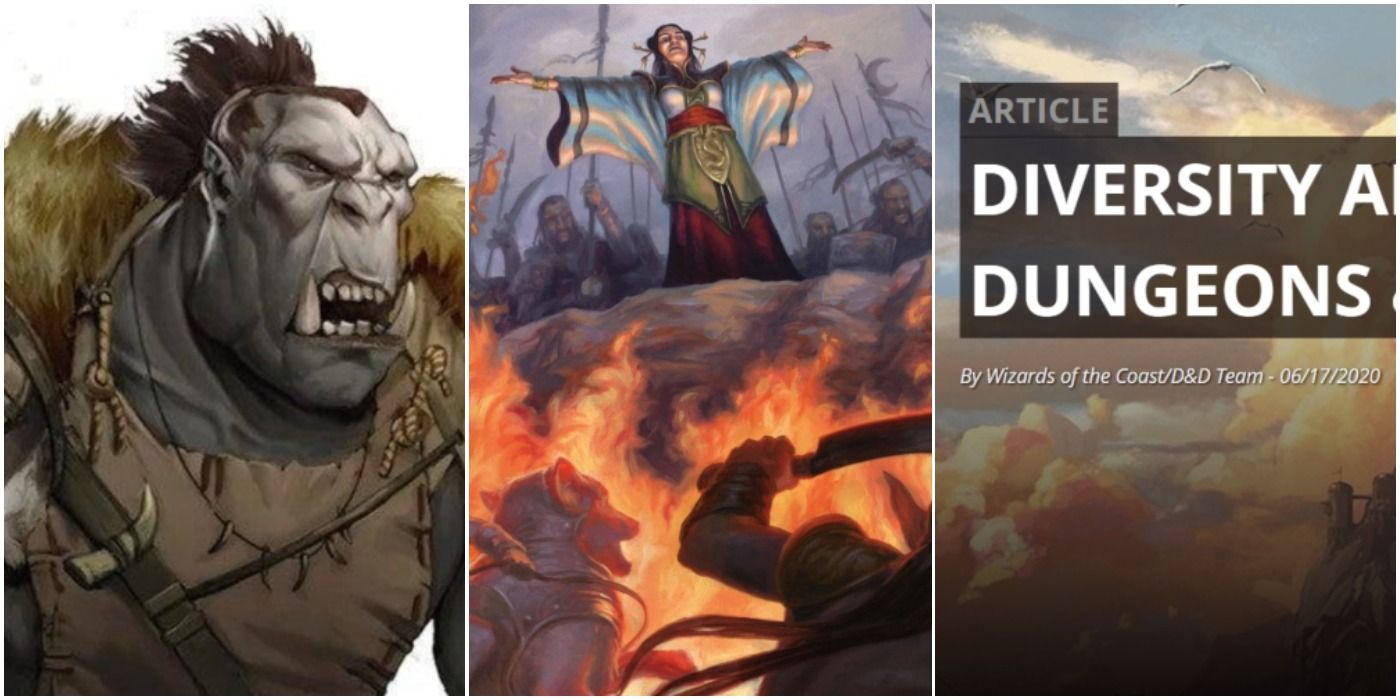
The fantasy genre as a whole has been associated with a number of unfortunate conventions around a range of topics, and Dungeons & Dragons is no different. Previous editions of the game have been scrutinized for content that is sexually and racially insensitive, which fits some of the worst conventions of the genre.
By contrast, 5e has taken great steps to be representative and sensitive. People of color are seen far more frequently in art, alongside nonsexualized women, and when issues have been raised – such as a stereotypical depiction of Romani-inspired people in the Ravenloft setting – steps have been made to correct it.
About The Author
