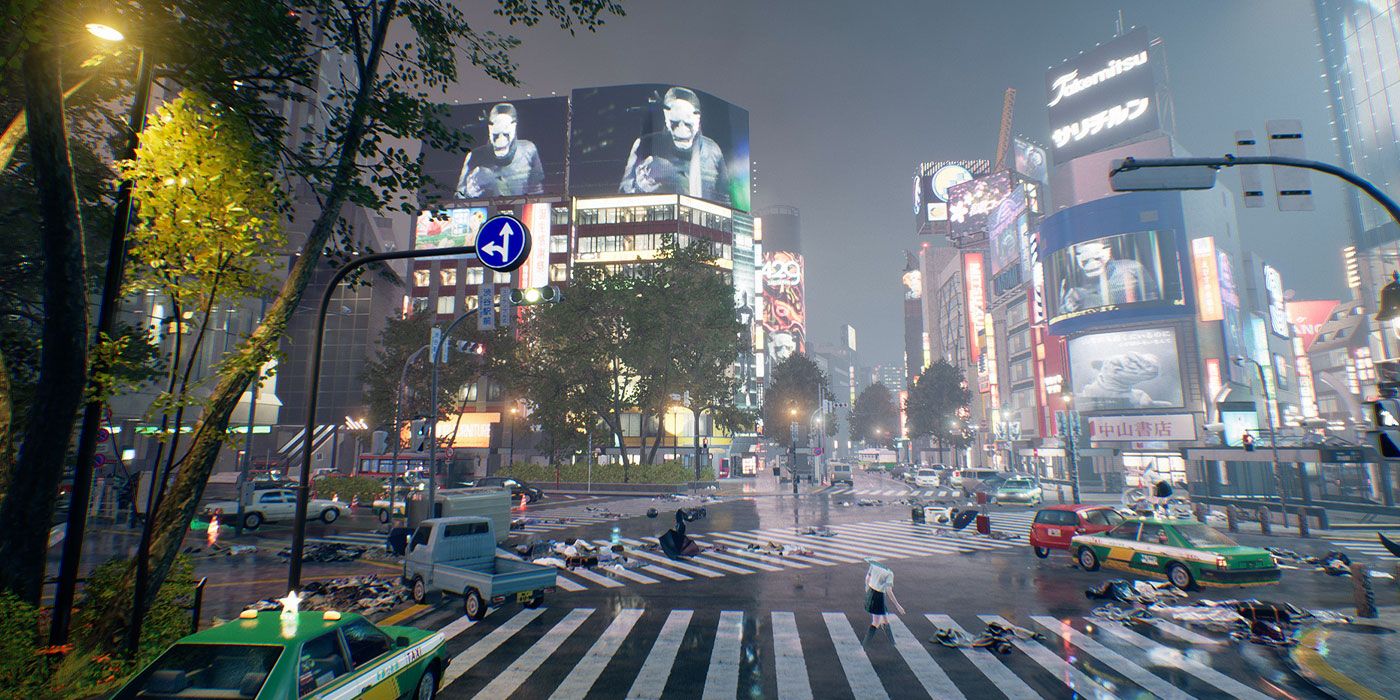
After what feels like an eternity of waiting, Ghostwire: Tokyo is finally approaching its long-awaited release. Developed by Tango Gameworks, the studio founded by legendary Resident Evil director Shinji Mikami, Ghostwire: Tokyo first caught the eyes of gamers following its energetic E3 2019 presentation but has been relatively quiet since.
In addition to the new information which has been slowly trickling out, CBR was invited to attend a special gameplay presentation for Ghostwire: Tokyo. Though much of the game’s narrative is still being kept tightly under wraps, we were able to get a close look at the combat and exploration mechanics of the upcoming action-adventure title.
The gameplay we saw consisted of early sections where the protagonist, Akito, explores the open-world Tokyo. Along the way, he encounters a number of spectral beings called Visitors menacing the city streets. Akito can defend himself against the Visitors via Ethereal Weaving, a supernatural ability that allows players to weave elements into offensive attacks. Alongside another mysterious spirit, KK, Akito must save his family and the city’s spirits from the mysterious Hannya.
The open-world design of Ghostwire: Tokyo is honestly fascinating. The player is able to freely roam a Tokyo that is barren save for yokai and Visitors who now populate the streets. While catching a Yokai can net you more power to confront enemies with, not all of them are out to kill you, such as the number of impossibly fluffy cat-like Yokai who run shops and dole out quests.
Ghostwire‘s gameplay loop appears to be pretty straightforward. In addition to KK, Akito will have various allies, each of whom has lost something dear to them. Using your new abilities, players must chase Hannya to save the loved ones they’ve lost, which appears to entail the occasional jaunt into another world that players must break free from.
In the gameplay we saw, Akito had plenty to do. Tokyo was wide open, although it didn’t appear you couldn’t go anywhere; a mysterious fog shrouds the city, which KK cryptically warns is dangerous. The first task Akito completes is visiting a nearby shrine with a few faceless Visitors standing by its entrance. With a wind-based Weaving ability, Akito can make short work of the Visitors by pulling the cores out of their forms.
Using his powers to cleanse the Shrine, the fog dissipates, opening up more of the world map and allowing Akito to enter the Shrine, where he finds a Katashiro, a small paper angel. Turning a corner, Akito found more Visitors attempting to feed on a Spirit, which KK remarks is the result of someone being trapped in the fog. Defeating the Visitors, Akito can store the soul in the Katashiro and use a phone booth to send the soul outside the fog, where they should return to normal.
Much of the gameplay loop appears to be rescuing these souls as you complete side quests and cleanse shrines, though Hannya occasionally torments Akito. Hannya is an interesting villain who seems to be mocking Akito but also attempting to sway him. He’s a great, theatrical presence in a game that would otherwise be stricken with a standard haunted city motif and someone we genuinely can’t wait to learn more about.
Ultimately, the whole thing made us think of a reinvented, modern take on Shin Megami Tensei, largely thanks to its abandoned Tokyo and demonic presence. The characters are driving the story throughout the whole experience, and it’s these interactions and conversations that result in a rich, fleshed-out world full of adventure and intrigue. There’s also the question of KK’s identity, raised when Akito receives a bow that was KK’s property. There’s a ton of mystery surrounding the game’s story and characters, but it keeps you guessing in a way that certainly feels like it will hold your interest.
The demo showed off a few traversal mechanics as it wound down, including Akito using the Ethereal Weaving to launch himself off a flying enemy, allowing him to ascend to the rooftops and cleanse another Shrine, removing more of the fog and opening up the world map even further. The map is large and has a lot going on, but Akito can use a Spectral Vision upgrade (think Dead Space’s location tracking) to point himself in the right direction, while a mini-map helps keep track of where you’re coming from.
While not much was revealed about the story’s finer details in the demo we viewed, the gameplay was more than enough to get us interested. The action appears fast and frantic, and the Tokyo environments are stunningly gorgeous. No release date has been confirmed yet for Ghostwire: Tokyo, but all signs indicate Tango Gameworks has a significant hit on its hands, not to mention one of the more interesting titles we’ve seen come to the PlayStation 5 this generation.
About The Author
