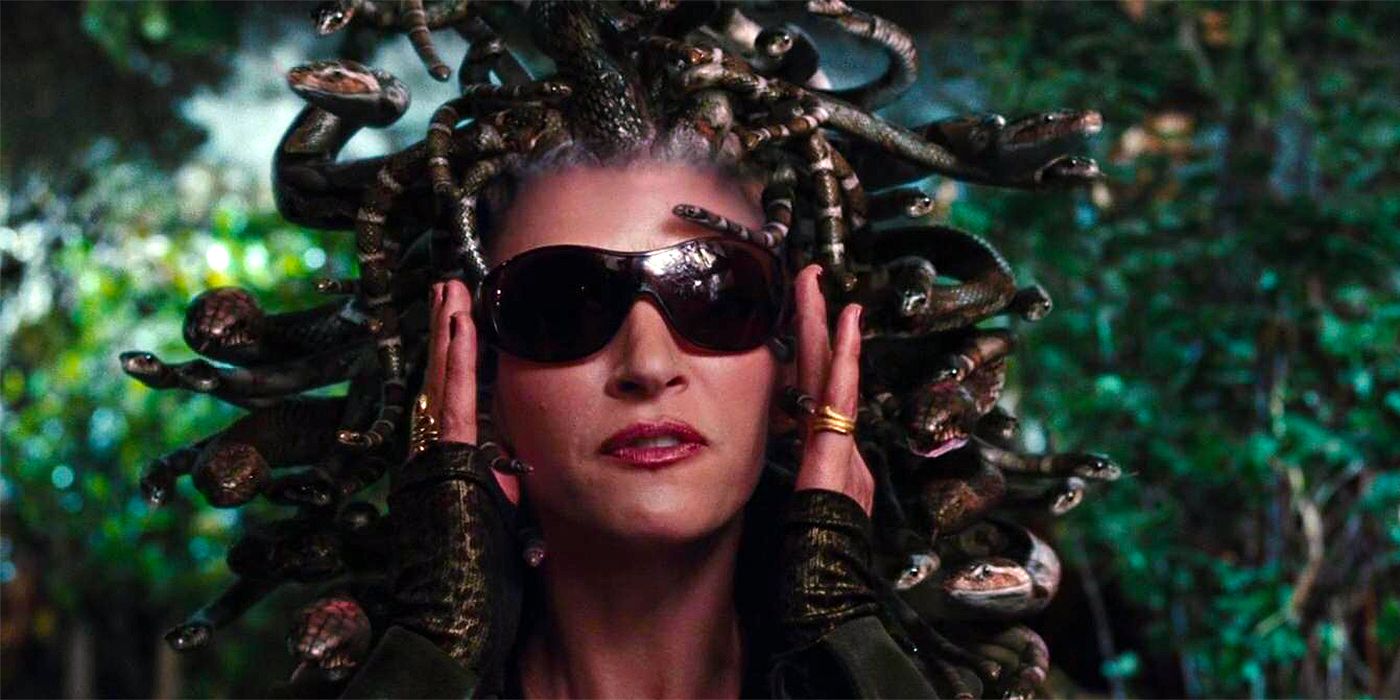
The central conceit of the Percy Jackson series is updating classic figures from Greek mythology to a modern setting, the better to link Percy and his friends with the ancient heroes in whose steps they follow. That includes traditional monsters as well as gods and demigods, notably the Medusa, whom Percy must slay and whose petrifying gaze plays a pivotal role in a number of subsequent challenges. She remains one of the most enduring figures from classical mythology for a number of reasons, and indeed her turn in Percy Jackson and the Olympians: The Lightning Thief is part of a long line of movie appearances.
However, while staying true to the spirit of the character, a number of substantial changes needed to be made from the Medusa of myth. Much of that owes to the more overt symbolism of the earlier stories, which doesn’t work well in modern narratives. Comparing Uma Thurman’s seductive variation on the original monster says a lot about what Percy Jackson retains from the core mythology, and what it’s forced to change in the name of 21st-century conventions.
Who Is Medusa in Greek Mythology?
Medusa’s origins are murky, stemming from oral tradition and only gradually working their way to the written page. She was one of three sisters, the Gorgons, who possessed wings on their backs and snakes for hair. Anyone who looked upon their faces were instantly turned to stone. The poet Ovid’s work The Metamorphosis has perhaps the best-known version of the story, describing Medusa as a beautiful maiden whom Poseidon seduced in the temple of Athena. When the goddess found them, she cursed Medusa with her serpent hair and petrifying gaze.
The Metamorphosis also recounts her death at the hands of the hero Perseus. Armed with a scythe and a mirrored shield – gifts from the gods – he crept upon Medusa while she was sleeping and beheaded her, using the shield to guide his blow rather than looking her in the face. He later used her severed head to save the princess Andromeda, who was to be sacrificed to a sea monster before Perseus turned the creature to stone. He then did the same thing to an unwelcome suitor of his mother, who had sent him off to claim the monster’s head in the first place. The 1981 movie Clash of the Titans recounts the essentials of the Ovid story – including a reimagined battle with Medusa in which Perseus uses a mirrored shield to help cut her head off – as does its 2010 remake.
How Percy Jackson Updated the Medusa Myth
Author Rick Riordan’s 2005 young-adult novel Percy Jackson & the Olympians: The Lightning Thief – along with the 2010 movie adaptation – had to contend with more than just moving Medusa to the present day. Since Ovid’s day, the character had become the focus of a great deal of study, including feminist critiques and subsequent revisions of her character, as well as similar psychological examinations of what she represents. In simplest terms, it wouldn’t be appropriate for a movie hero to behead a female monster in her sleep without coming across as considerably unheroic in the process. On top of that, it makes for terrible drama, and a figure like Medusa demands a suspenseful, fast-paced scene to convey the threat. Both versions of Clash of the Titans made similar adjustments, presenting her as awake and actively hostile rather than sticking to the specifics of the myth.
Percy Jackson and the Lightning Thief keeps a surprising amount of the myth intact, including Medusa’s previous relationship with Percy’s father, Poseidon (“I used to date your daddy,” she purrs at the beginning of their confrontation), and eventual use of her severed head to petrify his wicked stepfather.
As with Clash of the Titans, however, she needs to be a more active threat, and while the earlier movie compensated by giving her a bow and arrow for a ranged attack, that wouldn’t fit the setting of Percy Jackson. Instead, Thurman plays Medusa as seductress, who possesses serpent-like powers of hypnosis to compel her victims to look at her. When that fails, she threatens to tear their eyelids off with her snakes if they don’t comply. Percy and his friends have to face her while keeping their eyes closed the whole time, and the film succeeds in conveying how dangerous such a scenario can be. Indeed, in getting around some of the thornier issues of the original incarnation, it still conveys the heart of the story: Percy beheads her using the mirrored surface of his phone.
About The Author
