WARNING: The following contains spoilers for The Book of Boba Fett, “Chapter 4: The Gathering Storm,” now streaming on Disney+.
The Book of Boba Fett sees the return of Star Wars‘ most notorious bounty hunter, as Boba Fett becomes Tatooine’s newest crime lord, laying claim to territory once controlled by Jabba the Hutt. With fellow former bounty hunter, Fennec Shand, at his side, Boba is gradually establishing himself as the new daimyo of Mos Espa. His takeover of the Tatooine underworld has so far proven fraught with difficulties, as Boba struggles to command the fear or respect once afforded to Jabba. Consequently, he finds himself faced with new enemies at every turn and has had to seek the help of new allies.
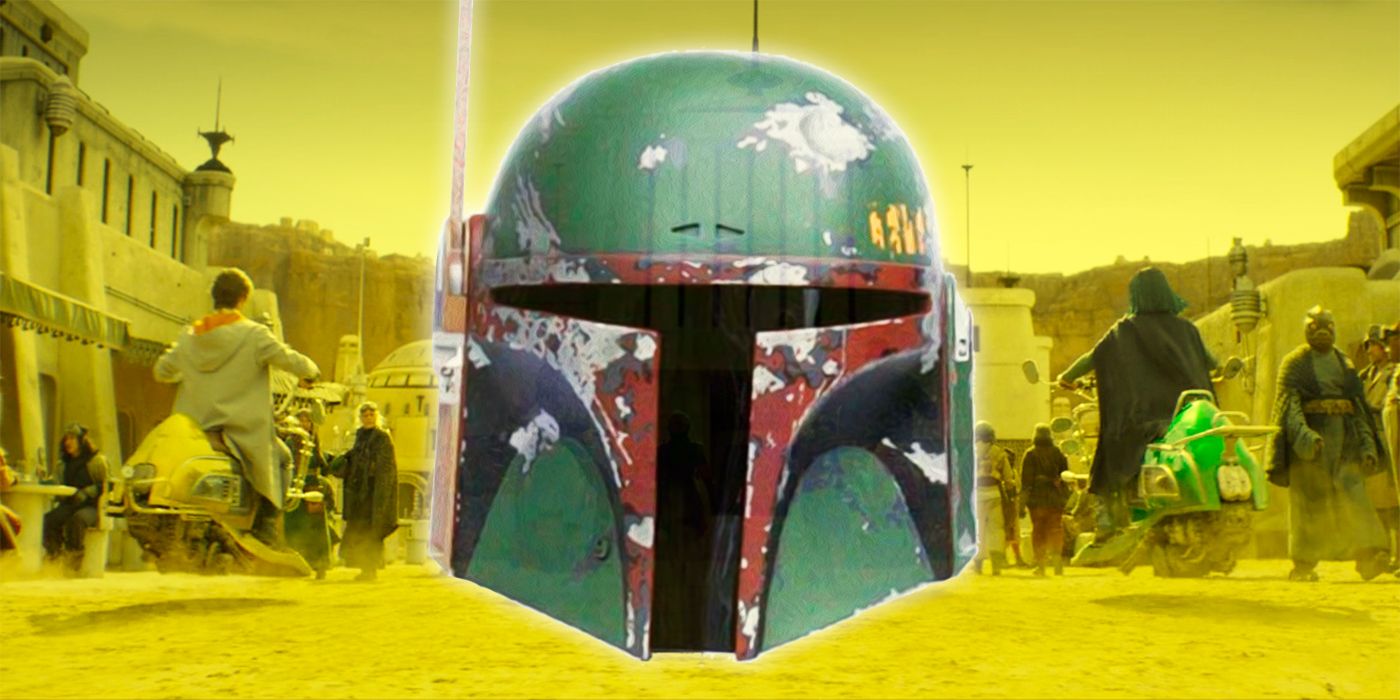
Predictably, Star Wars fans have been rather vocal in their opinions of some of Boba’s new allies. Episode 3, “The Streets of Mos Espa,” saw the introduction of a youthful speeder bike gang who Fett quickly puts to work as his new enforcers. However, these new lower-level crooks have split opinion in the fanbase. Their garishly colorful bikes and trendy outfits set them apart from the subdued, brutalist aesthetics typically associated with the barren world of Tatooine. Some fans feel they’re simply too out of place, while others appreciate them as a stylistic nod to George Lucas’ earlier work on American Graffiti. But nothing divides opinion like a good pun and the entire design of the biker gang appears to center on exactly that.
Boba is initially approached to apprehend the gang in question. Episode 3 opens with a local water-monger appearing before the bounty-hunter-turned-daimyo, requesting help handling a street gang who have been stealing from him. The water-monger asks Fett to “rid the streets of Mos Espa of this scourge,” also telling him that the gang have modified their own bodies with droid parts in order to make themselves more deadly. Boba sets out to confront the gang and, rather than the fearsome threat described by the water-monger, finds a group of teenagers with colorful bikes and a distinctive fashion sense, stealing only because there is no work and the water-monger’s prices are extortionate. Fett tells them they will work for him now.
The group’s clothing evokes skinny ties, cardigans, parkas and pea coats. Their speeder bikes eschew the designs seen in Attack of the Clones, Return of the Jedi and The Mandalorian in favor of a look closer to Vespa or Lambretta motor scooters. Overall, their look is clearly inspired by the mod youth culture of the 1960s. The same look fed into Lucas’ American Graffiti, making it a fitting tribute to the Star Wars creator. However, there is more significance to the design. As pointed out by the water-monger, the gang use droid parts to make modifications to themselves. Episode 4 even introduces the mod artist who works on the gang members, making clear how important a part of their subculture their modifications are. They have been styled after mods to nod to their own mechanical “mods” to their bodies.
The joke is subtle, but this little bit of wordplay is delightful — or perhaps agonizing for some. Fans can debate whether the pun justified straying so far from the established aesthetics of Tatooine and of Star Wars more generally. While some are sure to feel The Book of Boba Fett‘s mod gang was a misstep, others will surely agree that a good pun justifies all.
To see the mods in action on Tatooine, new episodes of Star Wars: The Book of Boba Fett air Wednesdays on Disney+.
About The Author
