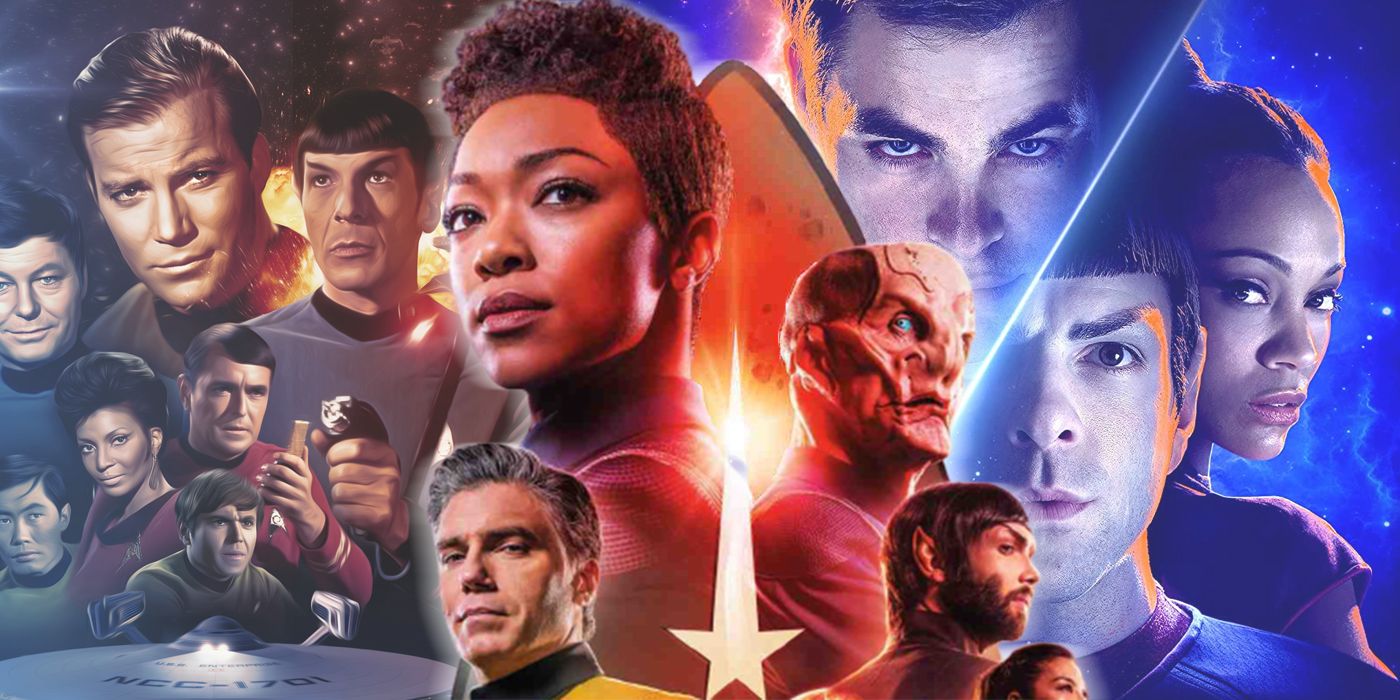
Continuity can be a monster for a franchise like Star Trek, which stretches back 55 years, and features contributions from countless creative voices. It’s improved in leaps and bounds on that front, yet its very nature entails challenges when it comes to the sweeping timeline. Star Trek: Discovery danced with the continuity devil — its first two seasons were set perilously close to the events of the original series – and pulled off a miracle by avoiding serious trouble before moving to the 32nd century, where it found no previous timeline events to entangle it.
Star Trek: The Motion Picture, however, wasn’t so lucky. Conceived at a time when no one knew how elaborate the franchise would become, the 1979 film played fast and loose with the timeline in an effort to make its cast appear younger than they were. The results stretch credulity even for hardcore Star Trek fans, and demonstrated that the franchise’s continuity challenges are far from new.
Discovery pulled off a high-wire act on this front in its first two seasons, particularly in its use of Mr. Spock and the crew of Captain Christopher Pike’s Enterprise. Such figures had a deep roots in the franchise, and employing them in Discovery meant running the risk of contradicting some previously established detail. Its initial setting, some 10 years before James Kirk’s command of the Enterprise, created a looming wall of continuity issues, and while Discovery acquitted itself admirably, it may have been only a matter of time before the series ran into a serious continuity error. It cut the Gordian Knot by sending the crew into the 32nd century – far beyond any previously established events in the timeline – while using the threat of Control in Season 2 to explain why Spock never spoke of his adoptive sister, Michael Burnham, or Discovery’s crew in other series.
It was a slick solution, but the original series was no stranger to such a problem, either. Star Trek creator Gene Roddenberry didn’t believe in continuity, and in the pop-culture ecosystem of the late 1960s, there was little reason for such considerations. Movies and television were built around single-shot dramas, with syndication allowing individual episodes to be swapped around the TV schedule at random. Even ongoing franchises like James Bond paid only lip service to continuity. Indeed, according to Gene Roddenberry: The Myth and the Man Behind Star Trek, the notion of a Stardate was created in part to avoid giving any hard dates for its drama. The opening title card for Star Trek: The Wrath of Khan – reading simply “In the 23rd Century…” – was the first concrete onscreen confirmation of any modern timeline dates.
That bit it hard during Star Trek: The Motion Picture, thanks to standard Hollywood vanity that complicated subsequent needs to pin down when events in the franchise took place. The movie was released 10 years after the final episode of The Original Series, and yet it was intended as a, more or less, immediate follow-up. The telltale line of dialogue comes from Captain Decker, whom Admiral Kirk replaces as commander of Enterprise. He notes that Kirk hasn’t “logged a single star hour in two-and-a-half years.” In The Star Trek Encyclopedia, franchise veteran Michael Okuda makes clear that the gap represents the time between the end of the original series’ five-year mission and the events of the film. When that takes place is still an unresolved question – with some sources citing 2271 as the year The Motion Picture is set, and others placing it as 2273 – but regardless, the dialogue makes it clear only a short time has passed between the 1969 final episode of TOS, “Turnabout Intruder,” and the events of the first 1979 movie.
Okuda’s efforts were intended to pin down specific dates after the fact. At the time the film was made, it was more important for their aging stars to look younger than they were. William Shatner was 48 years old when the movie premiered, and yet the dialogue suggests he should be a good deal younger than he appears. The film struggled mightily to hide the fact with make-up and lighting tricks, but it could only go so far; later high-definition restorations of The Motion Picture made those efforts embarrassingly apparent.
The Wrath of Khan gave an opportunity for a major course correction, as it grappled with the realities of Kirk’s advancing age head-on, and allowed the timeline to catch up. Ironically, the film was released two-and-a-half years after the first one, and yet the official timeline jumped forward 12 years, to 2285. The reversal speaks volumes, not only about the challenges Star Trek faced in making the leap to the big screen, but about how common continuity problems could be even in this comparatively early stage of the franchise’s development. They’re part and parcel of any creative endeavor of this size. The Motion Picture suffered a number of growing pains in order to help the franchise do better. Its head-scratching placement in the timeline was the price it had to pay.
About The Author
