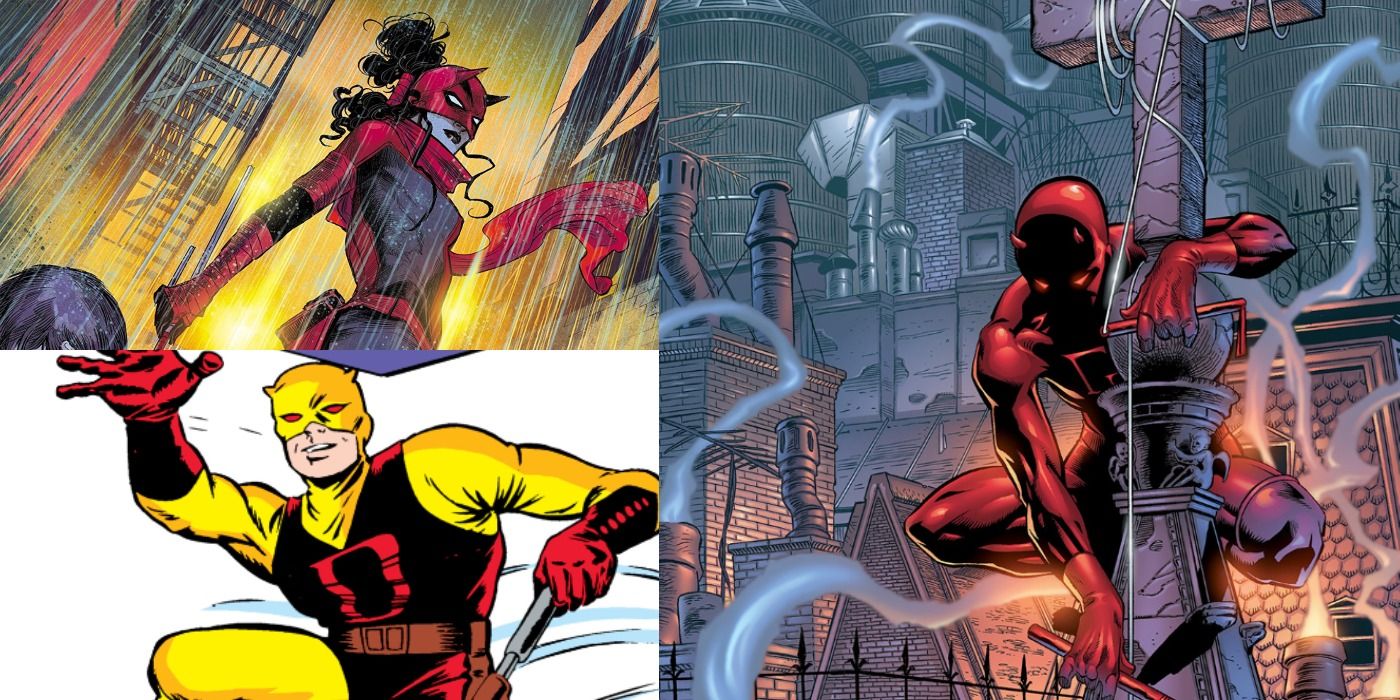
The Man Without Fear, Daredevil, first appeared in Daredevil #1 by Stan Lee and Bill Everett in 1964. The first issue is a far cry from the Devil of Hell’s Kitchen readers are familiar with today, as Lee was clearly still trying to get the character to click.
Nearly 60 years of reinvention and redesign have occurred since Matt Murdock first began his war on crime. Since then writers like Gerry Conway, Frank Miller, Kevin Smith, Brian Michael Bendis, Mark Waid, and Chip Zdarsky have all left monumental impacts on Daredevil. The following is a compilation of the major changes Marvel‘s “Red Batman” has gone through since his inaugural issue.
10 The Wally Wood Redesign
The most obvious difference when reading the first several issues of Daredevil is the costume. The original design by Everett isn’t particularly bad by the standards of the day. In fact, it’s quite striking and immensely recognizable. The issue is how incongruous it seems from hindsight now that audiences imagine Murdock as a brooding vigilante in a gritty crime-ridden world.
It wouldn’t be until Daredevil #7 when artist Wally Wood would streamline the outfit and give audiences the classic all-red look. While the stories still had that wonderful Silver Age wackiness, this new suit would function much better for the spy thriller and crime drama tales that would follow in the proceeding decades.
9 Daredevil’s Lovely Little Knapsack
One cute little tidbit of Murdock’s original suit introduced in Daredevil #3 by Stan Lee and Joe Orlando is a small knapsack that allowed the hero to store his civilian clothes. This included enough space for a full wrinkle-resistant suit as well as his shoes. One might think that storing a pair of loafers on your back might cause issues for highly gymnastic crime-fighting, but Matthew seemed to get by just fine. Since Matt’s fellow heroes like Spider-Man seem to always get their backpacks and gear stolen it might not be a bad idea for them to adopt a similar accessory.
8 Matt’s Cynical Teacher, Stick
While most new characters added to a superhero’s world tend to be modern-day supporting cast members, Frank Miller made the decision to dramatically alter and retcon Daredevil’s origin with the inclusion and creation of Stick. First appearing in Daredevil #176, Stick was Matt’s mentor in martial arts and “seeing” despite his disability. This retroactively made Murdock’s otherwordly agility and expertise more reasonable as he was now given a mentor figure rather than having to learn everything by himself. Stick would eventually be killed off in the comics, but his impact on Daredevil can still be felt today.
7 Foggy Nelson Got Dragged In
For about half of Daredevil’s history his closest friend and partner, Foggy Nelson, was unaware of his double life. It wouldn’t be until much later that J.M. DeMatteis finally had Foggy discover the truth while Matt was having a major mental breakdown in Daredevil #347 from 1995 with art by Ron Wagner. Allowing Foggy to become a part of Matt’s double life allowed the character a level of agency he wasn’t allowed before and gave Murdock arguably his closest confidant and ally.
6 Matt’s Villains Became Competent
Most early Marvel villains tend to be, outside the confines of their story, rather silly and inept. While there are some stand-out examples several of Daredevil’s baddies tend to come off more as costumed doofuses rather than genuine threats. As the years went on however that swiftly changed. Kingpin, prior foe to Spider-Man, became Matt’s primary antagonist as the main man behind all of New York’s crime. In addition, Bullseye, a villain that appeared in Daredevil’s time teaming with Black Widow, would make his mark on the character paramount when he murdered Elektra. The image of Elektra being stabbed with her own sai has from Daredevil #181 by Miller and Klaus Jansen has become one of the most iconic images from the series and marked the era of Matt’s rogues going from the silly antics of costumed loons like Stilt-Man to genuine bloodthirsty monsters.
5 His Inconsistent Abilities Got Defined
Stan Lee was nervous about how Daredevil would be received by the blind community, as the character’s abilities went well above and beyond what would be realistically possible. However, he was happy to hear news about how much of an idol and icon the hero became for the blind as well as the larger disabled community.
Everyone pretty much understood that, as a comic hero, it would make sense for Daredevil’s abilities to be played up to the Nth degree, but some of his powers have been left out over time for the sake of keeping things more grounded. While being able to read newsprint due to the indention of the ink is a well-known capability of Murdock, one lesser-known as described when he crafts his costume is that he claims to be able to feel the difference in colors as he sews his outfit. If Matt truly has synesthesia, it’s not something often used.
4 Mysticism Was Added To The Lore
Frank Miller appears several times for good reason. Much like with DC‘s Caped Crusader, Miller brought a level of grit and realism that hadn’t previously been seen. This, again like Batman, doesn’t mean that prior writers maintained a Silver Age level of fantasy, but rather than Miller’s natural affinity and interest for crime drama and mature storytelling gave his work a unique texture that wasn’t easily replicated. One major component of Miller’s work both in and out of Marvel was his fascination with Japanese culture. This led to his run on Daredevil adding many Eastern elements such as ninjas, a greater focus on martial arts, and even the mystical based on methods of religious meditation. Despite Miller’s grounded stories, they were still just as fantastical as any prior tale. It’s simply that when Miller did it, the fantastical felt as real as the ordinary.
3 Catholicism Became A Major Factor
While Miller is often credited with adding Matt Murdock’s Catholicism, based on Irish stereotypes, it was actually first implied by Tony Isabella who in Daredevil #119 with artist Bob Brown introduced a Catholic priest that Matt knew previously. Not an explicit mention of his religion, but implicit enough to get the idea across. Regardless of who truly decided to add the element to Matt’s character, it has become a unique and defining trait that has allowed writers to tell stories that couldn’t have been done before. Superhero comics generally tended to avoid religion outside of general American protestant Christianity. Matt, along with other heroes like Ben Grimm, Nightcrawler, and Kamala Khan help diversify the Marvel Universe and transform it, truly, into the professed “world outside your window”.
2 The Tone Of The Books Became Darker
By the time Gene Colan came aboard in Daredevil #20 from 1966, the character had already begun changing direction. By #47 the stories were tackling more mature subject matter such as the framing of a Vietnam veteran, a story Lee is particularly proud of. By the 1970s writer Gerry Conway took over had introduced Black Widow as a partner and love interest. This both provided an iconic era for the character but also brought the character to a more pulp aesthetic. Despite how far the character got from his Silver Age wacky roots, it was still a shock when Miller took over the book in 1979 and began making the character his own. Miller brought an edge and emotional realism that couldn’t be matched, and future writers have always been at their best when they don’t try to compete with him but rather make the character their own as he did.
1 Daredevil Isn’t Matt Murdock (Right Now)
As December 2020’s Daredevil #25 by Chip Zdarsky and Marco Checchetto, Matt Murdock is in prison. Because Hell’s Kitchen needs a Devil to save it, Elektra Natchios has taken up the mantle and become the Woman Without Fear. Aside from looking insanely cool in her new outfit, Elektra is making an effort to prove to Murdock that she isn’t just a killer but truly can turn to the side of the angels. Zdarsky’s run on Daredevil being fantastic is not news, but if one’s been living under a rock now is a great time to jump in.
About The Author
