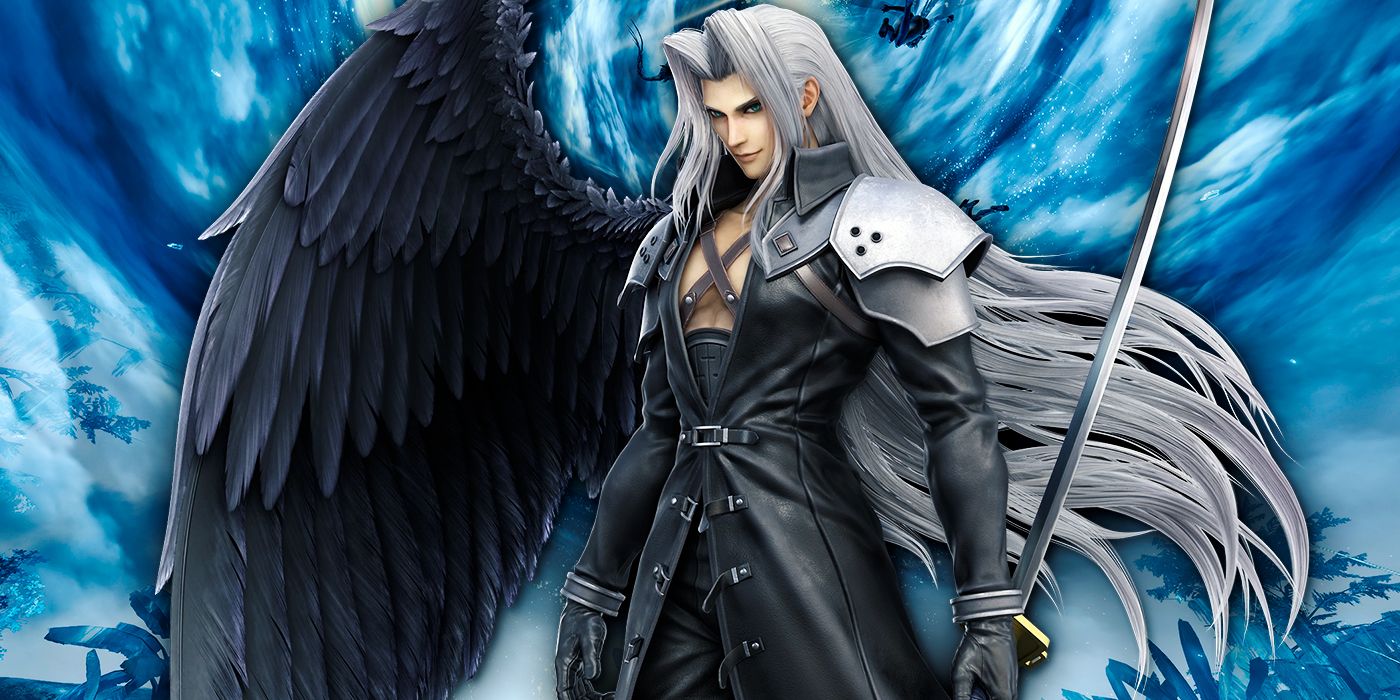
Sephiroth was first introduced 25 years ago as the main antagonist of the original Final Fantasy VII. Today, he is one of the most notable villains in the broader history of video games. Along with his major role as an antagonist in the branching storyline(s) of the extended Final Fantasy VII universe, he was also featured as a minor antagonist in the Kingdom Hearts franchise and a playable character in other series.
In the grand scheme of things, Sephiroth remains a likable character with whom many fans sympathize, despite his infamous standing. Whether it is because of his iconic looks or undeniably strong presence, he is a memorable antagonist whose appearance is easily recognizable and does not go unnoticed. While Square Enix has kept Sephiroth’s physical attributes intact for the most part over the course of the past two decades, fans who have played the original Final Fantasy VII might remember his human form without the massive black-feathered wing – and for a good reason, too.
Although Sephiroth’s initial winged appearance saw the light of day during the events of the original Final Fantasy VII, it was not in his human form. After being defeated by a wounded Cloud during the Nibelheim Incident, Sephiroth fell into the Lifestream, where he regenerated and emerged as the final boss, better known as Safer Sephiroth. Most of his lower extremity was replaced by blue-tipped wings, while his right arm was represented by a dark red wing instead. In line with his god-like transformation, Sephiroth’s theme song, “One-Winged Angel,” played during the battle sequence, eventually becoming one of his nicknames as well.
The next time Sephiroth appeared in his human form again was outside of the Final Fantasy franchise, he was donning a single black wing never seen before. In 2002’s Kingdom Hearts, Sephiroth appears as one of the secret bosses that could be unlocked at the Olympic Coliseum as a Platinum Match in the international release. Developers never provided an explanation as to why they had decided to alter his physical appearance at that particular time, but some theorize that the change was made to accommodate his theme song. Conversely, others believe that Cloud’s appearance played a part in this decision, as he was also sporting a black wing in Kingdom Hearts, indicative of the dark powers he used in the series and his lasting connection with Sephiroth.
The updated take on Sephiroth was a hit with fans, so Square Enix adopted it in the extended Final Fantasy VII universe. His new appearance carried over to Compilation of Final Fantasy VII, specifically his next immediate appearance in the film Final Fantasy VII: Advent Children. Going into the prequel game Crisis Core: Final Fantasy VII, Square Enix retconned some of the lore surrounding the wings. Although Sephiroth was not seen with his black wing throughout the game, two other First Class SOLDIERs, Genesis and Angeal, grew wings as a side effect of being imbued with Jenova cells in an attempt to achieve Sephiroth-like results. Shortly after the release of Crisis Core: Final Fantasy VII, the developers stated that black-colored wings in the franchise are supposed to signify evil.
Following the positive reception of Sephiroth’s recurring appearance with a massive black wing, other developers also took advantage of his upgraded human form in their respective franchises. In Super Smash Bros. Ultimate, Sephiroth unfurls his wing after activating his unique fighter ability, One-Winged Angel, which boosts his performance and lasts until either he or his opponent falls. Today the wing has become the accepted norm, with Sephiroth sporting during appearances in Monster Strike and Puzzle & Dragons, as well as Square Enix’s World of Final Fantasy, Dissidia (012) Final Fantasy and Final Fantasy VII Remake Intergrade.
About The Author
