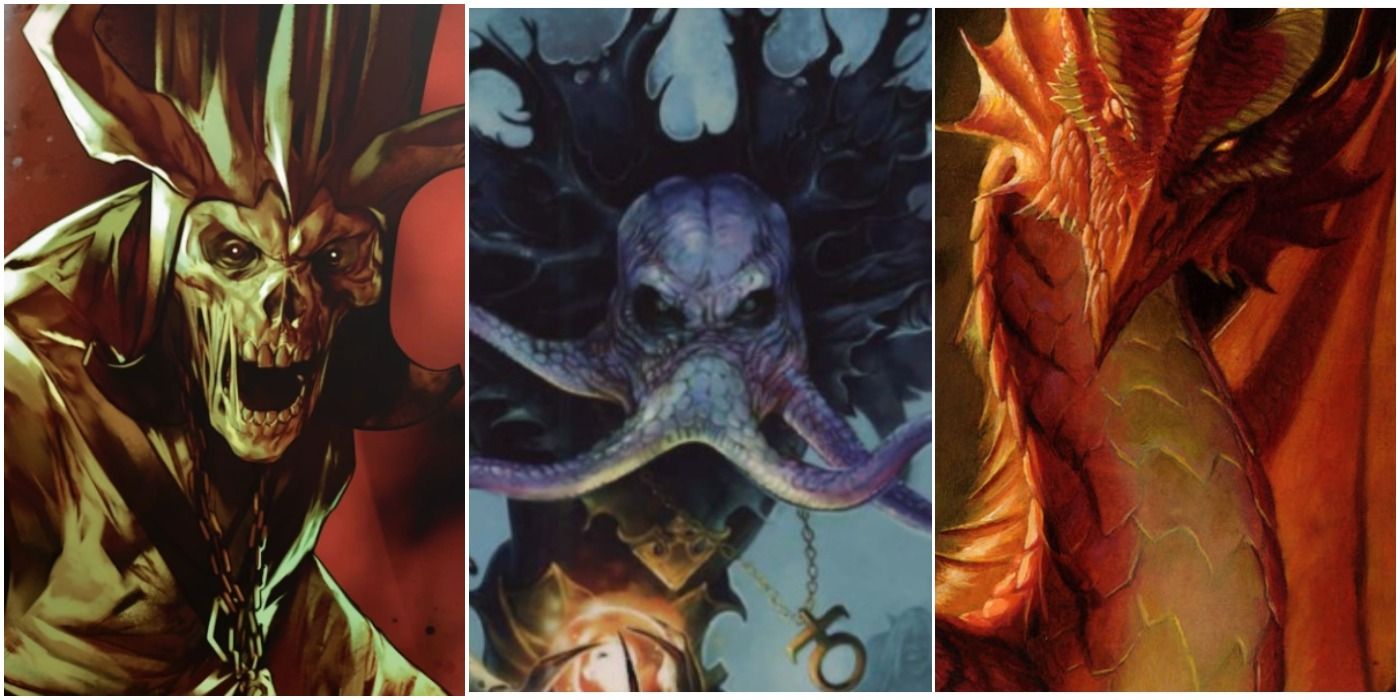
A game built on exploration and adventure, it’s only natural that a party of adventurers in Dungeons and Dragons might encounter different creatures over the course of their journey. While they may begin their quest fighting orcs and goblins, players may find themselves facing much more powerful foes by the end of a campaign.
Many of the enemies high-level D&D parties encounter will force them to play smart. These creatures have a vast array of spells, abilities, resistances, and special attacks that will make them more than a match for even the most skilled adventurers.
10 Humanoids Can Wield Great Power
While most humanoids are weak compared to other creatures in Dungeons and Dragons, this is not always the case. In fact, some mortals can gain incredible amounts of power. Archmages and Archdruids are some of the strongest humanoids in D&D, powerful spellcasters wielding a wide array of spells. Also in contention is the Warlord, not only powerful in combat but capable of commanding a group of warriors as well.
9 Aberrations Are Twisted Monsters From Another Realm
Aberrations can take on many forms and are often quite alien. They are said to come from another plane of existence entirely, one that is far unlike more familiar worlds. Some, such as the Illithids, may even hail from a completely different time.
Illithids, otherwise known as Mind-Flayers, are among the best known and some of the most dangerous of aberrations, second only to the Beholders. Lesser-known creatures such as Aboleths and Neogi can also be quite deadly for an unprepared party of adventurers.
8 Elementals Bring Forth The Fury Of Nature Itself
The four elements of water, earth, wind, and fire have been popular concepts in mythology and lore since ancient times. Elemental creatures are also quite common in D&D and come in many forms. While there are many lesser elementals within the game, they may also become elder elementals like the Phoenix, Leviathan, Zaratan, or Elder Tempest. These beings are the living embodiment of their element and will wreak destruction across the land in a way only the forces of nature can.
7 Fiends Are The Embodiments Of Pure Evil
Within Dungeons and Dragons, the concepts of evil and good are often very concrete and are capable of manifesting in physical form. Fiends are creatures of pure evil whose entire existence centers around taking power and causing harm to others.
The two most common and powerful types of fiends are the demons and devils. They form two ends of a cursed spectrum, chaos and law in opposition. In some lore, the two have been fighting an endless war for supremacy. This conflict is often the only thing stopping these monsters from turning their full attention on the mortals of the world.
6 Constructs Were Built With Purpose And Power
Constructs are creatures made of materials like stone, metal, or even flesh. They are crafted by magic and given some level of consciousness in order to perform a specific task, such as guarding a powerful mages treasure or fighting in a war.
Most constructs are fairly strong and will pose a threat to even a well-prepared party. They typically have a high amount of hit points, resistances, and can deal plenty of damage. Some of the strongest creatures in D&D are constructs, including the nearly-unkillable Marut.
5 Giants Take Their Strength Very Seriously
One of the most important aspects of lore around D&D giants is their hierarchy. This strictly enforced system is almost purely based on physical size and strength, and the way various types of giants fit within it is well established.
The lowest among the giants are the Hill Giants, but even these brutal and voracious creatures are capable of crushing a low-level party. The most powerful are the Storm Giants, whose power is unrivaled among their own kind and who pose a threat to even the most skilled adventurers.
4 Undead Are The Stuff Of Nightmares
While creatures such as skeletons and zombies may be considered fodder for new D&D adventurers, this is not true of all undead. In fact, some of the most dangerous creatures a party may come across will fall into this category.
At the top of the list is the Lich, a powerful and evil spell caster who has traded in their mortality for a cursed existence as a near-immortal undead. Other powerful examples include the Death Knight, the Dracolich, and the Mummy Lord, each with their own strengths and abilities but one thing in common; a hatred for all things living.
3 Celestials Carry Out The Will Of The Gods
While the gods might be some of the most powerful entities in the Dungeons & Dragons multiverse, encountering them directly is a rare occurrence. It would be more likely to encounter one of their servants or children, beings known as celestials.
Greatest among the celestials are the Empyreans, literal children of gods with powers as significant as their origin implies. While most celestials are good-aligned creatures, some stray from their path. Should one find themselves on the wrong side of one of these beings, they are sure to face a radiant fury unlike anything they could imagine.
2 Monstrosities Come In All Shapes And Sizes
The monstrosity creature type in D&D is a very broad term typically used to describe unnatural creatures that may be the result of some magical experiment or a curse. Therefore, these monsters do not have any typical defining traits or appearances and come in a variety of powerful forms.
The most infamous monstrosity in Dungeons and Dragons is the Tarrasque, a creature akin to a giant tyrannosaur with a magic-repelling carapace and the ability to destroy entire cities with ease. Only the most powerful adventurers could hope to tangle with this creature and survive.
1 Dragons Are The Classic Monsters Of D&D
Dragons are the most classic creature type in D&D, and often feature as the final enemy of a campaign. Dragons gain more power with age, which is why the Ancient Dragons have some of the highest Challenge Ratings in the game. The two most powerful, the Ancient Gold and Red Dragons, are among the strongest creatures a party can ever encounter while playing Dungeons and Dragons.
About The Author
