The Legend of Korra is the exciting sequel series to the original Avatar: The Last Airbender, and the world of Korra is at once wonderfully familiar and totally different. It’s a new generation, and the brash Avatar Korra has succeeded Aang as the world’s protector. She soon embarked on a wild adventure of a lifetime with her new friends.
Korra’s journey spanned four seasons, or “Books,” and each Book had heartfelt drama, charming comedy, deep characters and most of all, excellent action sequences and stunning setpieces. Many episodes of this series are definitely worth watching again, usually to rewatch Korra‘s best action sequences or personal drama. Which episodes should be re-watched on their own?
10 “Welcome To Republic City” – To See Where It All Began
The very first episode of The Legend of Korra is worth rewatching for many reasons, most of all for nostalgia. The whole adventure began here, and many fans may have forgotten some of the charming and fascinating details packed into this pilot episode.
What is more, the characters in Korra grew a lot during the series, so it’s interesting to see Korra as she was at first, when all her growth was still ahead of her. It shows just how far she has come, and it makes re-watching “Welcome to Republic City” that much more fun.
9 “And The Winner Is…” Has Exciting Action Of All Kinds
The sixth episode of Book One: Air featured the climax of the pro-bending story arc, when the Fire Ferrets bending team faced its greatest challenge, the Wolfbat team, led by the obnoxious Waterbender Tahno. This fight alone was worth re-watching this episode for, but there’s more.
Partway through “And the Winner is…”, the story launched Amon the revolutionary’s crusade for real, and his Equalist forces invaded the pro-bending arena. The sport quickly gave way to a real battle, and Korra’s friends only barely survived the Equalists’ terrifying assault.
8 “Out Of The Past” Shows Aang’s, Toph’s & Sokka’s Adult Lives
The episode “Out of the Past” had little action, but not every episode should be rewatched for the action scenes. This particular episode gave Avatar fans exactly what they’ve always wanted — clear insights into the adult lives of Avatar‘s characters as adults.
“Out of the Past” features Toph, Aang and Sokka in their early 40s, and they all faced a common threat in a young Republic City — the bloodbending criminal overlord, Yakon. Toph was a cop by now, and Sokka was on Republic City’s council. Now that’s cool.
7 “Beginnings, Part 1” Introduces The First Avatar, Wan
Jinora, Tenzin’s eldest child, once found a collection of Avatar statues, and she beheld a statue of the very first, depicting an unknown man. Korra soon met that mysterious male Avatar, the historic figure who launched the entire Avatar cycle. His name was Wan, and he had a story to tell.
“Beginnings, Part 1” introduced Wan as a good-natured thief who lived in a Lion-Turtle city of fire, and he chose honor and justice over obedience to the ruling family. Wan was soon exiled to the spirit wilds, but that didn’t deter him. He became a friend to the spirits, and he soon changed history with them.
6 “Beginnings, Part 2” Finished Wan’s Story With A Great Battle
The story of Avatar Wan was told across two episodes, both of which are fascinating insights into how the Avatar world took shape after the era of the Lion-Turtles. Wan’s journey to bring peace to the world continued, and he met the ultimate light and dark spirits, Raava and Vaatu. Wan mistakenly allowed the dark spirit, Vaatu, to gain the upper hand.
So, Wan took it upon himself to learn the four elements, not just fire, and confront Vaatu to save the entire world. He did just that in the spirit world, and permanently fused his body with Raava’s essence, which birthed the Avatar cycle. Wan heroically triumphed over Vaatu and sealed it in the Tree of Time, and later died an old man on the battlefield. His mission was complete.
5 “Light In The Dark” Is A Clash Of Titans
Book Two: Spirits was all about spirits and the Water Tribe civil war, and this made the battle persona for Korra, a Water Tribe native. She clashed with her scheming uncle, Unalaq, after learning the truth of his plans. However, Korra lost to him in the spirit world, and lost her connection to all past Avatars.
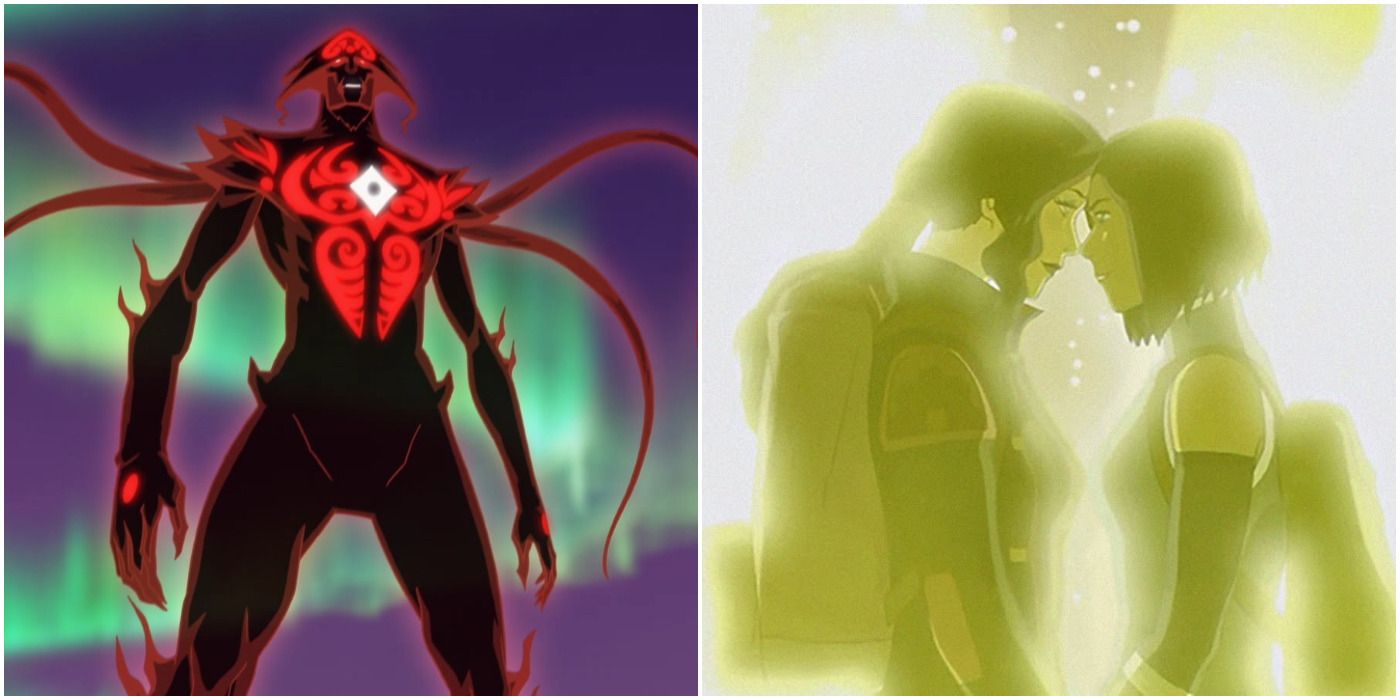
Korra still had one option left — energybending. With Tenzin to guide her, Korra became an energybending titan, and confronted Unalaq’s Vaatu form in Republic City’s bay in an exciting kaiju-style clash of the titans. This easily outstripped anything from Book One: Air.
4 “Original Airbenders” Emphasizes Airbending In New Ways
Book Three: Change really did bring about many changes, one of which was the sudden arrival of many new Airbenders, who had previously been non-benders. Since Korra opened the spirit portals, the spirits restored balance to the world by creating new Airbenders, and that included Tenzin’s brother, Bumi.
“Original Airbenders” gave Tenzin what he always wanted — a whole platoon of new Airbenders to train. Tenzin gleefully acted like a drill sergeant, much to Bumi’s dismay, and Jinora and Kai had their own little adventure along the way, involving some sky bison calves.
3 “Venom Of The Red Lotus” Was An Exciting But Terrifying Battle
Zaheer the anarchist wanted the Avatar dead so he could spread disorder and natural law to the entire world without the Avatar’s interference. In the final episode of Book Three, Zaheer already had Korra captured, and he poisoned her with mercury to weaken her and force out the Avatar state.
Zaheer and his goons fought long and hard to kill Korra and her friends, and the battle was a tense and desperate one. In the end, the Red Lotus fell, and Jinora combined all the Airbenders to capture the flying Zaheer and put an end to his rampage. For Korra, though, the struggle was just beginning.
2 “Day Of The Colossus” Has Incredible Action
The final battle for Republic City began in the episode “Kuvira’s Gambit,” but the battle really kicks into high gear in Book Four’s penultimate episode, “Day of the Colossus.” Sure enough, this episode stars Kuvira’s massive, platinum-plated mechanical giant, and it’s a dream come true for any Gundam fan.
This episode is almost entirely action, and that makes it like a miniature action movie for Korra fans who are feeling nostalgic. “Day of the Colossus” also features Hiroshi Sato’s heroic sacrifice to help add some emotional impact to the action.
1 “The Last Stand” Ends The Series On A Strong Note
The final episode of Book Four and Korra as a whole, “The Last Stand,” has a bit of everything. Korra has her exciting final showdown with Kuvira the tyrant, while Mako and Bolin support her however they can. The colossus finally falls, and Kuvira makes her last stand before succumbing to Korra.
“The Last Stand” neatly wraps everything up nicely, but it’s clear that the world and these characters have many new scars, which helps balance out the tone. In addition, “The Last Stand” features Varrick’s and Zhu Li’s lovely wedding, and it also gives Korra and Asami one tender moment together as a new couple to conclude the show.
About The Author