At one point, DC created a host of characters to feature alongside their protagonists. These characters were either pitched as sidekicks or used as comic relief, but their purpose was to balance out the more serious nature of their hero’s adventures. More often than not, stories that included a sidekick revolved around the hero having to save them. However, there are times the sidekicks helped out their hero in smaller ways, although ultimately stood back while their hero finished the job.
Despite the popularity of some sidekicks, DC has gradually fazed out a number of these mini-heroes over the decades. One of the reasons for this is due to DC wanting to simplify their continuity. However, in some cases, it was because they were ashamed of the characters they created.
10 Woozy Winks Doesn’t Offset Plastic Man’s Silliness Enough
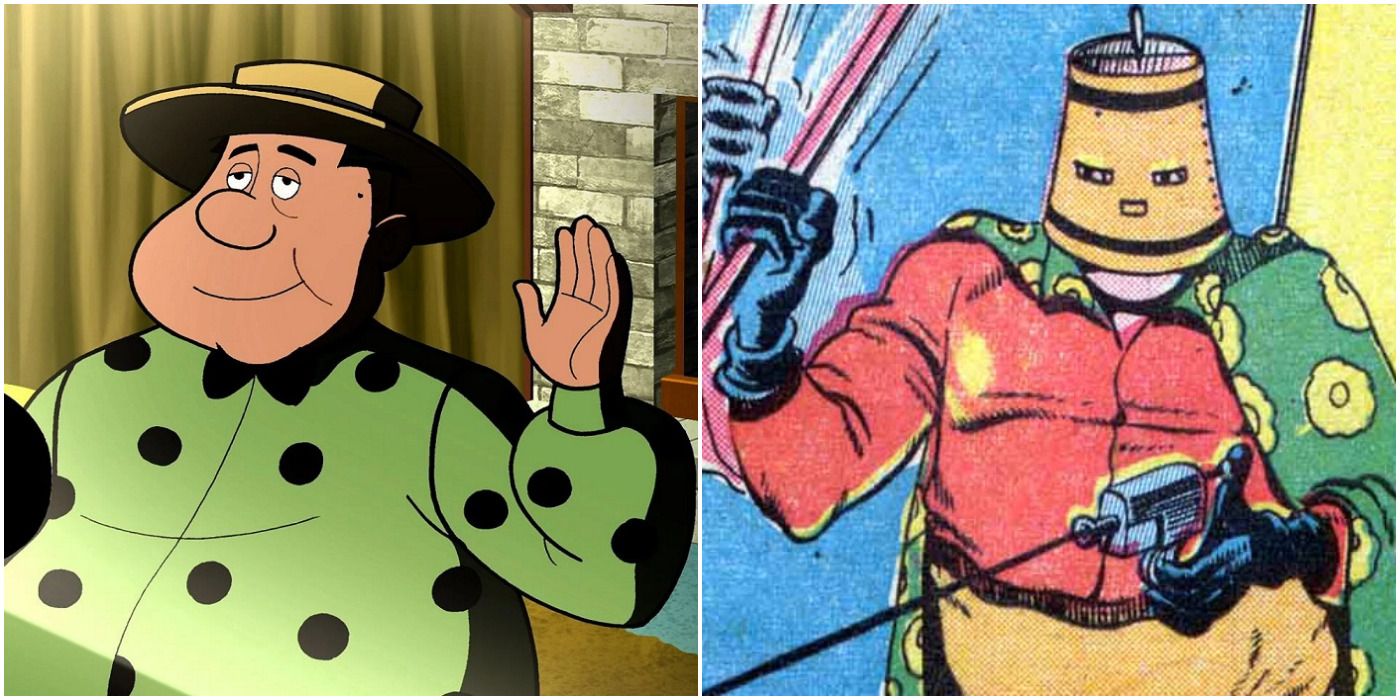
Woozy Winks was Plastic Man’s sidekick back in the early ’40s. And if Plastic Man doesn’t seem ridiculous enough on his own, Woozy makes it that much worse. In the vein of Doiby Dickles, Woozy is an overweight guy who’s mostly intended for comic relief.
Originally, the character had a spell cast on him that protected him from danger. However, as that didn’t give Plastic Man many opportunities to save him, the spell eventually wore off. His main purpose seems to be telling Plastic Man who is and isn’t worth arresting. These days, Woozy makes more appearances in cartoons than comics, where he hasn’t been seen in years. And even Plastic Man isn’t featured very often.
9 Terra Was Separated From Power Girl And Retconned To Simplify The DC Universe
Introduced in the late 2000s, this version of Terra came from a society that lived underground. First introduced in Supergirl, the character ended up becoming the sidekick of Power Girl in the late 2000s and early 2010s. She worked alongside Power Girl as a sidekick while learning how to live among humans. Although the character was likable, DC had no place for her during the New 52. As a result, the character vanished while Power Girl teamed up with Huntress to complete a quest that returned them to their homeworld, which also ended up being retconned to create a “simpler” DC Universe.
8 Lorena Marquez Was Erased So Tula Could Have The Role Of Aquagirl Again
Lorena Marquez was introduced at a time DC didn’t quite know what to do with Aquaman. She made her first appearance in 2004, where an earthquake sank a large part of San Diego into the ocean. As a result, many of the citizens adapted to living underwater, including Lorena, who became Aquagirl after Ocean Master briefly swapped lives with Aquaman.
In the end, Lorena worked alongside Aquaman on numerous missions and joined the Teen Titans. However, like many characters from that era, DC retconned her out to simplify things during the New 52 era. These days, there is no Aquagirl. However, the original Aquagirl, Tula is still around and helping out Arthur.
7 Bette Kane Was The Original Bat-Girl But DC Won’t Ever Admit It
Bette Kane was originally Kathy Kane’s niece. Introduced back in 1961, she and Kathy Kane were supposed to be love interests for Batman and Robin. In fact, they only existed to prove the Dynamic Duo were interested in girls and dispel the rumors that they might be gay. This means Bette Kane actually predates Barbara Gordon – the Batgirl everyone thinks is the original – by about six years.
The character’s identity as Bat-Girl was retconned out of the comics. Instead, she became Flamebird during her time with Teen Titans West. In the New 52 era, Bette spends most of her time sidelined. She’s never actually been Bat-Girl but has operated as Hawkfire for a time.
6 Fatman Is The Kind Of Comedic Relief That Wouldn’t Work In Modern Superhero Comics
Tex Thompson was introduced at the same time as Superman in Action Comics #1 by Ken Fitch and Bernard Bally. The character worked as a superhero during a period where all it took was a costume and a gadget or two. To meet that standard, Mr. America chose a whip and a cape that doubled as a flying carpet. With a hero that unimpressive, there wasn’t much hope for his sidekick.
Fatman was Tex Thompson’s friend, Bob Daley – a man who chose to wear a superhero costume that consisted of a lampshade over his head, a pair of oversized boxers, a shirt, and a cape made out of curtains. His weapon of choice was a broom, and more often than not, he served as the comic relief while Mr. America did all the real work.
5 Snapper Carr Was Only Added To Make The Justice League Connect To Kids
Snapper Carr was originally one of the Justice League’s sidekicks. Introduced in Brave and the Bold #28 by Gardner Fox and Mike Sekowsky, Snapper was meant to be the “hip teen” of the team. His real name was Lucas Carr, but they called him Snapper because he always snapped his fingers when he was excited, which referenced the “cool” 60s teenager he was based on.
Eventually, DC decided Snapper didn’t fit in with the comic. So, he was written out after betraying the team’s secret hideout to the Joker, who was disguised as “John Dough” at the time. In the modern era, Carr’s appearances have been kept to a minimum and his close ties to the Justice League are a thing of the past.
4 Pinky Butler Is A Fawcett Comics Character With A Really Familiar Origin Story
Pinky Butler is literally just Robin with a more fanciful costume. This makes sense when you consider how the character is from Fawcett Comics – a rival comic book company to DC Comics in the 1940s. The character became a superhero known as Pinky the Whiz Kid after being adopted by Brian Butler (the superhero Mr. Scarlet) when his mom was killed by the villain, Mr. Hyde.
The character was eventually retconned out of existence and wasn’t seen again until The Power of Shazam comic in the ’90s. Even then, he only made a brief appearance as there was nothing about the character that stood out from the Bat-Family. In fact, since being purchased, most of the Fawcett characters remain largely unused.
3 The Lieutenant Marvels Have Been Replaced By Billy Batson’s Marvel Family
In the early ’40s, the Captain Marvel comics were willing to have a little fun with their concept. This decision is a large part of why Captain Marvel was a more popular character than Superman at the time. In 1941, DC introduced the Lieutenant Marvels, a collection of civilians who all shared the name Billy Batso, including Fat Billy from Brooklyn, “Hill” Billy from the South, and Tall Billy from the West.
During a mission where Sivana was trying to have the real Billy Batson killed, the other three Billies were granted the power of Shazam and turned into their own Marvel versions. Although they made multiple appearances during the original Whiz Comics run, these days there’s an entire Shazam Family and not enough Captain Marvel power to go around.
2 Newsboy Legion Don’t Fit With How Metropolis And Cadmus Are Portrayed These Days
The Newsboy Legion were a collection of juvenile delinquents that worked with The Guardian on his cases. They could only exist in the World War II era as a concept because, these days, they’d raise serious questions about child safety laws and cloning ethics.
The group eventually became part of Project Cadmus where they created young clones of themselves, some of which went on adventures by themselves. The original Newsboy Legion were killed off by Codename: Assassin during the New Krypton story in the late 2000s. And since then, there’s been one reference to the team along with the Boy Commandos in an out-of-continuity one-shot.
1 Thomas Kalmaku Was Stuck With An Offensive Nickname
Thomas Kalmaku was Hal Jordan’s sidekick in the same way Doiby Dickles was Alan Scott‘s. The idea of having an Inuit character as a mechanic working on Ferris Air’s aircraft would have been progressive, had it not come with an offensive nickname like “Pieface.”
Kalmaku was referred to as Pieface more often than his real name. Most of the time, he was a major part of Green Lantern until Hal Jordan stepped down and Kalmaku was subsequently fazed out. He was also barely mentioned when they brought the Corps back. However, when the character made an appearance in DC: The New Frontier, he angrily objected to the name Pieface. And in the end, DC decided to avoid dealing with the character’s problematic past entirely.
About The Author