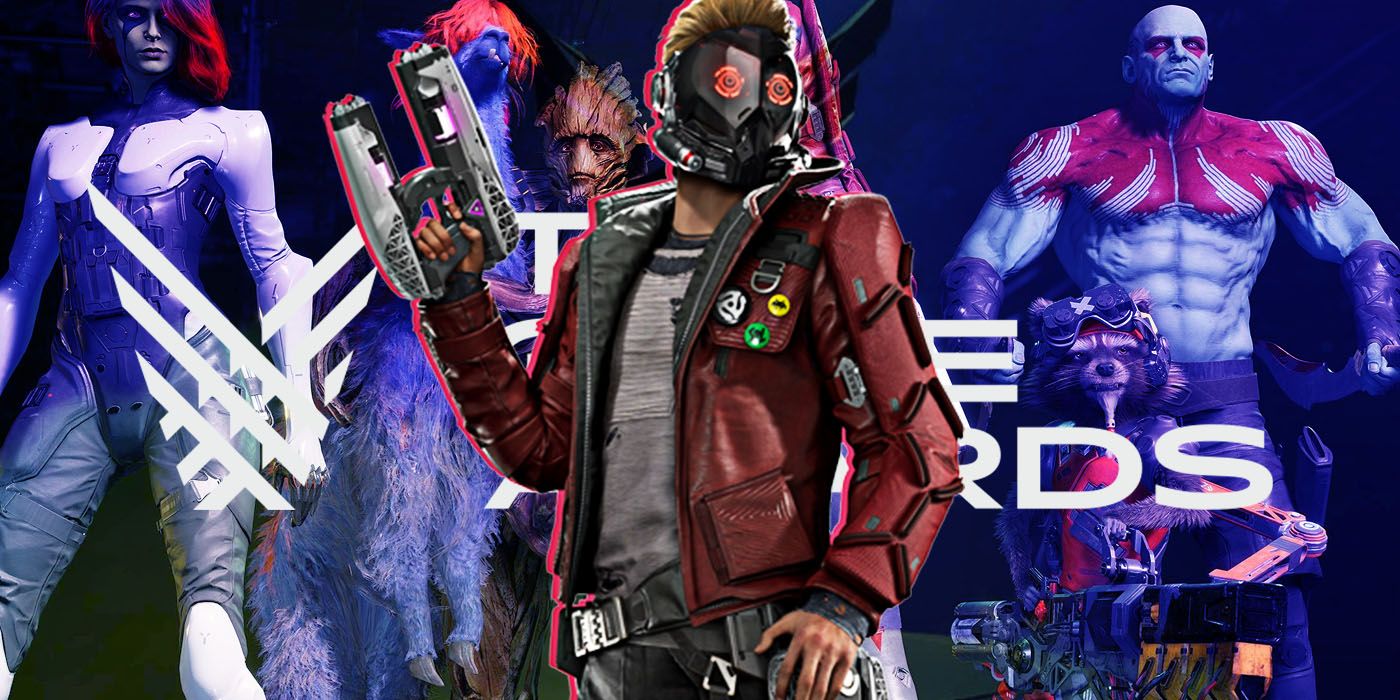
Marvel’s Guardians of the Galaxy was released Oct. 26 to general critical acclaim and glowing critical reviews. The game has now received four nominations at The Game Awards 2021, earning nods for Best Action / Adventure, Best Score and Music, Innovation in Accessibility and Best Narrative.
Guardians of the Galaxy isn’t a perfect game, but it deserves the win for Best Narrative. From gameplay design to solid foundations in storytelling and writing, Guardians crafts a well-thought and meticulous story. The game caters to fans of the comics and movies, as well as reaches for new audiences. Gamers don’t need to care about Marvel to enjoy Guardians of the Galaxy. The story shouldn’t have worked as well as it did, yet Eidos-Montréal pulled it off thanks to the game’s stellar narrative design.
No Unnecessary Details: How Guardians Uses Foreshadowing To Great Effect
Guardians hid and outright downplayed some of its biggest plot reveals. The first and easiest to miss was the early hint that Nikki would join the Guardians. When Rocket, Groot and Peter are in the Quarantine Zone trying to set up their monster-attracting machinery, Peter picks up a medical kit to inspect. Players may initially think this was a special collectible, but then Peter sets it down. He reveals that the medkit is tuned to Kree biology and says, “Too bad we don’t have a Kree on the team.” He’s alone in his opinion. The Kree have a less favorable reputation, and players are led to think of the scenario merely as another worldbuilding joke thanks to the ensuing banter.
The biggest act of foreshadowing was the nonchalant way the game’s true villain was revealed. Rocket and Peter are competing with each other to see who can shoot the most nests in the Quarantine Zone. When the final nest is destroyed, the Soul Stone falls to the ground and Peter and Rocket both lunge toward it. Peter grabs it first, then drops the stone when it burns his hand. He watches as an unidentified creature escapes from the stone.
Players know something’s up with that creature, but it reappears at the end of the Quarantine Zone level to defeat the Acanti and allow the Guardians to escape. Players could easily write off the whole scenario as one of extreme irony. Peter walks away without any loot and the monsters are attacking each other to allow the Guardians a sort of graceful retreat. Players come to discover that this one seemingly innocuous event is the basis for the rest of the game’s story.
Finally, the game teases its surprise boss when the Guardians are arguing over their con, and eventually woes, regarding Lady Hellbender. Drax repeatedly mentions Fin Fang Foom throughout the game and laments that they never went after the beast. Players don’t need to be familiar with Marvel lore to feel the excitement and anticipation when the team decides to hunt the dragon lord of Maklu IV in chapter 13. In fact, the game doesn’t assume the player has knowledge of everything relating to Marvel. Locations and people are introduced naturally, sometimes through offhanded remarks, other times through lore or events.
“We’re Just One Happy Flarkin’ Family” – Rocket
The Guardians are barely functional at the beginning of the game. Drax openly distrusts Gamora, Rocket misses the time it was just him, Groot and Peter (although mostly just him and Groot), and Gamora’s main tie to the team is Peter – and the contract she apparently signed to join the Guardians. They banter, fight, disband and eventually regroup only by necessity. By the end of the game, each character has overcome initial misgivings about the other members and instead openly supports each other.
Guardians is designed with such a strong narrative focus that dialogue in combat reflects the state the Guardians are in, and every collectible helps with the game’s worldbuilding. Problem-solving changes over the course of the game as well. Instead of Drax throwing Rocket across a chasm to lower a bridge, he’ll instead find a different object to throw and make a pathway. Instead of Rocket refusing to do what Peter asks him to do, Rocket will be one step ahead and offer his services. The writers managed to convincingly, and sometimes subtly, show the Guardians become a family.
Comedy Is Hard To Write And Guardians Makes It Look Easy
The best humorists accept that not every joke is going to land. The best humor is the sort that is still funny on subsequent tellings. Guardians manages to throw clever humor and wordplay at the player constantly, and the developers had the presence of mind to not try forcing humor onto the player. Credit also goes to the actors for the main cast, as their in-game chemistry and delivery helps bring the humor of the narrative alive throughout the game.
Ultimately, Guardians of the Galaxy knows where it stands. It can make fun of itself and its characters while still keeping the most ridiculous parts of the story serious enough – or cool enough – for players to play along. Most importantly, Guardians does not have filler. Every event leads necessarily to the next, and no loose ends remain by the end of the game. Guardians functions as a self-contained story while leaving room for more.
About The Author
