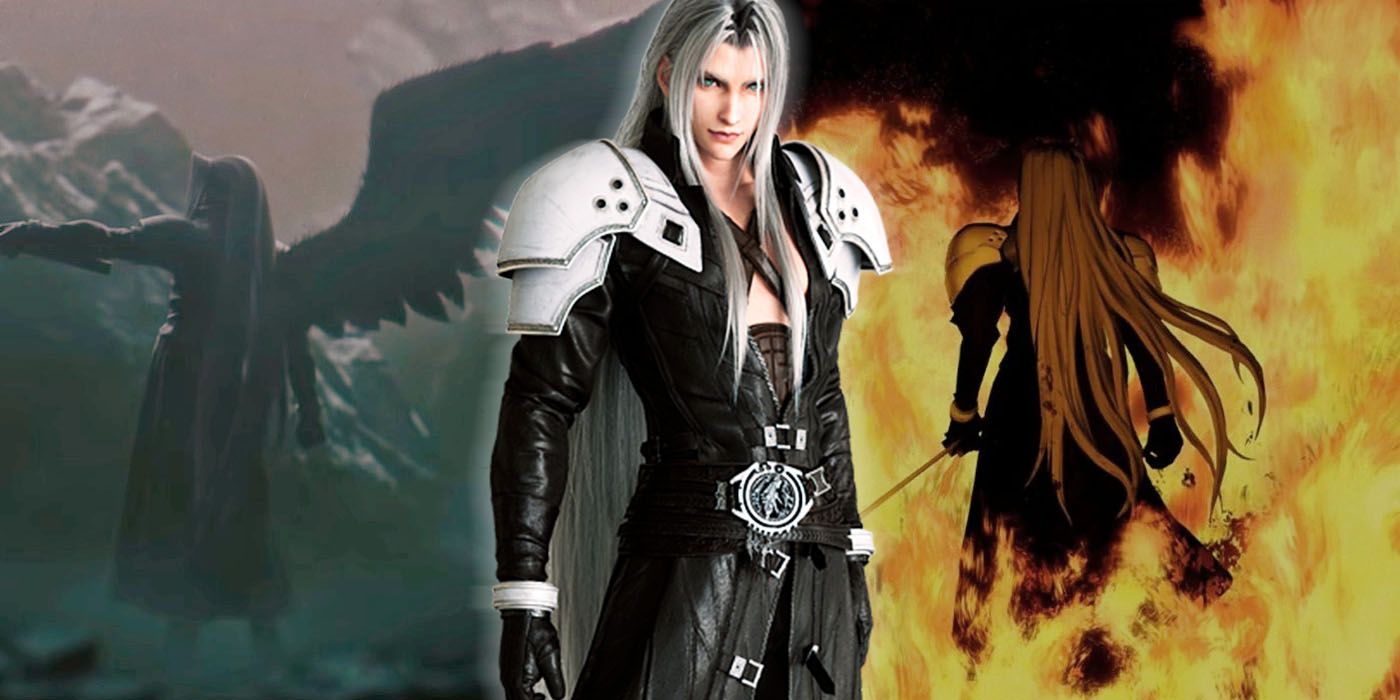
Final Fantasy is no stranger to body horror. Throughout the series’ lifespan, the games have thrown everything from rotting undead corpses to eldritch abominations at players. However, while such adversaries have existed since the franchise’s first title, it was arguably Final Fantasy VII that raised the bar thanks to the villainous Sephiroth. As the child of one of the game’s biggest antagonists and the product of flawed, amoral science, it goes without saying that the iconic enemy has a rather bizarre anatomy. While he looks human on the surface, the One-Winged Angel is anything but.
With powers that allow him to corrupt bodies and manipulate minds — plus the ability to survive serious injuries and inhospitable conditions — Sephiroth is probably closer to some kind of sentient plague or parasite than a person at this point. With Final Fantasy VII Remake underway, it’s likely that even more unusual additions will be made to the character’s anatomy and abilities. While there’s no way to tell what the future holds for Sephiroth, we can look back on his decades-long history and see just how far from humanity he’s strayed in his never-ending quest for godhood.
Sephiroth Isn’t Really Half-Alien
Sephiroth’s destruction of Nibelheim is one of gaming’s most-iconic scenes, but even some hardcore fans misunderstood his motivation for it. Prior to the massacre, Sephiroth discusses how the ShinRa Company “created” him thanks to a being called Jenova. Since he had been told that this entity was his mother, Sephiroth assumed he’s literally her biological child and set out to retake the Planet in her name.
However, this is far from the truth. Instead of being a half-alien hybrid, Sephiroth was born to human parents and injected with Jenova’s cells, giving him his notorious super-strength and speed. This is explained by Vincent Valentine, as well as his biological father Professor Hojo. Considering the depths of the latter’s depravity, however, one wonders whether being his offspring might be a worse fate than being Jenova’s.
Sephiroth Can Manipulate Alien Cells
In Final Fantasy VII lore, Jenova can influence any living creature contaminated with her genetic material. This manifests as a subtle form of brainwashing, not explicitly controlling others but pushing and directing them into carrying out her will. Surprisingly, despite not being her child by blood, Sephiroth demonstrates this same ability. However, his control goes beyond simply those implanted with her cells, extending to Jenova’s body itself.
Throughout most of the game, the hero Cloud and his allies pursue Sephiroth across the Planet in their quest for revenge. What they don’t realize, however, is that every sighting of the man was simply a piece of Jenova that had been transformed into a replica of Sephiroth. This is why every supposed encounter with him ends in a battle against one of her aspects. However, as the heroes learn, there is a very good reason why Sephiroth never directly engaged them in battle.
Sephiroth’s Body Is Already Half-Dead
In one of FFVII‘s most grotesque scenes, Sephiroth’s body is revealed as being already dead or dying. After his battle with Cloud in the game’s backstory, he was thrown off a bridge in a mako reactor, a power plant that harnesses the magical energy of the Planet. When his true body is finally revealed, so too are the full extent of his injuries. Specifically, he is missing the entirety of his lower body, only surviving due to being preserved in crystal.
As FFVII‘s script makes clear, extended exposure to mako can have adverse effects on the human mind and body. Considering the five year gap between the events of the Nibelheim massacre and the main game, it makes sense why Sephiroth’s true form is such a far cry from the mighty avatars he projects for most of the story. Having been reduced to such a weakened state after one fight with a powerless teenager was probably devastating for his ego.
Sephiroth Can Spit Into Remnants
Sephiroth may effectively be a corpse for most of FFVII, but that doesn’t mean he isn’t frustratingly difficult to kill. In fact, the sequel movie Advent Children revolves around this very concept. After his death in the original game, Sephiroth’s will manifests as three thoughtforms who spend the entirety of the story obliviously carrying out his will. They seek Jenova’s remains, through which Sephiroth is able to possess and overtake them, reviving himself.
While the practical mechanics of this aren’t particularly well-explained in the film, it does make some sense if one applies the game’s logic. If Sephiroth can turn Jenova’s biomass into copies of his body, and the remnants are just fragments of his mind, it stands to reason that he could recreate himself by combining them. However it’s supposed to work, the fact that he can keep coming back to life in this fashion makes him an incredibly persistent threat.
Sephiroth’s DNA Can Create a Pandemic
While Sephiroth is generally glorified throughout FFVII-related media today, the original story cast him in a more parasitic light. Not only does he constantly exploit others to achieve his goals, but his ability to consume the bodies of others has a lot in common with many real-world viruses. Advent Children arguably took this concept to its logical conclusion by having his very DNA pollute the Planet after his death, resulting in the Geostigma plague.
Those infected with Geostigma see their immune systems overcompensating to fight the incurable sickness, leading to sores, seizures and hallucinations. The cause of the sickness is explicitly referred to as the “Sephiroth Gene,” and the villain was able to spread it due to his corruption of the Planet’s very life force itself. While the heroes eventually find a way to overcome the virus, the gradual decay and destruction it wrought upon their would could, if left unchecked, have been just as dangerous as Sephiroth’s infamous Meteor.
About The Author