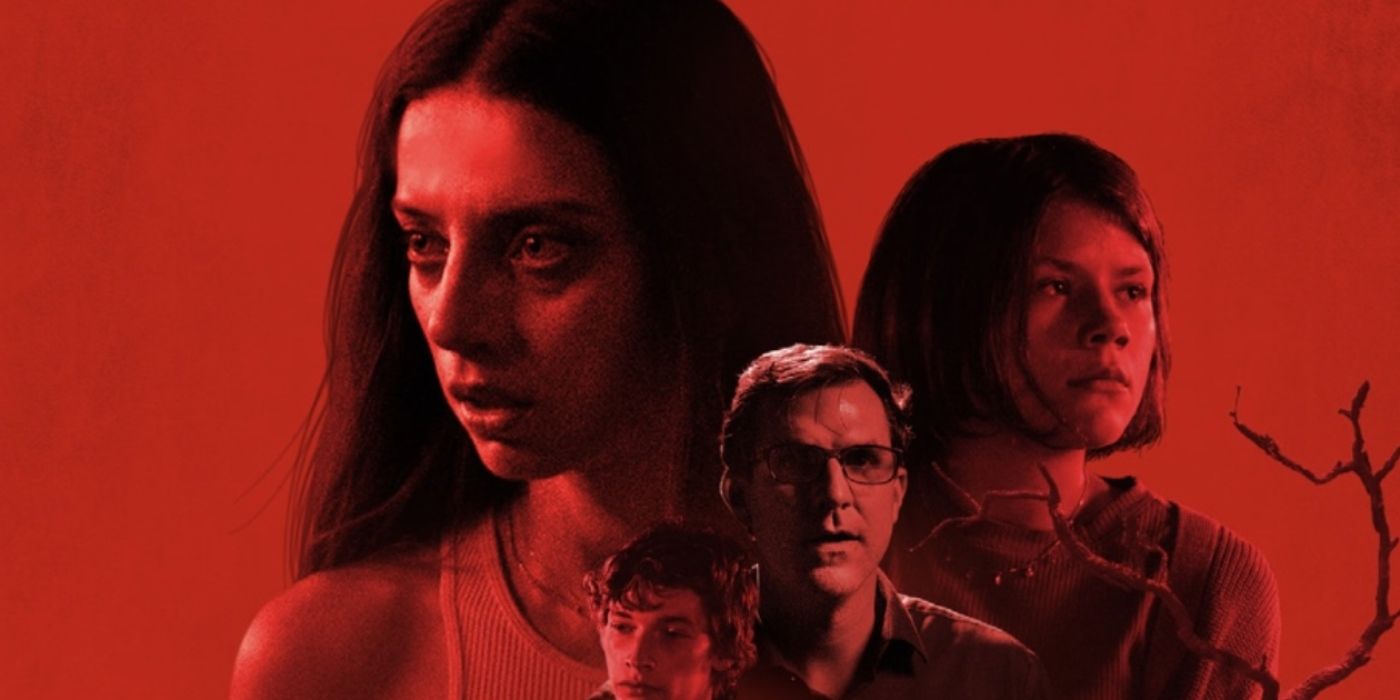
A House on the Bayou begins as a tight character drama focusing on Jessica (Angela Sarafyan) and John (Paul Schneider)’s fracturing marriage, which affects their relationship with their daughter Anna (Lia McHugh). Their situation quickly becomes even more complicated when their time together is interrupted by Isaac (Jacob Lofland), a devilishly charming young man who might actually be more frightening than he first appears. Despite some darker supernatural elements, the film never loses sight of the tense family drama at its heart, with the impressive cast elevating the nominally straightforward plot with painfully lived-in performances.
Speaking with CBR, Angela Sarafyan and Lia McHugh revealed which elements of their characters surprised them the most during production, what lessons they learned from each other as performers and the difference between tighter character dramas and big-budget projects like Westworld and Eternals.
CBR: A House on the Bayou gets to blend this very tightly focused character drama with elements from gothic horror in an interesting way. What attracts you, as performers, to projects like these?
Lia McHugh: It’s really just the storyline and the characters. I like to challenge myself and play characters that I haven’t played before and to understand the different mindsets of different people. My mom had a rough childhood, and I think by her telling me that type of story, and me understanding it, that’s a lot of what drew me to acting and to understanding different characters. I feel it’s really special when you can broaden your horizons and feel different emotions through movies. What drew me to this movie was the character and the storyline.
Angela Sarafyan: I was curious about who Jessica was, and what this relationship and her marriage was, and how [she and John] were going to try to reconnect. But what really interested me was consciously, sometimes we say we want one thing, but in life, something else happens. So, I thought maybe whatever’s happening throughout the film is a manifestation of what she subconsciously wants. So I was really fascinated to get to explore that specifically in the film and see who she is at the top of the film to the end and how that journey changes her.
You both get to go into some unexpected places with your characters. What would you say is the most surprising element you found during production that you hadn’t initially assumed about the role?
McHugh: [Angela and I] got together a few times, to read the script and read through scenes. There was a little different element that got cut from the film. I found that during filming, I realized a lot of Anna’s motivation is that she wants to be loved. I think through her parents’ turmoil, the attention deflects off of her because the parents are focusing on each other, even though they do still care about her. But as kids sometimes, you do overreact a little bit… so I found that her motivation in the film was wanting to feel loved, and whether or not that was like she was being immature and a little bit stupid because of that. She fell for this guy who was giving her what she thought was love and attention because she just wanted that so badly.
Sarafyan: I found surprising elements, not only on set but also off set. It was the unity of the people I’m working with and our dynamics. As we were doing the film, these moments were happening where it could be the wardrobe the other character’s wearing, somehow paralleled with my real life… I don’t want to get into specifics, but it was fascinating, the parallels and the lessons that I was learning throughout, working on it. So yeah, there were a lot of these kinds of moments, and I think I grew a lot working on it too.
Angela, I do also think you get a uniquely complex mission in the film while playing Jessica. She’s a sympathetic character, but not necessarily someone you find likable. What was it like to balance those two elements?
Sarafyan: I felt that in a way, the way Alex [McAulay] wrote the script, there is a danger where [Jessica] could almost be the villain or be mistaken for the villain in the beginning, which I thought was an interesting thing. So I was just going, “Well, okay. I’m curious about that.” I’m curious about being the person that’s like, “Do it this way. It’s got to be this; it’s got to be that.”
I like wavering between characters that are antiheroes, actually. I like not being the protagonist, necessarily. I’m just curious, because it makes them more three-dimensional. Because you can say, in one person’s story, you might be the hero, and in another person’s story, you might be the villain. So in this case, I think Jessica shapeshifts, even though she’s very strong in her morals.
Both of you — Lia with Eternals, Angela with Westworld — have experience tackling massive-scope storytelling. What would you say is the key difference between appearing in more character-focused material like A House on the Bayou and projects of that scope?
McHugh: I think it’s a timing difference. When I worked on Eternals, it was very slow. It was a six-month shoot. We shot a scene or two a day. But on A House in the Bayou, it was more fastly paced. It was like a month and a half we shot, and I worked every day but one. It was a lot of work, and I think what sort of made it easier for me was the bond that I had with Angela and Jacob [Lofland]. From the first or second day, Jacob was like, “You want to come to my room and help me read lines? I’m doing this audition and I need some help.” And I was like, “Yeah, sure! We just hit it off so quickly.”
Same with Angela. When we got to work, I and Jacob thought she was so interesting, and we’d be like, “Oh my gosh, she’s so fun! I love working with her.” I think that was the difference, I had to really put myself into this character and stay there, because it was a lot more fast-paced, and you get less chances when there’s less time in a day to make the scene perfect. So it’s really important that you just stay there in that moment and stay in the character’s seat. You can really get those scenes good.
Sarafyan: I love the point you’re making, Lia. That’s so interesting. Thinking about the six-month period and how things worked on Westworld, it’s very similar to what Lia’s saying. It was every day; we worked every single day. We were on set about 12 hours a day. It’s kind of fun, but also it was quite intimate, because we were together… we would go to set, work, come back, look at the scenes for the next day, basically sleep for four or five hours and go back to set. It felt like camp. I’ve never gone to it, but I imagine that’s how it is. So it was great, I love those kinds of intimate scenes.
What lessons would you say you learned from each other during production?
McHugh: Every movie that I do, I grow and I learn new things. It started out, I was like the little kid who has to be perfect all the time, so excited to be on set. It has grown to be more of a love for the work, and I feel like as I’ve gotten older, I’ve been more focused on really getting into the work. But in every movie, I feel like I change as an actor. I’ve changed so much since House on the Bayou. I learned so much on that film. I think what’s really cool is you get to watch other actors… you get to see the way that they work, and their work ethic. Angela and Jacob really pushed me. Every day on set, I wanted to be up to their level, and I wanted to impress them, in a way.
Sarafyan: I similarly was very challenged by Lia, and Jacob, and Paul [Schneider] too. I just remember that scene in the car, and there was something that was happening, where it was the merging of both the script and reality, because we were so intimate as people that I think that sometimes you get lucky, where you go, “See, it’s not about hitting something. It’s about knowing how you can touch the person that’s in front of you.” I would want to touch Lia with my words, and I want to reach her, and not just about saying the words because that’s what’s written in the page.
A House on the Bayou releases Friday, Nov. 19 on EPIX and Paramount Home Entertainment.
About The Author
