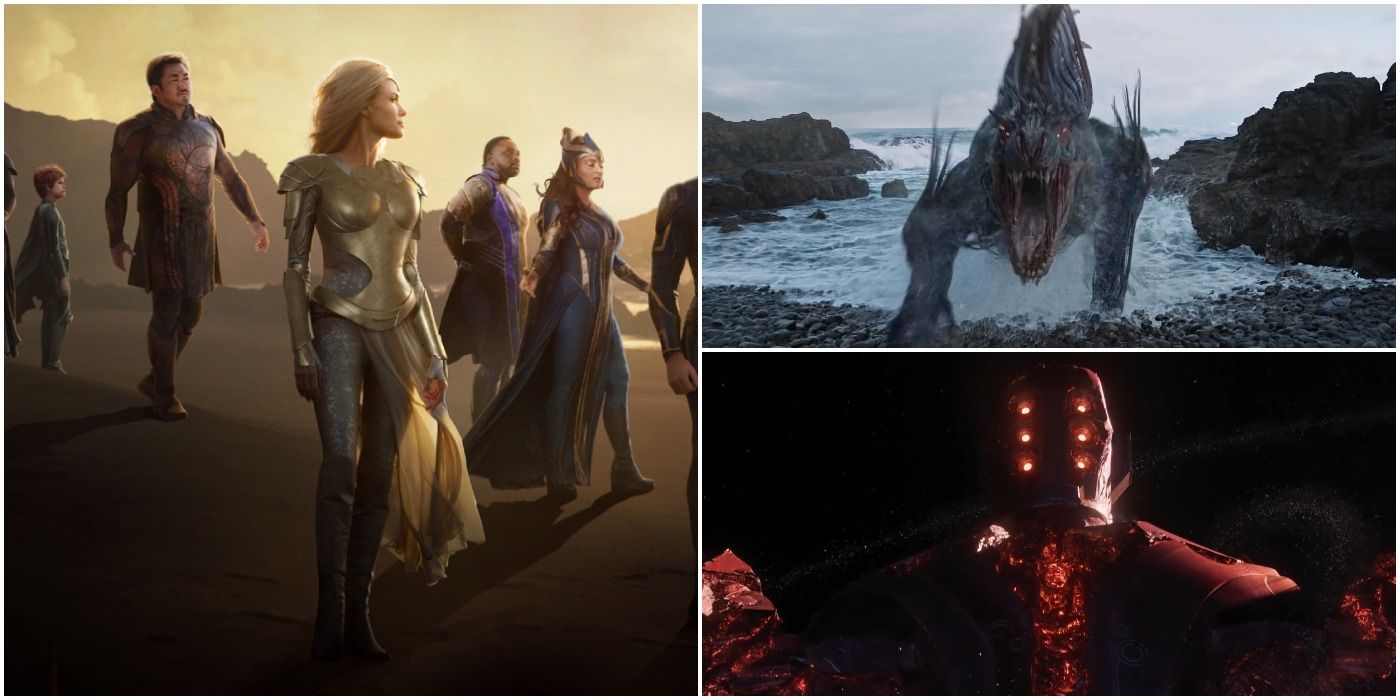
The third movie in the Marvel Cinematic Universe’s Phase Four, Eternals adds a whole new group of superheroes to the MCU’s already massive cast. The movie shares minor similarities with Guardians of the Galaxy, in that it tackles lesser-known characters from the comics.
But in almost every other way, Eternals is very different from Guardians, just like it is from other installments in the franchise. Eternals has a much darker tone than most MCU movies, to the point that the regular MCU humor – albeit welcome – doesn’t always come off as suitable. This creative decision is perhaps appropriate, though, as being an Eternal isn’t easy. Throughout Eternals, the characters have to face a lot of harsh realities.
11 Eternals Are Synthetic Beings Created By Celestials To Defeat Deviants
Eternals are originally presented as cosmic beings hailing from the planet Olympia. They come to Earth with a mission given to them by the Celestial Arishem – to defeat the deviants plaguing humanity. It’s not an easy task, but for a while, the Eternals believe they have been successful.
However, the Eternals’ origins hide a darker secret. The leader of the group, Ajak (Salma Hayek) is found dead, killed by deviants. She picks Sersi (Gemma Chan) as her successor. When she manages to communicate with Arishem, Sersi learns Olympia doesn’t exist at all. The Eternals are actually synthetic beings, created by Arishem with the specific purpose of accomplishing their task.
10 They Ensure The Birth Of Celestials By Facilitating Genocide
The truth about the Eternals’ nature is already dreadful, but it doesn’t even scratch the surface of the horrors the Eternals have to face. Sersi and the others believe they are meant to protect humanity. In reality, they have to simply ensure the growth of Earth’s population, for a far more brutal purpose.
The Celestial Tiamut is growing in the core of the planet and has to be fed by the life force of its people. Once the population reaches a certain number, Tiamut will be able to emerge, destroying the planet with its birth. Earth survives this fate, but Eternals makes it clear that other worlds haven’t been so lucky. Through their loyalty to Arishem, the Eternals have facilitated genocide many times in the past.
9 They Struggle With The Moral Dilemma Of Their Task
The concept of the Emergence is doubtlessly a monstrous one, as it involves the destruction of a whole planet. However, Celestials are vital for the growth and development of the universe. They are shown birthing suns and various worlds. Without them, countless lives will never exist.
As such, the Eternals have a difficult moral dilemma to face. Sacrificing Earth and its people would presumably lead to the development of many other planets and species, but it would also kill billions. No matter what they choose, it’s still a loss.
8 Eternals Die And Are Reset After They Accomplish Their Mission
Assuming the Eternals accomplish their mission, they die alongside everyone on the planet they inhabit during each Emergence. Their identities are preserved through their bond with the Celestials, and they are brought to life again with their memories of their ordeal forgotten. The circle continues ad nauseam, with Arishem constantly resetting their minds and making them think they have a past beyond their current role.
7 They Can Become Mentally Ill If Their Memories Are Imperfectly Wiped
Even the Celestials can make mistakes. The deviants are the first example, as they were originally crafted by Arishem with the same basic purpose as the Eternals – to defeat the apex predators on each chosen planet. They are highly effective, but Arishem loses control of them due to their ability to evolve. Eternals are meant to overcome that flaw through their synthetic nature, but things don’t always go as planned. The mind-wiping process that takes place after each Emergence is sometimes imperfect, leaving traces behind.
The memories manifest into the disease Mahd Wy’ry, which causes the afflicted Eternal to attack their teammates. In Eternals, the warrior Thena (Angelina Jolie) suffers from this illness and comes close to giving up her memories because of it. In the end, that doesn’t happen, as Gilgamesh (Ma Dong-seok) takes charge of her. The two retire together to Australia and leave there peacefully until the reappearance of the deviants.
6 Their Bodies Aren’t All Created Equal
Considering their origin, one would think that Eternals would be physically “perfect” in every way, but Mahd Wy’ry isn’t the only problem they suffer from. Sprite (Lia McHugh) is stuck in a permanently childlike body, even if she has seven thousand years’ worth of memories. This is incredibly painful for her, and makes her romantic feelings for Ikaris (Richard Madden) impossible to pursue.
Meanwhile, the speedster Makkari (Lauren Ridloff) is deaf. The reasons for her disability are unclear, though they could be related to her skills. It is definitely nice to see a deaf person as a superhero, but one has to wonder why the Celestials would give their creation such an obvious disadvantage.
5 They Are Kept From Helping Humanity By Arishem’s Commands
The Eternals’ presence on Earth rotates around one single thing – the Deviants. They’re only allowed to protect humanity from this particular threat, and aren’t supposed to get involved in everything else. This serves as an explanation for the fact that they never helped the Avengers during their previous battles with world-ending threats like Thanos.
The concept doesn’t make sense considering the end goal of the Emergence. Many Eternals aren’t happy with it either. Druig (Barry Keoghan) grows disenchanted with the idea and defies Ajak to stop a conflict between humans. The method he uses – mind-control – is less than ideal, but he does want to protect humanity from itself. This major disagreement is part of the reason the Eternals separate and go their own way.
4 The Technology Eternals Offer Can Do More Harm Than Good
The inventor Phastos (Brian Tyree Henry) wants to share the Eternals’ technology with humanity. He later finds in shock that his good intentions can lead to disastrous results. It’s unclear what kind of involvement Phastos had in the development of the atomic bomb, but he blames himself for the tragic events in Hiroshima.
The scene has displeased some viewers, as it takes away a large part of humanity’s autonomy and responsibility, placing it on the shoulders of a convenient godlike figure. It doesn’t help that Phastos is the MCU’s first gay superhero. His involvement in the incident is likely indirect, but it’s still not an ideal approach.
3 Their Power Helps Deviants Evolve Further
While the team of Eternals is overwhelmingly large, there’s a good reason for its size. The deviants are tough opponents to handle. Incredibly fast and strong predators, they are difficult to take down even by an Eternal. To make matters worse, deviants can feed on the powers of their enemies. When Ajak falls prey to the deviants, their leader Kro inherits her regeneration abilities.
Gilgamesh’s death – also at Kro’s hands – gives Kro both Gilgamesh’s exoskeleton manifestation power, and the ability to speak and reason. It’s unclear if other deviants can do something similar, but it seems likely that they’re at least capable of evolving in this direction.
2 Eternals Are Actually The Bad Guys
As terrifying and lethal as deviants can be, they are just trying to survive. Originally used as tools by Arishem, they are hunted down and killed once they become a hindrance. The deviants have no interest in destroying Earth, for the simple reason that they need the planet to live. The Eternals cannot say the same. If there is anyone who is villainous here, it’s Arishem, and by extension, the Eternals.
1 They Turn On Each Other For Divided Loyalties
To give the Eternals some credit, they do try to find a better solution for their predicament. Many of the group’s members feel the birth of Tiamut isn’t worth the high cost. Sersi, Phastos, Thena, Druig, and Makkari fall in this category. So does Ajak, who – despite being the Prime Eternal – changes her mind about their mission.
However, not everyone is comfortable with betraying Arishem. When Ajak tells Ikaris about her new opinion, he feeds her to the deviants, still loyal to the Celestial. Sprite joins his side due to her feelings for him. Kingo (Kumail Nanjiani) is a more complicated case. He agrees with Ikaris, but doesn’t wish to fight his friends, so he stays out of the conflict. In the end, the divided loyalties of the Eternals are what lead to the deaths of so many of them.
About The Author
