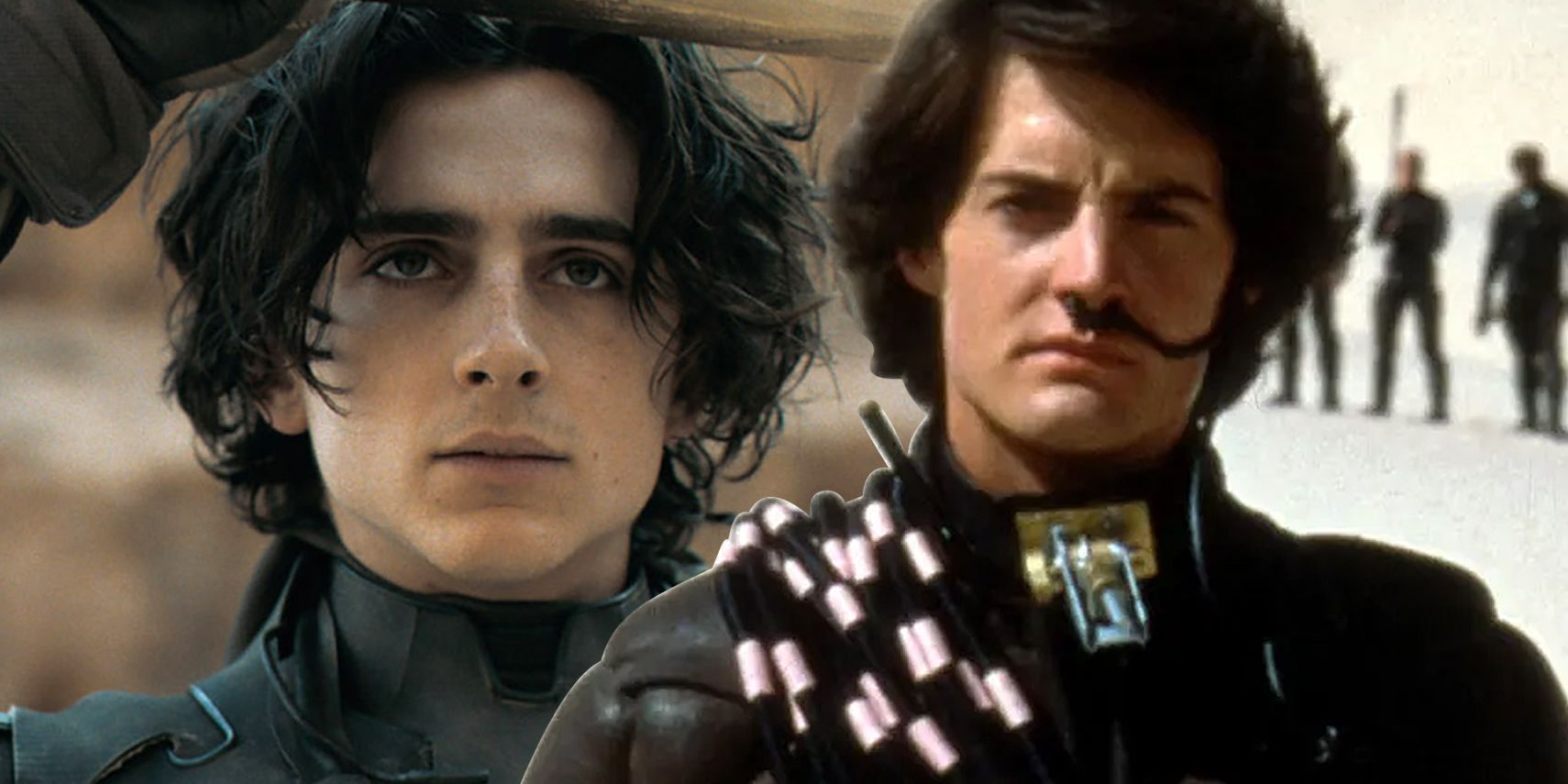
Before Denis Villeneuve dominated the box office with his critically acclaimed adaptation of Frank Herbert’s science-fiction epic Dune, David Lynch attempted the same in 1984. Unfortunately, the movie didn’t just bomb, but Lynch disowned it.
As flawed as Lynch’s Dune was, it did get some things right. Besides giving the 1984 movie its oddball charm, these quirks are actually improvements to the 2021 version. Lynch’s Dune is a silly guilty pleasure, but it shouldn’t be ignored entirely.
Spoiler Warning: The following list contains spoilers for both versions of Dune.
10 The Unforgettable Soundtrack By Toto
One of the first Dune‘s weirdest creative decisions was getting rock band Toto to score it. Even if they did create the legendary song “Africa,” they’re the last band anyone would associate with the deserts of Arrakis. Nowhere is this more evident in the closing cast montage, which had the ballad “Take My Hand” playing over it.
But as jarring as the combination of Toto and Dune may be, the band gave Lynch’s movie an unironically great soundtrack. Meanwhile, Hans Zimmer’s score for Villeneuve’s movie is good, but isn’t exactly his most memorable. Where Zimmer’s atmospheric score faded into the background, Toto’s music really called attention to itself.
9 It Told A (Mostly) Complete Story In One Sitting
One of the best and worst things about Lynch’s Dune is how it condensed the generations-spanning book into one movie. While this led to character arcs getting abruptly cut (such as Duncan Idaho’s) and years’ worth of story being rushed through, Lynch’s Dune is still a mostly coherent movie with a clear beginning, middle, and resolution.
In contrast, Villeneuve’s Dune is an incomplete story with too many cliffhangers. If not for its recently greenlit sequel, Dune: Part One would barely stand on its own as a prequel to its more interesting conflicts and ideas. It’s hard not to get the feeling that Part One was more interested in impressing viewers with its world, not telling a story.
8 Its Pacing Is More Accessible Than The 2021 Version
Since it was directed by Villeneuve of Incendies fame, the first chapter of his two-part Dune is unsurprisingly deliberate and slow in terms of pacing. That said, it’s slow even by his standards. Clocking in at two hours and thirty five minutes, Villeneuve’s Dune took its time setting up what’s essentially the prologue to Paul’s forthcoming saga.
Contrast this to Lynch’s Dune which had a similarly long runtime, but told a more complete story. Because it compressed an entire novel into one movie, its pacing was snappier. Whether or not this was a good thing is subjective, but for some viewers, Lynch’s faster-paced attempt at a blockbuster is easier to digest than Villeneuve’s meditation.
7 Its Art Design Was More Alien & Bizarre
If there’s one thing Lynch’s Dune can’t be faulted for, it’s production design. Thanks to distinctly Lynchian creative choices like the Eraserhead-esque Guild Navigator, its look at the Atreides’ heightened opulence, and the disgusting Harkonnens. That said, it’s hard not see Villeneuve’s desaturated Dune as a direct rebuttal to Lynch’s camp.
Like how Christopher Nolan responded to Joel Schumacher’s campy Batman And Robin by excising all artifice for his own Dark Knight trilogy, Villeneuve demanded brooding realism in an adaptation of a grandiose and metaphysical sci-fi epic. Just because Arrakis is a barren desert doesn’t mean there’s no room for creative flourishes and madness— Mad Max: Fury Road is a perfect example of this.
6 Its Characters Were More Iconic & Memorable
More than anything, Dune is a deconstruction of the messianic hero’s journey, and its characters are proof of this. If anyone adapted them as faithfully as possible, they’d feel flat because they’re more deconstructions of literary archetypes than fleshed out people. Both Dunes faced this challenge, but Lynch’s take won out— even if it was somewhat by accident.
Since Lynch’s Dune was an ill-conceived attempt to imitate Star Wars, its characters were exaggerated and turned into larger-than-life heroes and villains to make them more mainstream. Villeneuve did the opposite, grounding everyone in so much realism that they were reduced to mouthpieces for exposition and functional dialogue.
5 Its Characters Felt More Human & Realized
Both Dunes— neither of which are especially faithful to the books, to be fair— boasted powerhouse casts, but Lynch did a better job at maximizing his stars. Not only were characters like Feyd-Rautha or the Lady Jessica more memorable thanks to the aforementioned exaggerations, but they were allowed to cross paths, making their final reunions and clashes feel earned after having established those relationships so well.
As for Villeneuve’s Dune, if his cast wasn’t too spread apart, they barely had any screen time at all. More than once, no more than two characters shared a scene only to coldly explain more plot and worldbuilding, not give their world some humanity. For example, Dr. Yueh’s betrayal in Lynch’s movie had more gravitas than his perfunctory turn in Villeneuve’s.
4 The Fremen Were Actually A Part Of The Plot
The bitter irony of the Dune movies is that even if they’re set on the Fremens’ colonized home planet, the race are treated as little more than plot devices. This is a problem that afflicted both movies, but Lynch’s Fremen had it better than Villeneuve’s thanks to the simple fact that Lynch completed their story instead of leaving it hanging.
In a vacuum, Villeneuve’s Fremen delivered exposition, promptly disappeared, and then returned in the third act to tease the sequel. At most, Chani cameoed in Paul’s dreams. Lynch’s Fremen did the same things but with the benefit of a finished story, they joined Paul’s revenge, made true their prophecy, and reclaimed their home world.
3 The Harkonnens’ Presence Was Better Felt In 1984
Despite their limited screen time and only confronting Paul near the end, the Harkonnens are Dune‘s most well-known antagonists. Before that point, the Baron Harkonnen and his nephews schemed with the emperor while ruling over House Atreides’ ruins. Both movies’ Harkonnens did the same things, but their Lynchian incarnations made the better impression.
Even ignoring their lack of screen time which hamstrung their full potential, Villeneuve’s Harkonnens were just as stern and stoic as everyone else, making it hard to stand out. Meanwhile, Lynch’s Harkonnens were cackling maniacs who relished in their vices. As campy as they were, Lynch’s Harkonnens could at least be more readily remembered than Villeneuve’s.
2 Paul Atreides Had More Agency
A major drawback of Villeneuve’s Dune getting split into two was that Paul’s central arc of coming to terms with his supposed godhood was left hanging at the end of Part One. Because of this, Paul’s identity crisis and confusion took up an entire movie, leaving him with little to no agency and motive as he’s dragged from one predestined scenario to the next. In brief, Part One was just the dragged out prelude to Paul’s actual story.
Even if Lynch’s Dune unwisely ignored the books’ deconstruction of the messianic figure by turning Paul into Arrakis’ literal savior, his arc is better by virtue of being complete. Besides that, the 1984 cinematic version of Paul chose to fulfill his destiny as the Lisan al Gaib halfway through the movie, whereas the 2021 Paul only realized he had that choice near his movie’s end.
1 It Wasn’t Afraid To Get Surreal & Weird
What makes Dune iconic, revered, and intimidating all at once isn’t its dense history and text, but its esoteric side. The Spice alone is the perfect summation of this, since it’s both fuel and the hallucinogenic bridge between the physical mind and the cosmos. It’s no wonder its adaptations attracted surrealists like Lynch and Alejandro Jodorowsky.
The brutalist Villeneuve, however, is those two’s antithesis. While the abstractions are probably being saved for the sequel, Part One didn’t even bother with them. At most, Paul had vague dreams that were lit differently than his waking life. Lynch’s Dune really is an oddity, but at least it didn’t feel as if it were ashamed or dismissive of its source material’s strangeness.
About The Author