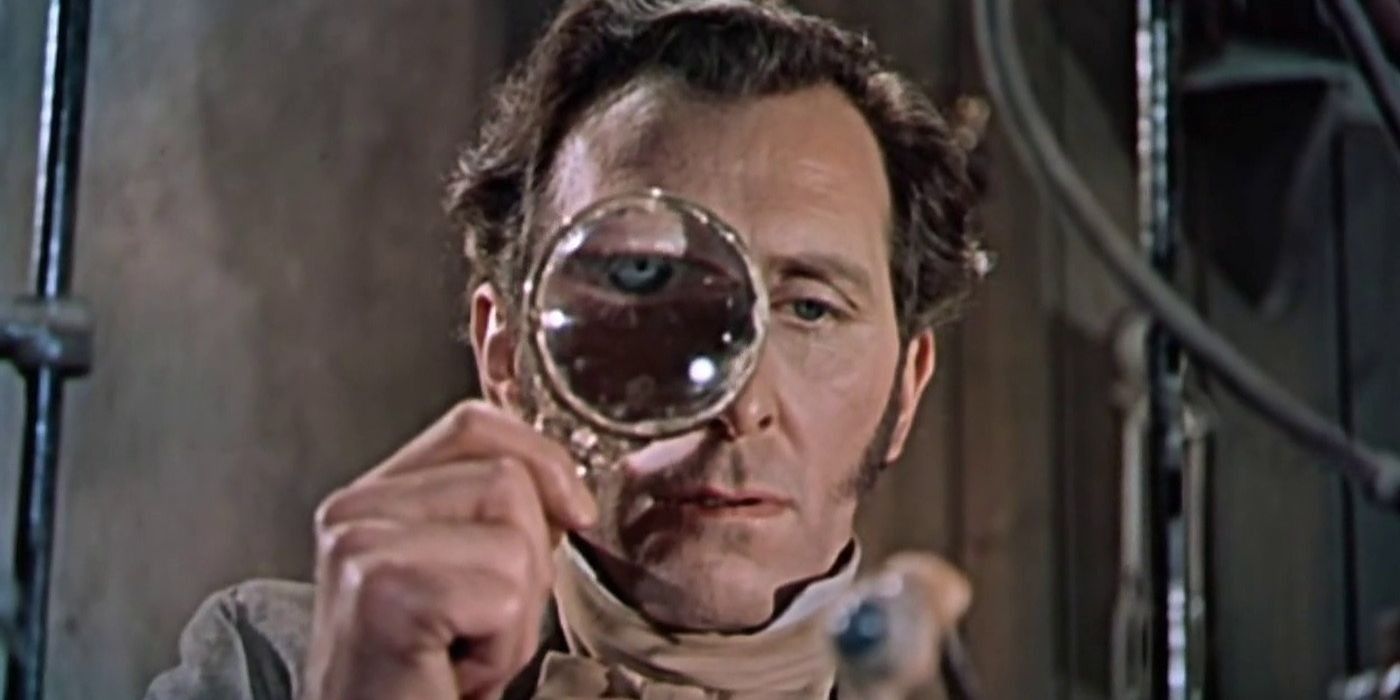
When movie fans think of Peter Cushing the first character that comes to mind is Grand Moff Tarkin in the original Star Wars movie, but the second most iconic role of his illustrious career is as Dr. Frankenstein in the Hammer Films franchise of the same name. While Universal’s famous Frankenstein films followed the actions of the creature, Hammer focuses on the mad creator himself. Even as the quality of the film’s in Hammer’s franchise declined, Cushing’s performance throughout the series is compelling enough to make each movie worth watching.
Here are all seven Hammer Frankenstein films ranked according to an aggregate of critics ratings on Rotten Tomatoes, and for the franchise’s original film, The Curse of Frankenstein — the only one with an official ranking on Metacritic — the average between its Rotten Tomatoes and Metacritic scores.
The Horror of Frankenstein – Rotten Tomatoes: 55 Percent
It makes sense that the lowest rated Hammer Frankenstein film is the only one without Peter Cushing involved. The Horror of Frankenstein from 1970 is actually supposed to be a comedic remake of the original The Curse of Frankenstein with Ralph Bates taking over as the titular character. While Grand Moff Tarkin isn’t in this film, Darth Vader is. David Prowse played the role of Frankenstein’s creature in Horror seven years before donning Vader’s suit. Critics were mixed on the remake, with New York Times reviewer Howard Thompson writing, “The film shatters, with awkward horror pitted against rather bland sheepishness. But it was good fun while it lasted. Hammer almost had something special.”
Frankenstein and the Monster from Hell – Rotten Tomatoes: 57 Percent
David Prowse returns in 1974’s Frankenstein and the Monster from Hell as The Creature. In this last entry in the Peter Cushing franchise, Frankenstein hides as the Doctor in an insane asylum so he can continue his mad experiments. Just by looking at the design of Monster from Hell’s Creature, it’s clear Hammer was struggling to find a refreshingly creepy monster and instead made one that looks ridiculous. Even with those flaws it falls just short of being fresh on Rotten Tomatoes at 57 percent. The most recent review from Gone With The Twins writer Mike Massie states, “Were it not for the odd moment of slapstick, the notions of playing god and of psychological torture and of uncontrollable rage would be genuinely terrifying.”
The Evil of Frankenstein – Rotten Tomatoes: 57 Percent
The third Hammer Frankenstein film, 1964’s The Evil of Frankenstein takes a step back from its groundbreaking predecessors, even with a Creature that closely resembles Boris Karloff’s iconic Universal monster. Only seven critics on Rotten Tomatoes reviewed Evil, which received a score of 57 percent, although out of 1000 audience reviews, only 36 percent view the film favorably. Antagony & Ecstasy writer Tim Brayton sums up the disappointment, writing, “It’s pretty wan and spotty, in fact, though probably not as bad as the most rabid of Hammer fanatics would have you believe. Certainly, it is a stunningly terrible sequel.”
Frankenstein Created Woman – Rotten Tomatoes: 62 Percent
A decade after it began, Hammer’s Frankenstein attempted to change with the times in 1967’s colorful and chaotic Frankenstein Created Woman. While Baron Frankenstein remains the catalyst of the events in the film, the star is his first female Creature. Frankenstein’s assistant Han was wrongly framed and executed for a crime he didn’t commit, prompting his lover Christina to commit suicide. Frankenstein transfer’s Han’s soul into Christina’s body, compelling the Creature to exact revenge against those who wronged them. This unique approach to the story was good enough to earn a fresh rating on Rotten Tomatoes , with ESplatter writer Luscius Gore observing, “The same year as ‘Sgt. Pepper’s Lonely Hearts Club Band’ and the Summer of Love, Hammer Studios decided to make a great Cushing Frankenstein film.”
The Curse of Frankenstein – Average Score: 68.5 Percent
The film that made Hammer into a legitimate horror factory and turned both Cushing and Christopher Lee into genre icons is this first film in the Frankenstein franchise, 1957’s The Curse of Frankenstein. It’s the only movie in the series with a Metacritic score, but falls a point short of being considered a “Good” film on the aggregator. On the other hand, it’s the most popular and praised film of the Hammer Frankenstein franchise on Rotten Tomatoes, with 78 percent. As the Creature, Lee balances fear and sympathy, but it’s Cushing’s obsessed scientist who owns the show, demonstrating the creator, not the creature, is the true villain. Variety put it best: “Peter Cushing gets every inch of drama from the leading role, making almost believable the ambitious urge and diabolical accomplishment.”
Frankenstein Must Be Destroyed – Rotten Tomatoes: 70 Percent
Most horror franchises decline with each sequel, but remarkably, the fifth film in Hammer’s Frankenstein series, 1969’s Frankenstein Must Be Destroyed, is the third-highest rated on Rotten Tomatoes. Seven out of 10 critics on the aggregator praised the film, along with 68 percent of the site’s 2500 audience reviews. Baron Frankenstein’s pursuit of perfection reaches near insanity when he attempts to transplant the brain of his former associate into another body to learn his secret formulas. The ambiguous ending in which the Creature carries Frankenstein into a burning house remains the most memorable climax in the series. Alternate Ending’s Tim Brayton remarked, “For those of us who love Hammer horror, this is an unmarred example of all the reasons why.”
The Revenge of Frankenstein – Rotten Tomatoes: 87 Percent
The first sequel in the series, 1958’s The Revenge of Frankenstein, is a worthy follow-up to the original classic. Baron Frankenstein survives the devastating events of The Curse of Frankenstein and escapes to Germany to create a new and improved Creature. Critic David Parkinson from Time Out best explains why it has a score of 87 percent on Rotten Tomatoes: “In one of his best performances, Cushing plays on the ambiguity of the central character, so that the Baron becomes a kind of Wildean martyr, alternating between noble defiance and detached cruelty.”
About The Author
