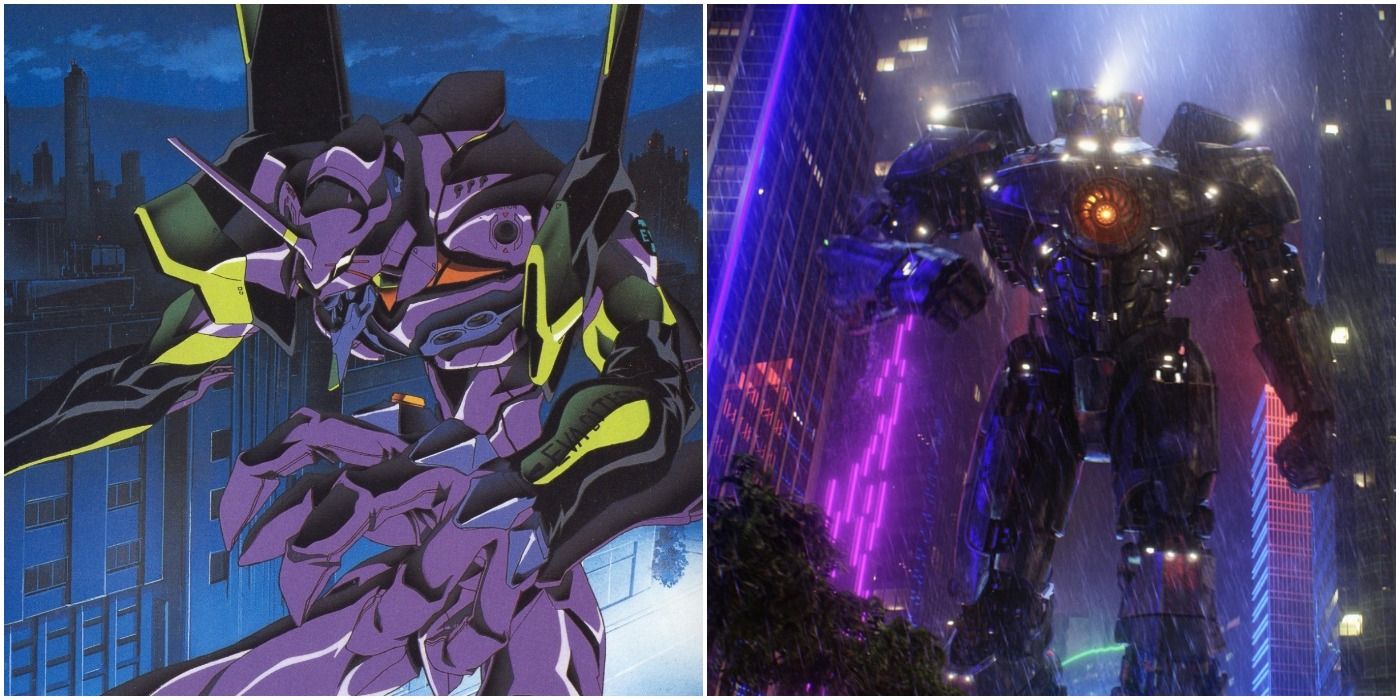
Pacific Rim is an eye-popping homage to two of Japan’s biggest pop culture creations: mecha anime and kaiju films. If there’s one anime that has been cited as particularly similar to Pacific Rim, it’s Studio Gainax’s Neon Genesis Evangelion. The similarities may be unintentional – director Guillermo Del Toro has never seen Evangelion and co-writer Travis Beacham after his work on Pacific Rim.
Coincidental as they may be, the similarities are there. However, there’s plenty to differentiate the two works as well. There are numerous big similarities and differences between Pacific Rim and Evangelion.
10 The Same: The Premises Are Undeniably Similar
In the near future, mankind is besieged by enormous, monstrous beings who desire our extinction. To counter this offensive, humanity constructs humanoid weapons of the same size as the monsters – weapons that require human pilots. In these broad strokes, Evangelion and Pacific Rim sound virtually identical.
There’s also the key role the ocean plays in both. In Evangelion, the cataclysmic “Second Impact” (caused by the awakening of Adam, the first Angel) turned the oceans red and wiped out marine life. In Pacific Rim, the Kaiju emerge from a dimensional breach on the floor of the Pacific Ocean.
9 Different: The Tones Are Totally Unalike
The biggest difference between the two is their tones. Evangelion starts off relatively conventional, but about halfway through it switches gears, becoming more psychedelic, introspective, and horrifying. Series creator Hideaki Anno was inspired by Freudian psychology, particularly the “Hedgehog’s Dilemma” (how getting close to others increases the risk of hurting them or being hurt ourselves), a thesis on which the series’ themes and character arcs are built.
Pacific Rim, however, is pomp and spectacle through-and-through. It’s nerdier and more earnest than most modern, Michael Bay-flavored blockbusters that come out of Hollywood these days, but it’s still much more straightforward than Evangelion is. This isn’t a flaw, though – what Pacific Rim sets out to do, it accomplishes, thanks to the stunning action, dazzling colors, and the rock-flavored score (composed by Ramin Djawadi with some help from Rage Against The Machine‘s Tom Morello).
8 The Same: Pilots “Syncing” With The Mechs
The robots may be the most eye-catching sight in Mecha stories, but these enormous robots wouldn’t be doing anything without their pilots. In both Evangelion and Pacific Rim, a major point is made of pilots “syncing” in order to operate their respective mech.
The mechanics are a bit different though. In Pacific Rim, the Jaegers require two adult pilots, for one mind can’t bear the strain of operating something so enormous. To work together as one, the pilots must share a mental meld called a “drift.” In Evangelion, the EVAs technically need two pilots as well, but in a more abstract way – the EVAs are animated by the souls of humans, and the pilots need a connection with that soul to operate the EVAs. Shinji and Asuka are chosen as pilots because their mothers’ souls reside in Units 01 and 02, respectively.
7 Different: The Nature Of The EVAs Vs The Jaegers
One of Evangelion‘s big twists on the mech anime is that the EVAs weren’t “robots” in the strictest sense, but instead cyborgs. In fact, the EVAs are clones of the Angels, albeit lobotomized and outfitted with robot-esque armor/restraints to keep them under human control. Whenever EVAs are damaged, their organic nature tends to be revealed.
The Jaegers, on the other hand, are much more straightforward robots, composed entirely of metal and with no organic components besides the pilots themselves.
6 The Same: Mechas, Need A Hand?
One of the most famous fights in Evangelion happens in Episode 19, with the arrival of 14th Angel Zeruel. Unit-01 loses power and its left arm to Zeruel, but reawakens in “berserk” mode, regrows the arm free of armor (or, in the Evangelion 2.0 recreation of the scene, generates an energy-replacement) and devours Zeruel.
Gipsy Danger, the main Jaeger in Pacific Rim, loses both of its arms at separate intervals in the story. First, its left arm is torn off by Knifehead in the opening scene, then later it loses its left to Raiju.
5 Different: The Nature Of The Angels And The Kaiju
Evangelion takes a “show, don’t tell” approach to explaining its lore – one thing only spelled out in supplementary material is that the Angels are not extraterrestrial. They’re just as native to Earth as humans are – the Angels are all descended from Adam (the Seed Of Life), just as humans are descended from Lilith (the Seed of Knowledge). The Kaiju, on the other hand, hail from an alternate dimension and are not natural beings like the Angels. Instead, they’re bio-weapons designed by inter-dimensional invaders.
Aside from their origins, the Angels are also much more wide-ranging and sometimes abstract in appearance – the 5th Angel, Ramiel, was simply a giant, blue, floating octahedron. In contrast, the Kaiju are more uniform in their appearance as huge reptilian monsters with individual features inspired by Earth fauna.
4 The Same: Shinji & Raleigh Are Both Reluctant Pilots
Shinji Ikari is summoned to Tokyo-3 to pilot Unit-01 – he only agrees to do so when he learns that an injured Rei Ayanami will take his place if he refuses. Raleigh Beckett, on the other hand, is introduced as a Jaeger pilot, but leaves it behind after the death of his brother Yancy in the Knifehead fight.
Raleigh quickly answers the call to return, with some encouragement from Pentecost being all he needs. Shinji, on the other hand, consistently struggles with the weight of his duties and why he pilots the EVA in the first place – his uncertainty leads him to quit a couple of times over the course of the series.
3 Different: Gendo Ikari And Stacker Pentecost Are Polar Opposites
NERV Commander/Shinji’s father Gendo Ikari and Marshall Stacker Pentecost serve similar roles as the overseer of the Eva/Jaeger programs. Personality-wise, however, they could not be more different. Whereas Gendo is cold, calculating, and selfish, Pentecost is brave, inspiring, and heroic.
Pentecost, a former Jaeger pilot himself, even leaps back into the battle for the film’s third act, on the heel of a rousing speech to end all others – “Today, we are canceling the apocalypse!” Compare that to Gendo, who plans to burn the world to the ground in service of his own self-centered machinations and desires.
2 The Same: Rei Ayanami And Mako Mori Are Similar On The Surface
On the surface, Rei Ayanami and Mako Mori are the most similar characters between Evangelion and Pacific Rim. Both quiet and withdrawn, both the surrogate daughter of the garrison commander, both wear their blue hair in bob cuts, and, of course, both Mech pilots.
The Japanese dubbers of Pacific Rim must have noticed the similarities, since they cast Megumi Hayashibara, the voice of Rei, to dub over Rinko Kikuchi’s performance as Mako.
1 Different: Rei & Mako’s Backstories
However, beneath these surface-level similarities, Rei and Mako are quite different. For one, their backstories – Rei isn’t technically human, but a clone of Yui Ikari with the soul of Lilith stuffed inside. She also isn’t an individual, but rather a series of clones, so if she dies, she’ll be replaced by the next in the series.
Mako, on the other hand, is a totally normal human – her family was killed when a Kaiju attacked Tokyo, but her life was saved by Pentecost piloting the Jaeger Coyote Tango. This makes Mako is a much more driven character than Rei. Whereas Rei has no motivation beyond what she is told to do, Mako wants to pilot a Jaeger to avenge her family – Mako’s backstory and motivation actually share more with Evangelion‘s Misato Katsuragi than Rei.
About The Author