In the world of anime, it’s very common for things to get lost in translation. Even when a dub or subtitled version tries to be as accurate as possible, sometimes it’s just inevitable for things to get lost when transitioning from one language to another.
Sometimes, it’s a quirk of the language, like gendered language or different translations of what can only be described with one word in another language. There can be Japanese proverbs or idioms that are familiar to native speakers but would confuse English speakers. Oftentimes, language isn’t directly an issue; it’s just the way things are translated. For example, a joke on two characters sharing an actor in Japanese doesn’t make sense in English if they are voiced by different people.
10 Bleach: There Are A Lot Of Puns In Ichigo’s Name
In anime, character’s names are often untranslatable puns, and this can be seen with Kurosaki Ichigo of Bleach. His full name can mean “protector.” However, when pronounced, his first name sounds like the words for “one” and “five.” The number 15 becomes a running joke in the series because of this. It’s Ichigo’s age, and the number can even be seen as a decoration in his bedroom.
Another pun that actually gets brought up in the series is that Ichigo can also mean strawberry, which can be seen as a reference to Ichigo’s red hair.
9 Sailor Moon: The Sailor Scout Hierarchy Is Based On The Days Of The Week
One thing that often confuses Western fans of Sailor Moon is why, for a long part of the series, the main team is just four planets and a moon. While other Scouts representing the other planets do eventually appear, the original arrangement is a pun on the Japanese days of the week. The Japanese names of the five weekdays are “Moon Day,” “Fire Day,” “Water Day,” “Wood Day,” and “Gold Day,” corresponding to Mars, Mercury, Jupiter, and Venus being the “Fire Star,” “Water Star,” “Wood Star,” and “Gold Star” in Japanese. Not only does this also explain why the moon is more or less treated as a planet, but Sailor Moon’s role as the leader also makes sense as her day comes first.
The joke technically works in English, but it’s not as clear-cut. For example, Tuesday is derived from “Tyr’s Day,” and Tyr was seen as the Nordic counterpart to Mars, as both were seen as war gods. Wednesday means “Woden’s Day,” and Woden was seen as a counterpart to Mercury, as both were seen as wind gods and psychopomps. Thursday means “Thor’s Day,” and Thor was a thunder god like Jupiter. Friday means “Frigg’s Day,” and both Frigg, seen as an incarnation of Freyja, and Venus were love goddesses. Interestingly, Monday is just one letter and space off from “Moon Day.”
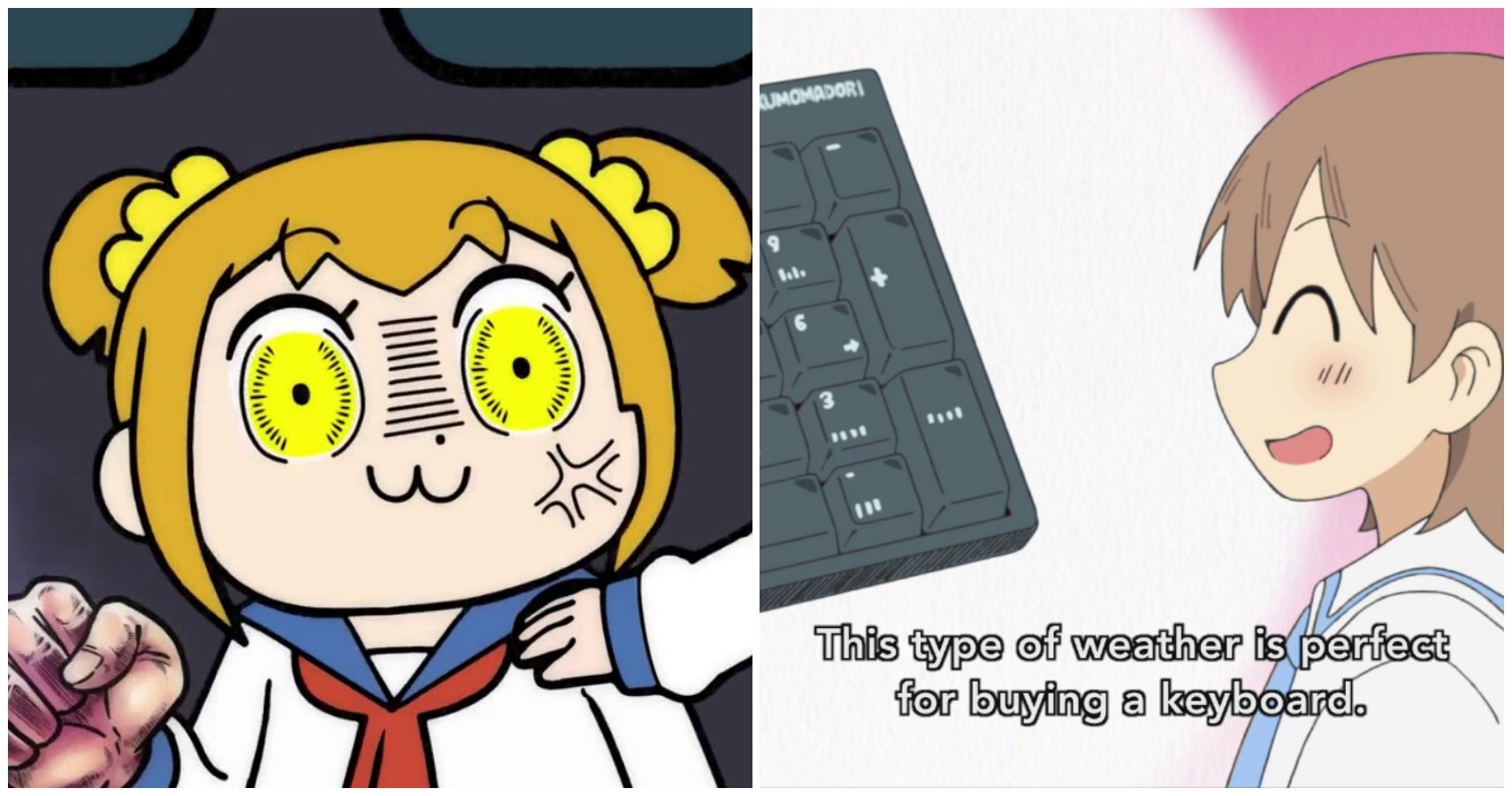
8 Pop Team Epic: There’s A Reason Popuko Wanted To Hurt That Flight Attendant
In one Pop Team Epic segment, the girls are on a plane where a stewardess asks them if they would like some beef or chicken for their in-flight meals. At this, Popuko becomes violently enraged at the woman and has to be calmed down. Western viewers might think the joke is that Popuko is just that much of a picky eater or the whole thing is a non-sequitur.
In Japanese, “beef or chicken” is an idiom asking if someone is strong or weak, akin to the Western “man or mouse,” meaning she got offended at being called a “chicken.”
7 Nichijou: The Keyboard Meme Can Be Explained
Western fans of Nichijou have made a meme out of how often they like to take scenes out of context, especially when it concerns a joke that got lost in translation. One such example is when Yuuko notes that it’s good weather to buy a keyboard.
This is a pun on the fact that the Japanese words for “weather” and “keypad” are homophones, with the former rendered “tenki” and the latter a portmanteau of “ten” and “key.”
6 Puella Magi Madoka Magica: The Series’ Big Twist Comes With A Pun
In Puella Magi Madoka Magica, Kyubey comments that it’s fitting that young women are called girls, before revealing the series big twist: that the witches were once magical girls.
The line makes a little more sense in Japanese than English, as it’s a joke on the fact that the Japanese word for “witch,” or “majo,” (sort of meaning “devil woman”) sounds like it could be a portmanteau of “mahou shojo,” or magical girl.
5 Pokémon: This Is Why Jessie & James’ Introduction Speech Makes Them Sound Like Good Guys
In the English dub of Pokémon, Jessie and James of Team Rocket are supposed to be the bad guys, making it a bit confusing as to why their motto says that they want to “protect the world from devastation” and “unite all peoples within our nation.”
In the original Japanese, they claim to be lying, charming villains who say they’ll do good to play on society’s sympathies. Meowth’s original line “Nyante Nya!,” a play on “nante ne,” is meant to imply they’re just kidding about what they’re saying.
4 Hime-Chan’s Ribbon: A Japanese Pronoun Brings About An Embarrassing Moment For Himeko
Himeko, the heroine of Hime-chan’s Ribbon, surprises her love interest Daichi when she refers to herself with the feminine “atashi,” and not the more masculine “boku.”
This is what alerts him to the fact that she is actually a girl, despite her rather tomboyish personality and appearance. Offended, she kicks him in response, causing her to accidentally embarrass herself in front of her crush.
3 Another Note: It Might Surprise Western Fans To Learn Akazukin Chacha Is Real
In Another Note, a light novel spin-off of Death Note, one joke is that one of the main characters, Beyond Birthday, is obsessed with Akazukin Chacha. He spends at least one paragraph gushing over it and a clue is left in one of its manga books.
It might surprise some readers in the West that Akazukin Chacha is actually a real anime and manga, focusing on a little witch dressed like Little Red Riding Hood, who has adventures with other fairy tale-themed characters. A similar joke is made in the Korean webtoon City of Dead Sorcerer, in which the detective Kim compares the killer Crimson Robe to Chacha, claiming to also be a fan of the series.
2 Fairy Tail: Characters Being Counterparts To Each Other Made Less Sense With New Casting
Sometimes, things can get lost in translation for more reason than just the words being used. In Fairy Tail, it’s a running theme that various characters are counterparts of each other. This is proven to be the case with Porlyusica and Grandeeney, who even share a voice actor, as is commented on.
Unfortunately, the official English version gave them different voice actors, initially ruining this plot point until one of the roles was recast. A similar issue had also occurred with King Faust and Makarov, who are also parallel counterparts to each other, but voices were re-recorded to fix this at the last second.
1 Excel Saga: Excel’s Actor Allusion Turns Into A Rant About North American Dubbing Policies
In one episode of Excel Saga, “Animation USA,” the plot ends up becoming a discussion about the differences between Japanese and American animation, and Excel borrows a few tricks from both genres to take on her opponents. She even does a brief Sailor Moon impression.
While many Western viewers could get the reference, the joke loses something of its meaning overseas, as Excel originally shared Sailor Moon’s actress, Kotono Mitsuishi. In the English dub, for example, Excel instead complains about how Sailor Moon was originally dubbed in Canada.
About The Author