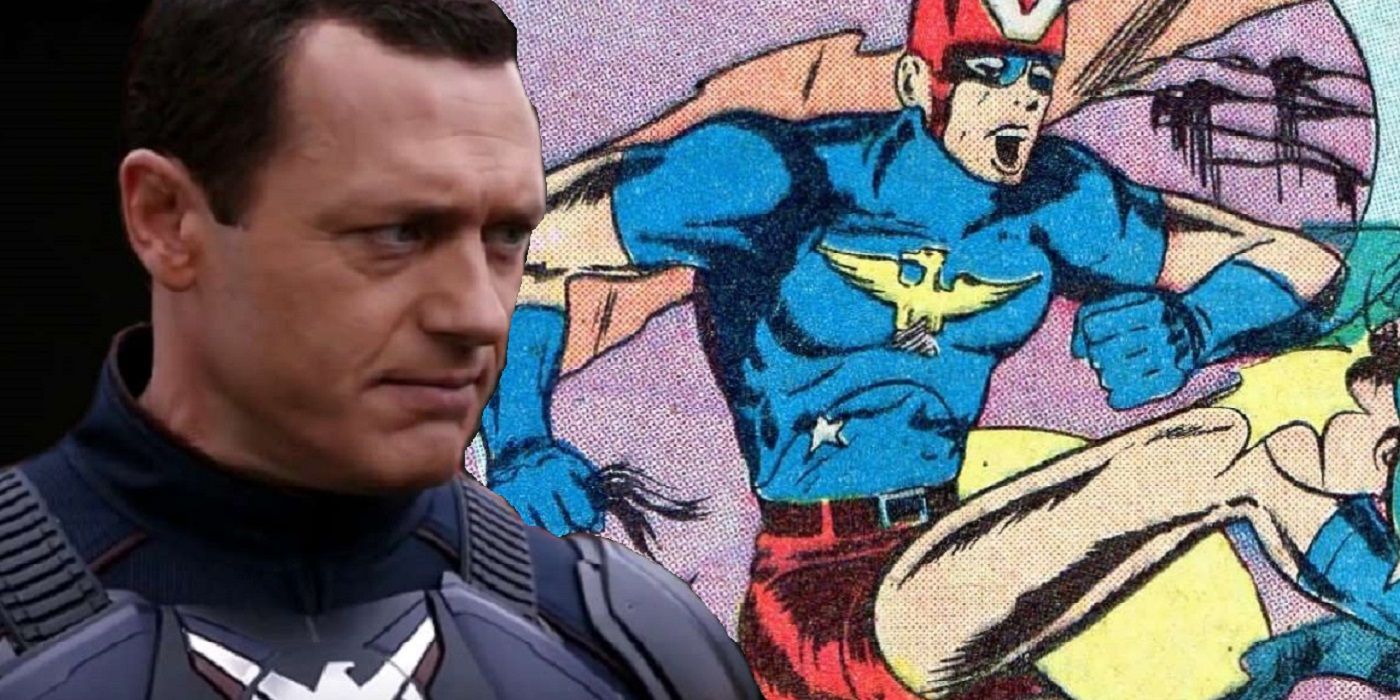
Today, we look at the 1946 Golden Age farewell of one of Marvel’s lesser-known patriotic superheroes, the aptly named, The Patriot!
This is “Look Back,” where every four weeks of a month, I will spotlight a single issue of a comic book that came out in the past and talk about that issue (often in terms of a larger scale, like the series overall, etc.). Each spotlight will be a look at a comic book from a different year that came out the same month X amount of years ago. The first spotlight of the month looks at a book that came out this month ten years ago. The second spotlight looks at a book that came out this month 25 years ago. The third spotlight looks at a book that came out this month 50 years ago. The fourth spotlight looks at a book that came out this month 75 years ago. The occasional fifth week (we look at weeks broadly, so if a month has either five Sundays or five Saturdays, it counts as having a fifth week) looks at books from 20/30/40/60/70/80 years ago.
We’re a bit behind, so we’re still looking at May books, specifically May 1946’s farewell to Jeffrey Mace, the Patriot, in Marvel Mystery Tales #74, by Bob Oksner and a mystery writer.
Action Comics #1, which introduced the world to Superman, wasn’t just a hit, it was a sort of cultural phenomenon, with Superman appearing in his own nationally syndicated newspaper comic strip by September 1939 (which is sort of amusing, as Jerry Siegel and Joe Shuster only turned to comic books because they couldn’t sell Superman to any syndicates as a comic strip) and his own national radio program by February 1940. Clearly, with success like that comes many imitators and a number of comic book companies started up to try to compete with the publishers of Action Comics.
One of the first imitators was Wonderman, a creation of Will Eisner for Fox Publications’ Wonder Comics #1 in 1939. Detective Comics, Inc. sued Fox’s parent company, Bruns Publications, Inc. for copyright infringement and was victorious in Detective Comics, Inc. v. Bruns Publications, Inc. Fawcett Publications, Inc. was a successful magazine publisher that debuted a comic book division, dubbed Fawcett Comics. They launched their own Superman knock-off, Masterman, in Master Comics #1. Detective threatened to sue and Fawcett backed down. Then, in late 1939, Fawcett Comics debuted their soon-to-be flagship character, Captain Marvel, in Whiz Comics #2 and that became a whole thing.
That, though, wasn’t the only example of this sort of thing happening during the Golden Age. Sometimes, even within the same company! For instance, when the Flash made his debut in 1940 for National Comics, he was soon followed by another super-speedster, Johnny Quick…also from National Comics!
Similarly, when MLJ Comics hit it big with a patriotic superhero in 1940 with the Shield, the other comic book companies were quick to follow suit. The most famous of these knock-o…ahem…similar superheroes was Joe Simon and Jack Kirby’s Captain America. However, at the same time that Simon and Kirby were coming up with Captain America, other employees of Timely Comics (now known as Marvel Comics) were trying their hands at patriotic superheroes, as well, and while Simon and Kirby definitely came out with Captain America first, I tend to believe that Ray Gill and Bill Everett (Everett famously had created Namor the Sub-Mariner a couple of years earlier) were looking more to the Shield than Cap when they introduced the Patriot in 1941’s Human Torch #4…
Amusingly, like Captain America, this was all before the United States even entered World War II, so the Patriot fought criminals on the homefront. Jeffrey Mace was a reporter and when stories led him to problems, he turned into the superhero known as the Patriot.
The problem is that Patriot didn’t have quite the hook as Captain America and was never as popular as the good Captain and thus, when superheroes lost a lot of their popularity after World War II, patriotic superheroes especially took a hit.
Therefore, the Patriot’s regular feature in Marvel Mystery Comics came to a close with #74 in May 1946. By this point, I have no idea who was writing the feature, but the great Bob Oksner was drawing it (early in his comic book career). The final story sort of showed how hard it was to come up with stories that worked for a patriotic hero, as now that the war was over and the United Nations were beginning, who was even the villain? The Communists weren’t a problem yet…
And so some mysterious group are trying to cause problems in South America, of all places…
Jeffrey Mace figures it out and so the Patriot springs into action, temporarily foiling a plot to have the bad guy take over for the Brazilian ambassador and cause trouble in the United Nations…
The Patriot tracks them down, throws some fists and saves the day….
And that was it for the Patriot for the next thirty years or so until Roy Thomas came up with the idea of having Jeffrey Mace fill in as Captain America after Steve Rogers “died” in an issue of What If…?. Decades later, a new Patriot joined the Young Avengers. On Marvel’s Agent of S.H.I.E.L.D., Jeffrey Mace was reformatted as the short-lived Director of S.H.I.E.L.D. (while keeping his Patriot superhero identity, as well).
If you folks have any suggestions for August (or any other later months) 2011, 1996, 1971 and 1946 comic books for me to spotlight, drop me a line at brianc@cbr.com! Here is the guide, though, for the cover dates of books so that you can make suggestions for books that actually came out in the correct month. Generally speaking, the traditional amount of time between the cover date and the release date of a comic book throughout most of comic history has been two months (it was three months at times, but not during the times we’re discussing here). So the comic books will have a cover date that is two months ahead of the actual release date (so October for a book that came out in August). Obviously, it is easier to tell when a book from 10 years ago was released, since there was internet coverage of books back then.
About The Author
