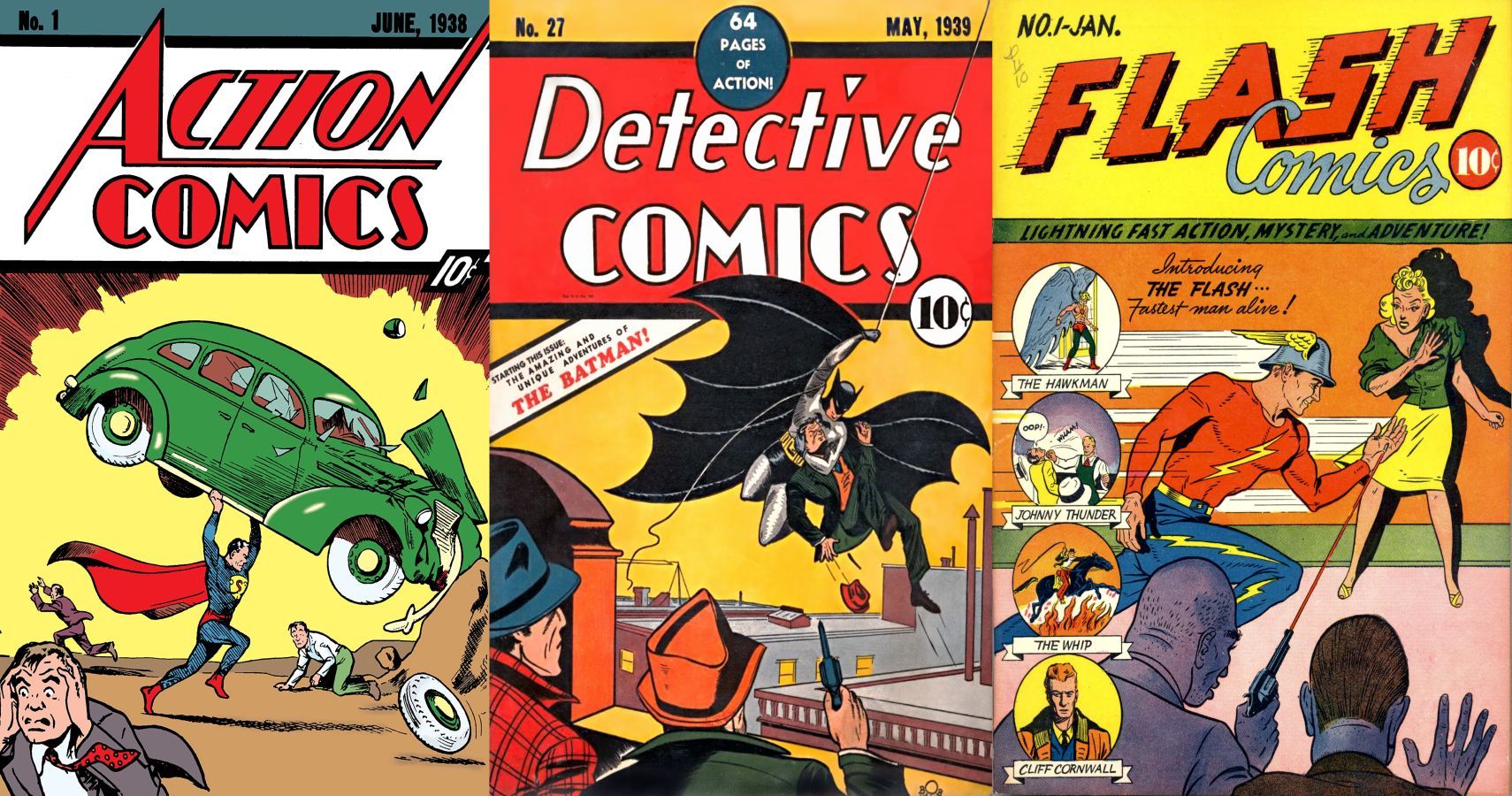
There’s no doubt that DC Comics have been the leader in superhero titles over its history. It debuted a new generation of superheroes to usher in the Silver Age of the 1950s. Before that, it moved pulp magazine heroes to four-color panels to kick off the Golden Age.
The company and its creators introduced several superheroes between 1938 and 1942. Many of them are still part of the comic book culture. It’s a testament to the imagination of its writers and artists that the personalities in this chronological list are still around nearly a century later.
10 Superman (1938) Is DC’s First True Superhero
Mystery Men and Women like Doctor Occult and Rose Psychic were introduced by DC Comics in 1935. Yet, it wasn’t until the Man of Steel’s debut in 1938’s Action Comics #1 (by Jerry Siegel and Joe Shuster) that the company’s true superhero era began.
The concept of Superman remained popular enough to garner his own series a year later. Plus, he became the flagstone of a company that began to move its titles toward characters with heroic abilities far beyond those of mortal men.
9 The Crimson Avenger (1938) Preceeded Batman In Detective Comics
History always points to Detective Comics #27 (by Bill Finger) as the premiere of DC’s second superhero. What they don’t know is another masked vigilante came to being seven issues before the Dark Knight. This is Lee Travis, otherwise known as the Crimson Avenger.
Using his Olympic-level training and gas guns to hold his own, the Avenger is quite similar in design to the radio serial character The Shadow. He even introduced the concept of comic book sidekick before Batman with the character Wing. Though dressed in a red trenchcoat and mask at the start, the Crimson Avenger his partner donned more superheroic outfits when they helped found the Seven Soldiers of Victory.
8 The Dark Knight (1939) Entered Without An Origin
When The Bat-Man was introduced in Detective Comics #27 (by Bill Finger) readers were placed in the heart of his career. They didn’t even realize that Bruce Wayne, the nice young chap who is friends with Commissioner Gordon, was actually the black-caped Dark Knight.
It was something readers accepted as they continued to read his adventures. Luckily, they didn’t need to wait long to find out why this millionaire socialite likes to dress up and fight crime. His two-page origin in Detective Comics #33 (by Bill Finger and Gardner Fox) cleared things up and established a prominent history.
7 The Introduction Of Sandman (1939) Began A Long Legacy
The concept behind Sandman isn’t much different than the pulp magazine heroes introduced during the 1930s. The main difference is characters like The Spider and Black Bat disappeared. the legacy of Wesley Dodds continues well into the 21st century.
For instance, Sandman is one of the founders of the Justice Society of America, a team well-known in the comics and shows like Stargirl. His partner, Sandy, became chairman of one of the JSA’s modern incarnations. Plus the monicker of Sandman has been used by several heroes over the decades. In other words, Wesley’s simple origins in World’s Fair Comics #1 (by Jerry Siegel) cemented a lengthy narrative.
6 The Flash (1940) Ushered In A New Generation Of Superheroes
Save for Superman, the first generation of DC heroes weren’t that super. They relied on their smarts and gadgets to battle crime. On the other hand, the next generation of heroes, led by the Golden Age Flash, did have those special powers.
Jay Garrick gains his super-speed powers by inhaling the fumes of the gas elements that comprise hard water. On top of being a founding member of the JSA, this Flash continued his adventures through the Silver Age and after Crisis on Infinite Earths. Jay eventually became connected to the Speed Force.
5 Hawkman (1940) Is DC’s First Flying Superhero
Flying superheroes are a dime a dozen today. Nevertheless, DC didn’t have any characters that flew. Not even Superman. When he was first introduced, the Man of Steel only leaped tall buildings with a single bound.
Now Carter Hall, the hero named Hawkman, could fly with his winged harness attached. Therefore, he’s considered DC’s first airborne superhero. The title would be short-lived when the Spectre and Doctor Fate came on the scene a few months after Hawkman’s debut.
4 Johnny Thunder (1940) Calls Upon A Superpowered Genie
Technically, Johnny Thunder isn’t a superhero. He isn’t even a mystery man like Sandman. His powers come from a genie named Yz, whom Johnny calls on with the command Cei-u (pronounced “say you”.)
Despite his lack of skills, Johnny ended up as a founding member of the Justice Society. Furthermore, his legacy continued during the days when the Golden Age heroes resided on Earth-Two. Eventually, the elderly Johnny merged with Yz to become one entity.
3 Spectre (1940) Becomes A Superhero After Death
The Spectre is the first superhero in the history of DC Comics to die. He’s also the first to be returned to Earth as a being whose goal is to eliminate all evil. Though not a superhero per se, the spirit who was once Jim Corrigan became a JSA charter member.
Unfortunately, writers never knew what to do with the character during his early life. First, they resurrected Corrigan and made Spectre a separate entity. Then, he became a guardian angel for a bumbling police officer. It wasn’t until the mid-1960s and early 1970s did the character get a new and more violent lease on life.
2 Hourman (1940) Is A Superhero For 60-Minute Spans
At the start, Rex Tyler’s Hourman was unique. By taking something called Miraclo, he gains super-strength and agility for one hour. After that, Rex has to be a hero without the medicine or step into the shadows until he the next dose.
While a founding JSA member, Hourman’s popularity didn’t have the same staying power as the Flash or Green Lantern. When he returned during the Silver Age, Rex’s personality was fleshed out. Along with stories about drug addiction, writers also delved into the character’s abnormal need to fight crime.
1 Robin (1940) Ushered In A New Era Of Sidekicks
Though the concept of a younger partner originated with the Crimson Avenger and Wing, it wasn’t until Robin’s introduction in Detective Comics #38 (by Bill Finger, Chad Grothkopf, and Gardner Fox) that it established a trend. It’s due to the method of his introduction. Rather than an existing character like Wing, Robin created a new dynamic between hero and partner.
Dick’s debut also changed the scope of Batman’s stories. No longer a dark figure seeking bloody vengeance, Bruce Wayne now had a ward to protect. So, he changed his methods and even lightened his costume to be more accessible.
About The Author