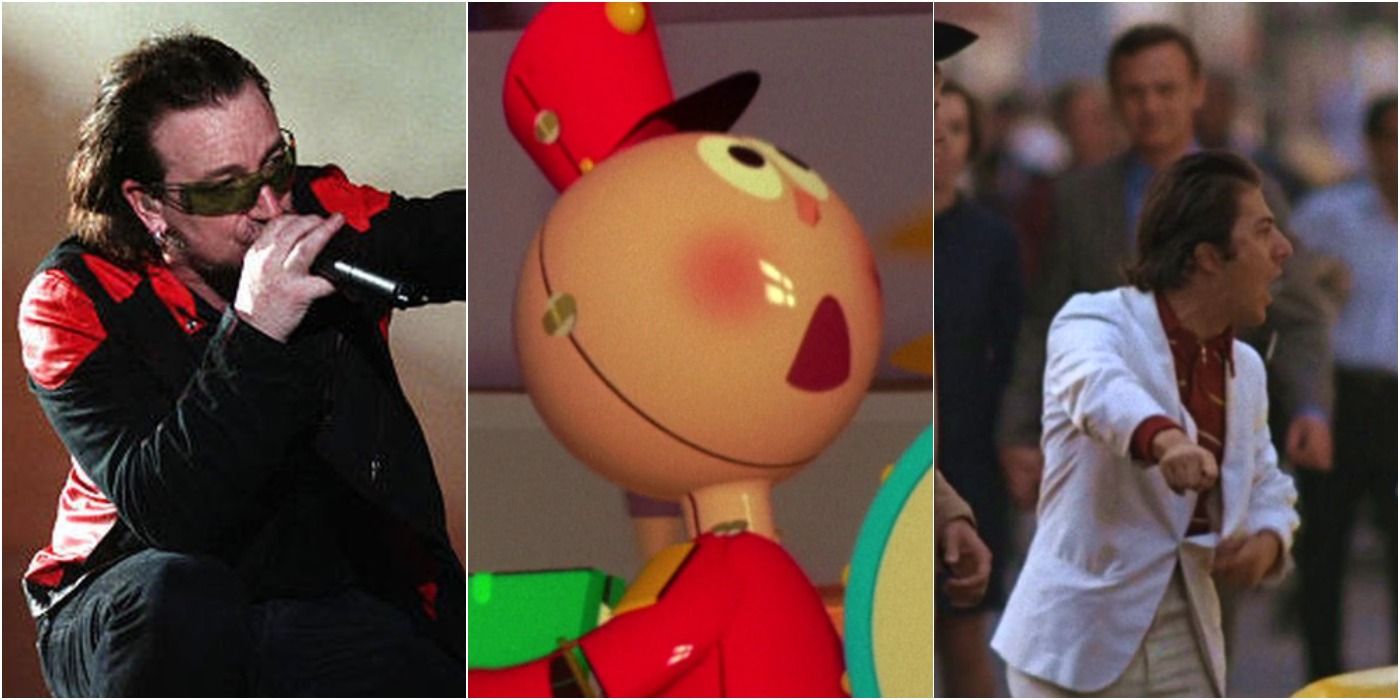
Filmmakers are constantly pushing the boundaries of their medium. In their quest to create unique cinematic experiences for fans worldwide to enjoy, they occasionally raise the bar on quality, inspiring generations of filmmakers or even earmarking a significant societal paradigm shift.
Unfortunately, with the sheer volume of content battling for viewers’ limited attention, it is easy for some of these gems to fall through the cracks. In some cases, the films themselves are not well received by viewers and critics. Their achievements, however, should not be overlooked because they have advanced the field to appease an ever-demanding audience.
10 Distant Drums: First Film To Use The Wilhelm Scream
The most well-known movie sound effect, The Wilhelm Scream, originated from a reel of recordings created for the film Distant Drums (1951). The Western is set in 1840 during the Second Seminole War and follows Captain Quincy Wyatt, played by Gary Cooper, on a rescue mission that forces him to flee through the Everglades.
The film itself is rather mediocre but has left an indelible mark on filmmaking with the distinct howl recorded to capture the scream of a man bitten by an alligator. The recording existed in the Warner Bros. stock library for decades and came to mainstream attention when it was used in Star Wars. Since then, the scream has popped up in no fewer than four hundred films.
9 Lilies Of The Field: First Black Man To Win The Academy Award For Best Actor
Hattie McDaniel was the first African-American woman to win the Academy Award for Best Supporting Actress for her portrayal of Mammy in Gone With The Wind. Over twenty years later, Sidney Poitier would win the award for Best Actor in Lilies Of The Field (1963), making him the first Black man to receive this prestigious honor.
The movie follows Homer Smith (Poitier) as he stumbles upon a group of European nuns who believe God sent him to help them build a new chapel. It was nominated for five Academy Awards and later turned into a musical. Its impact on cinema is so significant that in 2020 it was inducted into the Library of Congress’s National Film Registry.
8 Midnight Cowboy: First (& Only) X-Rated Film To Win Best Picture
Midnight Cowboy (1969) remains the only X-Rated film ever to win the award for Best Picture. It stars Dustin Hoffman and Jon Voight, a con man and male sex worker, respectively. The pair become unlikely friends as they hustle their way through the seedy underbelly of New York City.
Midnight Cowboy was very well received upon release and regularly featured on lists of Greatest Films Of All Time despite very few modern viewers being aware of it. In addition to being added to the National Film Registry in 1994, it won the Academy Awards for Best Director and Best Adapted Screenplay in the year it was released.
7 Young Sherlock Holmes: First Photorealistic CGI Character
Young Sherlock Holmes (1985) is an adaptation of the works by Sir Arthur Conan Doyle. It centers around a mystery at the boarding school both Holmes and Watson attend. Based on an original screenplay penned by Chris Columbus, it was later edited for authenticity by a Sherlock Holmes expert and a British novelist.
The forgettable adventure film even had Steven Spielberg attached, but the movie is most notable for its CGI character. The character in question is a knight composed of stained glass panels and only appears on-screen for thirty seconds. The effect took six months to craft and was created by John Lasseter and the team at Industrial Light & Magic.
6 Tin Toy: First Computer-Animated Short To Win An Academy Award
Before Disney bought Pixar, it was an independent company. Before that, it was a division of Industrial Light & Magic, itself a division of Lucasfilm. Pixar’s independence was primarily funded by Steve Jobs, the co-founder of Apple. John Lasseter pitched the idea of Tin Toy (1988) to Jobs. This film would later inspire Toy Story.
Despite financial woes, production went ahead, and the film went on to win the first Academy Award for the acclaimed studio. Pixar continues this tradition of animated shorts featuring bold, outlying ideas to this day.
5 Wax or the Discovery of Television Among the Bees: First Film To Be Streamed On The Internet
An increasing number of streaming services are popping up all the time. We take this form of on-demand content for granted, spending hours daily watching whatever we want whenever we want. In 1993 one film became the first to be streamed over the internet. This historical event would pave the way for how we consume and perceive accessible entertainment.
Wax or the Discovery of Television Among the Bees (1991) is an award-winning, independent art film that uses mixed media and represents a critique of the Gulf War. It was very well received upon release, covering themes such as the use of technology in warfare.
4 Casper: First CGI Lead Character In A Feature Film
Casper (1995), received a tepid response upon release, even earning a nomination for Worst Picture at the Stinkers Bad Movie Awards. Based on the popular comic book character Casper The Friendly Ghost, the film was produced in conjunction with Amblin Entertainment, founded by Steven Spielberg. The film’s depiction of a CGI lead character preceded the release of Toy Story by a full six months.
Among the many technical marvels achieved is a scene where the fully computer-generated Casper hands a full glass of orange juice to Christina Ricci. Despite its production team’s caliber and a stellar cast, the film has been largely forgotten, and the character has not seen the same resurgence in popularity as other properties riding the wave of nostalgia.
3 Twister: First Film To Be Available On DVD In The United States
The blockbuster disaster movie Twister (1997) spun its way onto screens to mixed reviews. Despite this, it was a Box Office hit with various spin-offs and tie-ins, including arcade pinball machines, video games, and a theme park attraction. Marketing for the film and its merchandise included a push to the new (at the time) DVD format.
The shift to DVD is considered a monumental shift in the way that viewers consume media. Previously home video rental existed on VHS tapes, which diminished over time. Video and audio quality were also limited. DVD quality allowed viewers to experience Twister’s big-budget effects and rocking soundtrack at significantly higher quality, both visually and aurally.
2 Russian Ark : First Film Shot Entirely In HD (& In A Single Take)
Higher fidelity video quality and cinematic effects have become things that we take for granted in the era of blockbuster films such as those featured in the MCU. We can now stream 4K movies with HDR and digital surround sound directly to our smartphones. Back in 2002, Russian Ark was the first film to be recorded in what we now consider a minimum standard, HD.
The experimental film follows a ghostly narrator through history and various rooms of the Winter Palace in Saint Petersburg. Four attempts were made to film the entire movie in one continuous, Steadicam sequence. Of those four, only the last was successful.
1 U2 3D: First Live-action Film Completely Shot, Edited, And Exhibited In 3D
Unfortunately, the first film to be shot, edited, and screened entirely in 3D is not a Hollywood blockbuster but a concert film produced for the much-maligned Irish band U2. Despite their reputation, U2 3D received rave reviews upon release, primarily due to its production.
The first multi-camera setups were created along with custom-built rigs requiring five camera operators each to operate. In total, 100 hours of footage was filmed with 19 cameras and 110 microphones around multiple stages. Not only did the film wow critics and viewers, but it also inspired filmmakers and other bands such as Muse.
About The Author
