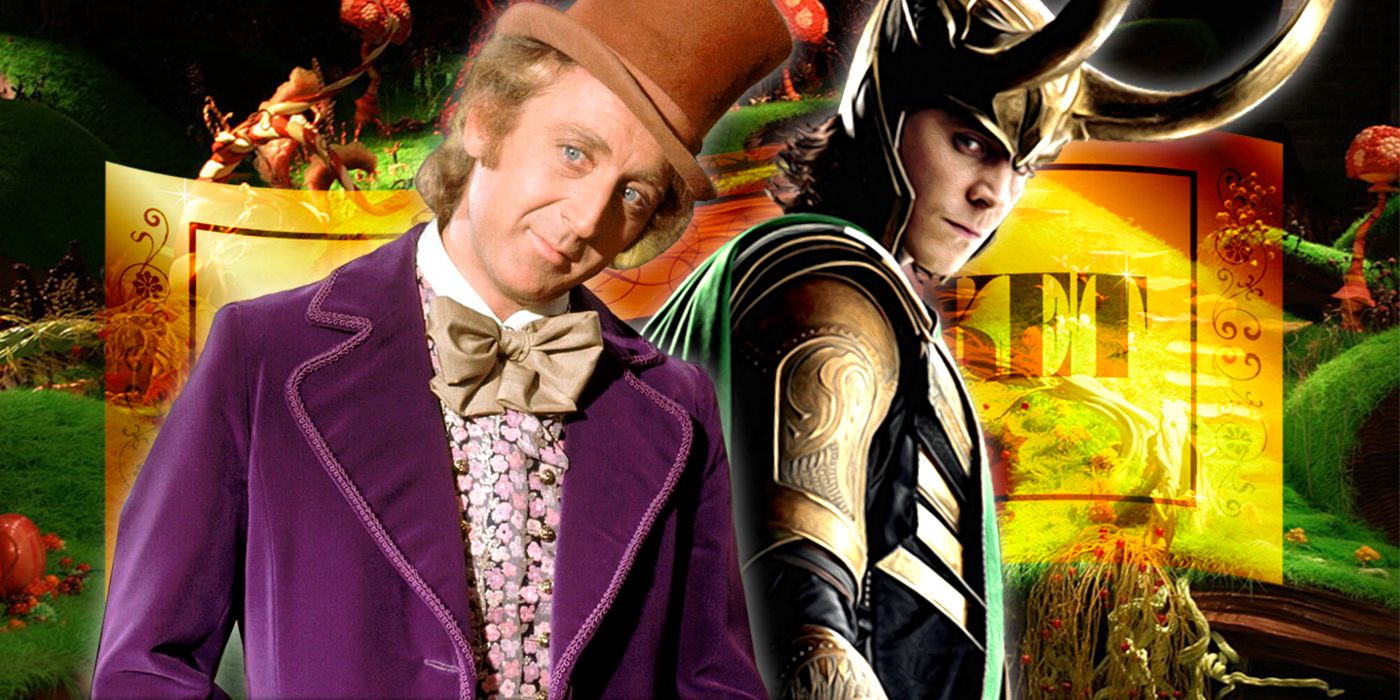
WARNING: The following contains spoilers for the Season 1 finale of Loki, “For All Time. Always.,” streaming now on Disney+.
Loki borrowed a page from The Wizard of Oz in its reveal of He Who Remains at the finale of Season 1, Episode 6, “For All Time. Always.” Having faced the terror of Alioth, Loki and Sylvie find the controller of all creation, who turns out to be far more trickster and imp than a godlike deity. The Marvel Cinematic Universe isn’t the first property to use the “man behind the curtain” trope. However, the motivation behind it more closely resembles that of another children’s classic: Charlie and the Chocolate Factory, whose mysterious Willy Wonka carries more than a few parallels to He Who Remains.
Wonka and He Who Remains are of a kind in that they’re both tricksters who use deception and distraction to control a large organization more or less in secret. Both possess no godlike powers and rely on trickery to convince those beneath them that they’re gods. And both ultimately have a rather surprising goal: they’re looking for a replacement. The differences are largely one of scale.
Willy Wonka is a more sinister character than pop culture often gives credit for. In both the original novel Charlie and the Chocolate Factory and the 1971 movie Willy Wonka and the Chocolate Factory, he’s portrayed as a figure of mystery whose true motives remain unknown until the end. In truth, he’s paranoid. Other candy makers sent spies to steal his formulas, forcing him to seal off his factory and employ the Oompa Loompas to run it. He’s lived a great deal of his life that way: hidden in the depths of a world he created and unable to trust anyone else to help him run it.
He Who Remains is no less paranoid and behaves accordingly. Like Wonka with his rivals, he’s worried about variants of himself whose motivations may be less than pure. He’s walled himself off behind Alioth, like Wonka in his factory, and controls the TVA to run reality under his absolute control. The methodologies are the same, as is the implicit need for control running under both men’s actions.
In both cases, they’re running out of time. In Charlie and the Chocolate Factory, Wonka confesses that he’s older than he looks and that his ruse with the Golden Tickets was an effort to find a suitable replacement. He Who Remains is the same way: wearying of eternity and looking for someone else to keep the Sacred Timeline running. He believes that Loki and Sylvie have the necessary skills to replace him.
Similarly, both men engineer a kind of audition for their successor. In Wonka’s case, it’s a surprisingly gruesome process of elimination, as the selfish children on the tour are all undone in various poetically appropriate ways until only good-hearted Charlie Bucket is left. He Who Remains states much the same thing: having gone through “a lot of scenarios” to find the proper replacement only to be finally left with Loki and Sylvie.
It’s a clever parallel with a final twist. Wonka is willing to relinquish control to find his successor, trusting in luck for the right child to find a golden ticket. He Who Remains doesn’t have the same trust and tries to leverage Loki and Sylvie to take his spot. One ends in happiness, the other in chaos. He Who Remains may be emulating Willy Wonka, but he clearly needed to study the model a little more closely.
Created by Michael Waldron and directed by Kate Herron, Season 1 of Loki is streaming on Disney+.
About The Author
