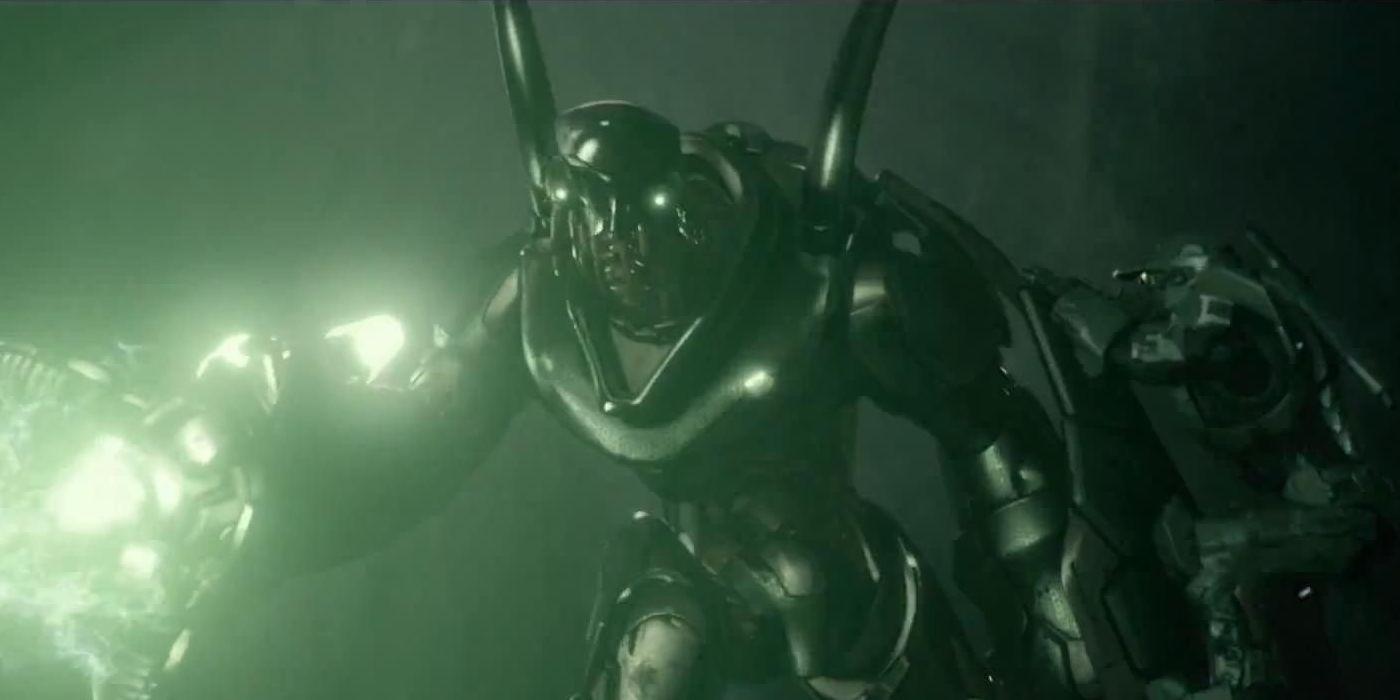
At first glance, Halo‘s Hunters appear to be little more than giant walking tanks. However, there is more to these aliens than meets the eye. Hunters, or Mgalekgolo, are not individual creatures like Elites or Grunts but are instead more of a hive. Each hunter is made up of a collection of small worm-like creatures known as Lekgolo. The worms do not speak, so how did these strange creatures end up joining the Covenant in the first place?
Hunters have been a part of the Halo games since the beginning and have appeared in every game to date. They are usually portrayed in their large armored forms and act as a roadblock for players. While the Legkolo forms are only seen as part of a mass, they do have a presence in the game. However, more of the history was expanded upon in Halo 2‘s dialogue and the terminal entries in the remaster.
The Covenant originally encountered the Legkolo and their home planet, Te, by accident. The Covenant was searching the galaxy for any Forerunner artifact they could find. In their travels, they came across a world surrounded by orbital rings. The Covenant searched the rings and found that they were the destroyed remains of Forerunner artifacts. They also discovered hives of Lekgolo worms that were the cause of the destruction. The worms had used the artifacts as a part of their diet for centuries. This act of heresy angered the Prophets, who demanded that the Lekgolo be destroyed. However, the Elite shipmasters realized that simply glassing the planet would cause even more destruction to the remaining artifacts on the planet’s surface. The difficulty mostly stemmed from the fact that the Legkolo worms made their homes in many of the Forerunner artifacts buried on the planet’s surface.
The Covenant forces were at an impasse, but the Arbiter that had been created soon realized that there may be potential in this new species. The Covenant had realized that some of the Lekgolo were not destroying the artifacts and were instead preserving them. The Arbiter appealed to the Prophets that these hives could be tamed and inducted into the Covenant. The Prophets agreed but also decreed that any of the hives that destroyed the artifacts had to be wiped out. The Arbiter began to engage the hives, taking the ones that preserved the artifacts and destroying the others. However, it was not a simple task as the Covenant found themselves in a costly ground war. The Hunter forms of the Lekgolo were a considerable threat, and the Covenant soon found that they were losing the majority of the battles. Eventually, the cost became too high and the Covenant retreated to space. With no other option, the Elites threatened to glass the entire planet if the remaining Lekgolo hives did not surrender. Eventually, the Lekgolo surrendered as they had no way to fight in space and were at the mercy of the Covenant.
The Lekgolo were fully incorporated into the Covenant and, while they weren’t the most sociable of species, they soon found their place. The Elites viewed them as powerful warriors and had their Hunter forms incorporated into the main Covenant military. Meanwhile, the Prophet engineers found the worms to be perfect for exploration into the depths of Forerunner machines. The Lekgolo were also used to help control the giant Scarab battle platforms.
The Hunters are an interesting parallel of the Covenant’s experience with Humanity. Both are species that had their extermination called for by the Prophets. Humanity managed to fight the Covenant for years and had earned the respect of many of the Elites but was never offered inclusion into the Covenant. It is also interesting that, if the Hunters had never been accepted, the armed threat of the Covenant would have been considerably lessened. Without the Hunters, the war against humanity would have been very different. The Covenant use of Scarabs and Hunter pairs allowed them to combat Spartan groups and engage defensive positions with more ease than would otherwise have been possible. The Hunter forms will reappear in Halo Infinite and, hopefully, they have a chance to show more of their versatility, rather than as nothing more than walking tanks.
About The Author