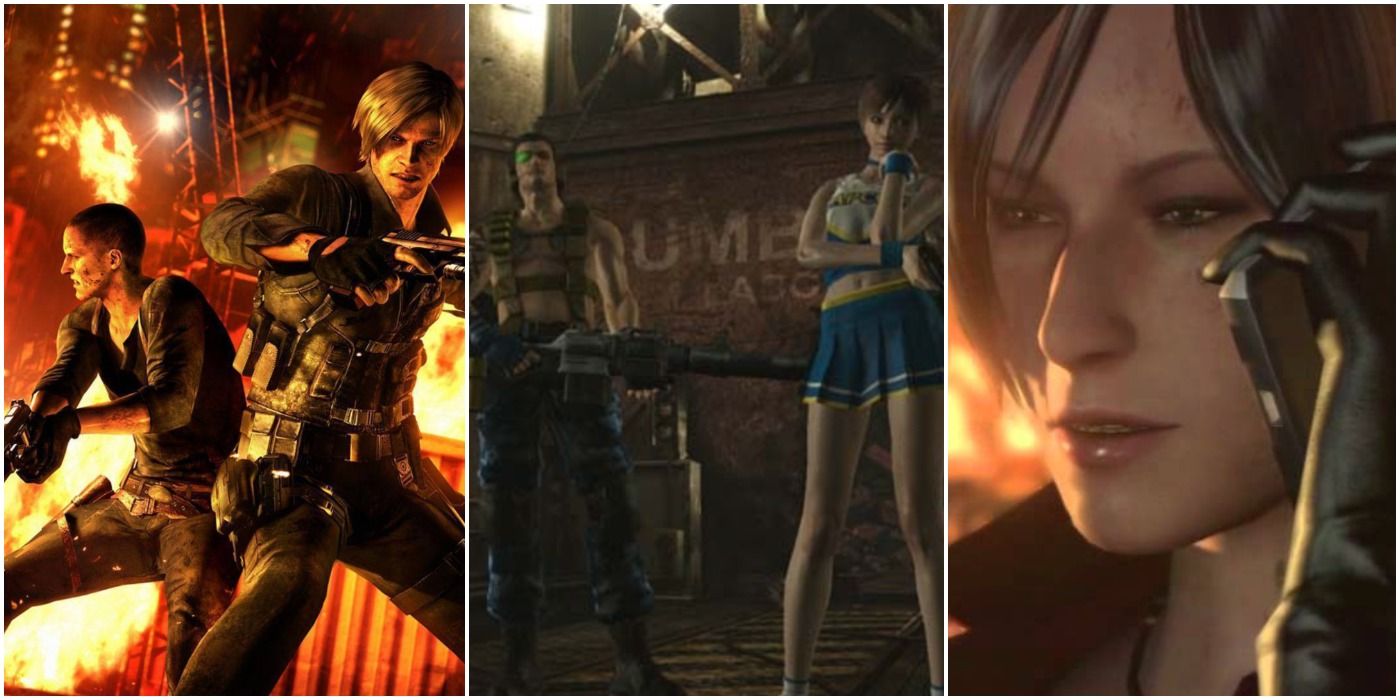
The video game industry is full of evergreen franchises that have gone on to define different genres and generations of gaming, but the Resident Evil series has turned into a breakout success that’s transcended beyond just video games. It’s hard to imagine a time when there weren’t video games that made scaring the audience its priority. However, the survival horror genre was incredibly niche before Resident Evil came around to revolutionize the industry.
Resident Evil has endured for decades and it’s taken many different forms, but this desire to experiment doesn’t always result in success. There have been significant changes to the Resident Evil franchise since its debut, but there’s still much debate over what chapter in the series represents its low-point, whether it’s Resident Evil 6 or Resident Evil Zero.
10 RE6: The Prevalence Of Quick-Time Event Sequences
It’s fascinating how certain gaming trends can invade long-running series, for both better and for worse. There was a time where quick-time event sequences— segments where players need to quickly execute button commands to pull off actions— felt like an innovative way to add tension to a game.
The Resident Evil series succumbs to this mechanic for Resident Evil 5, but it becomes seriously egregious in its sequel. QTE sequences feel out of place in Resident Evil and only accentuate its action genre sensibilities. Its disastrous use in Resident Evil 6 has at least led to their elimination in subsequent titles.
9 RE Zero: It’s A Prequel When People Wanted A Sequel
Resident Evil Zero was first released towards the end of 2002, following Resident Evil Remake. At this point, Resident Evil CODE: Veronica was the latest entry in the series and audiences were eager to know what would happen next. Resident Evil 4 wouldn’t hit the GameCube until 2005, but in the interim time was Resident Evil Zero.
Rather than advance the series’ growing chronology forward, Resident Evil Zero instead turns the clock backwards with a prequel entry that leads into the original game. A Resident Evil prequel can work, but this one just didn’t arrive at the right time. Even worse is that the game itself felt like a “prequel” in the gameplay sense, befitting its history as originally being a cancelled Nintendo 64 game.
8 RE6: It’s Too Action-Based & Strays From Its Horror Roots
Resident Evil helped put the survival horror genre on the map, which makes it so discouraging that there’s a span in the series where the games progressively become more action-based titles.
Resident Evil 4 kicks off this trend, but it’s Resident Evil 5 and 6 that push it too far and minimize the franchise’s trademark scares for busy action sequences. This trend is at its worst in Resident Evil 6, which feels like a cliché action film, and the continual evolution of the game’s third-person perspective erases the terror.
7 RE Zero: The Partner Zapping Mechanic Is Flawed
The Resident Evil series has featured numerous control styles that take into consideration the multiple protagonists that are present in each game. Early Resident Evil games adopt complimentary narratives with the different main characters, but Resident Evil Zero is the first entry in the series to really mess with this staple.
Resident Evil Zero has two protagonists, Rebecca and Billy, but they’re simultaneously controlled. A “partner zapping” mechanic gets introduced where players swap, on the fly, between their characters. It’s a lot to manage and can be a frustrating gameplay element for some to master.
6 RE6: Its Emphasis Is On Co-Op
There have been multiple protagonists right from the start of the Resident Evil series, but the franchise has largely remained single-player. Resident Evil 6 continues on the co-operative mechanic that is a factor in its predecessor, Resident Evil 5. Resident Evil 6 goes so far as to allow four-person co-op, which is significantly different from standard Resident Evil gameplay.
There’s such emphasis on this style of play that the single-player experience suffers. The focus on co-op also introduces a slew of bland partners like Helena Harper and Piers Nivans, which feel like they’re only present because co-op is a feature.
5 RE Zero: For A Long Time It Was A GameCube-Exclusive With Limitations
Capcom announced their “Capcom Five” project in 2002, which was five GameCube-exclusive releases, which included Resident Evil Zero. Many didn’t get a chance to experience Resident Evil Zero since it was tied to the GameCube for so long. The formerly GameCube-exclusive game later received a Wii port in 2008, as well as a more robust HD remaster in 2016.
This is a step in the right direction for PlayStation and Xbox fans, but Resident Evil Zero HD Remaster is a barebones release that still feels like it’s lost in the past and tied to outdated mechanics.
4 RE6: There Are Too Many Campaigns With Uninteresting Major Villains
There can be a growing trend in long-running series to continually make things bigger, when excess isn’t always the answer to the problem. Resident Evil 6 is practically double the length of Resident Evil 5, but this becomes more of a chore than something to celebrate. Resident Evil 6 features four distinct campaigns, which could easily be simplified into a tighter and more effective game.
To make matters worse, these separate campaigns are littered with derivative major bosses like Haos and Ustanek, which fail to match Albert Wesker in terms of complexity or effectiveness. There’s just too much content.
3 RE Zero: There Are Less Interesting Standard Enemies
There are a wide variety of monsters across the Resident Evil series, but at its core it’s always been about a zombie outbreak. It’s shocking how zombies have taken a bit of a back seat in favor of more specific plague infestations later in the series. Resident Evil Zero is restricted in some ways when it comes to enemies, since the bio-weapons should be less advanced than what follows in the series.
Zombies are prevalent in the game, but there’s a heavy emphasis on deadly leeches throughout Zero. Zero has some horrifying threats, but leeches feel like a step backwards.
2 RE6: Beloved Franchise Mainstays Are Turned Into Caricatures
Arguably one of the most exciting components of Resident Evil 6 is that it unites Chris Redfield, Leon S. Kennedy, as well as a handful of other significant Resident Evil figures. This should be a satisfying culmination to years of storytelling, but Chris and Leon’s showdown is full of eye-rolling machismo and clumsy plotting that’s an injustice to both characters.
Chris, Leon, and even Ada Wong, feel more like caricatures of who they originally were. The changes made to several Resident Evil heroes set them down problematic paths.
1 RE Zero: It Squanders Rebecca Chambers & Billy Doesn’t Stand Out
The original Resident Evil establishes a strong roster of characters that have gone on to play vital roles throughout the franchise. One of Resident Evil Zero’s initial perks is that neglected S.T.A.R.S. member, Rebecca Chambers, returns as a main character. This expansion on an important character should be deeply rewarding, but Rebecca still feels inconsequential.
Resident Evil Zero should turn Rebecca into a protagonist that’s as developed as Claire or Jill, but she still feels lacking. Rebecca’s new partner, Billy Coen, also fails to make a proper impact on Resident Evil’s larger legacy.
About The Author
