WARNING: The following contains spoilers for Loki Episode 3, “Lamentis,” streaming now on Disney+.
The Marvel Cinematic Universe has allowed many of its directors to experiment with new and classic techniques, although not all of them work out to perfect effect. Thor showed off a golden future framed in Dutch angles, while Thor: Ragnarok tested out new dynamic techniques to slow time to illuminate the Valkyrie’s traumatic memory. Now, Loki is the first MCU entry to use a classic method to raise tension and deepen immersion. It’s often called the “long take,” and the one seen in “Lamentis” recalls the same fraught energy as Alfonso Cuaron’s Children of Men.
The long take is sometimes erroneously called an oner or a long shot, but the gist is easy to understand. It’s an uninterrupted film scene of up to several minutes in length. Traditionally achieved in-camera, clever editing techniques can hide the seams between multiple takes. One of the gold standard examples of the long take is the opening of Orson Welles’ 1958 crime drama Touch of Evil. Its masterfully choreographed three-and-a-half-minute-long sequence twines a car through busy streets until it encounters its leading man, Vargas (Charlton Heston). It’s not the first long take to make cinema history, though, as Alfred Hitchcock‘s Rope achieved the feat ten years earlier. But it’s the complexity of Touch of Evil that makes it a stunner.
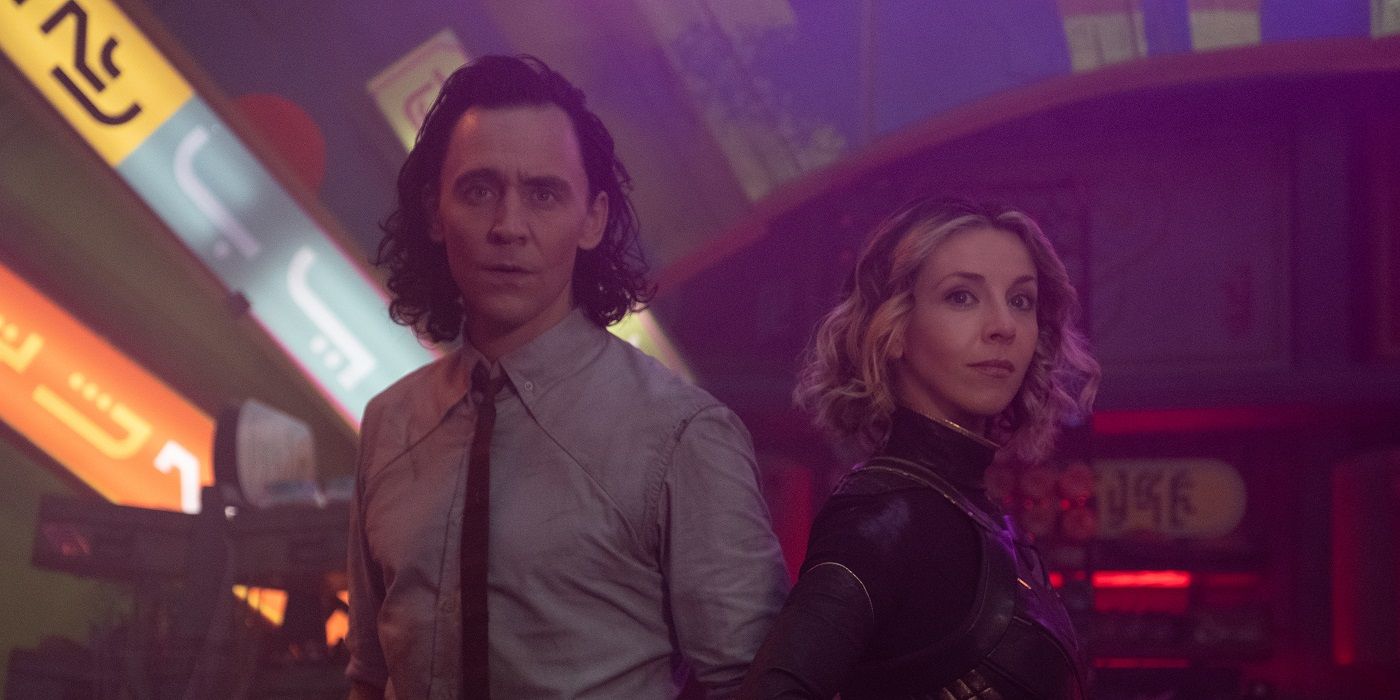
Loki’s long take begins as Sylvie and Loki enter a city full of desperate civilians fighting the guards and each other to find safety aboard the departing Ark. The camera keeps them in the center of the shot as the time-trapped duo begin to wend their way through tightly packed streets actively being damaged by a falling planet. The camera stays pinned as Loki and Sylvie dip into alleys and through corner bars, swiveling into a better position during a fight. The camera zooms in on Loki as he’s shoved to the ground by fallen concrete, swivels with grace as he magically shoves a falling building back on its foundations and eventually ends with a slow zoom away as their chance to escape on the Ark disappears along with the ship’s structural integrity.
It’s a show-stopper on par with True Detective‘s famous six-minute tracking shot, but Loki’s inspiration comes from another master of the long take, Alfonso Cuarón. Loki series producer Eric Martin noted the impact Cuarón’s Children of Men had on preparing the Shuroo sequence, and the same dramatic rules apply. The use of the long take ensures the audience is pulled deeper into the fear and rising tension that the characters themselves are feeling, subconsciously becoming more aware of time’s passage and the growing chance that something may go wrong.
Martin’s tweets also describe long nights as Loki’s crew fought to nail down the action sequences choreographed around Kasra Farahani’s production design. There’s no confirmation that Loki used the same new digital technology as The Mandalorian and several upcoming Marvel film products, but the results are on par. The hazy neon chaos and the set pieces the characters have to move around make the doomed Lamentis feel deep, lived in and ultimately, tragic.
The noir-style influences and high concept set designs shown off in Loki continue to prove that Marvel can do some amazing things on the small screen. But the draining terror and tension that follows the abrupt cut to credits at the end of “Lamentis” feel like a big-screen moment on par with the finale of Avengers: Infinity War or even the countless, haunting long takes of Children of Men itself.
Loki stars Tom Hiddleston, Owen Wilson, Gugu Mbatha-Raw, Wunmi Mosaku, Sophia Di Martino, Richard E. Grant, Sasha Lane, and Eugene Cordero. New episodes air Wednesdays on Disney+.
About The Author
