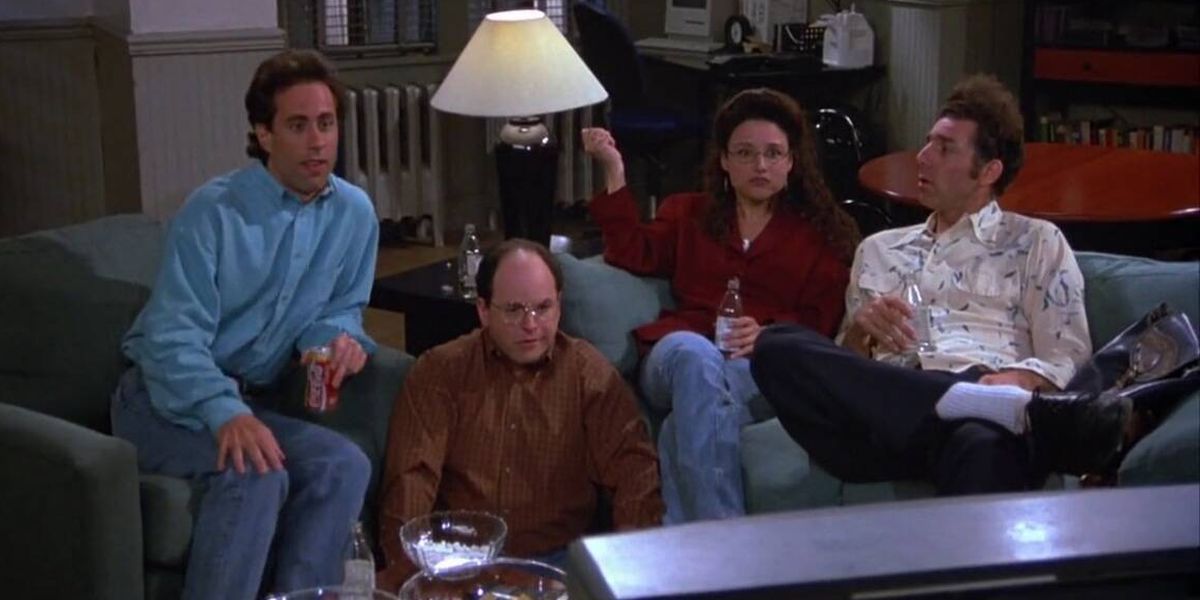
Seinfeld is rightly considered to be among the best and most influential sitcoms of all time. But before it entered its juggernaut status in the mainstream, the show was thought of as a chic oddity, constantly teetering on the brink of cancellation for its low ratings.
Following an unheard of five-episode first season, Season 2 saw Seinfeld on thin ice. With the show still struggling to find its footing, Larry Charles wrote an episode called “The Bet” that was so controversial with the cast and crew that it threatened to put the kibosh on Seinfeld for good.
“The Bet” — also known as “The Gun” — was set to revolve around two different wagers: Elaine betting Jerry that she would buy a gun to protect herself in the city, and Jerry betting George that Kramer is telling the truth about sleeping with a flight attendant en route from Puerto Rico. Charles, who directed Borat and wrote many of Seinfeld‘s darker episodes, based the story on the real experiences of Seinfeld writer Elaine Pope who had expressed a desire to buy a handgun.
In the lost episode, Kramer would take Elaine to see his friend, Mo Korn, a black market gun salesman who lives with his mother. Mo shows Elaine and Kramer several guns but Elaine backs out and buys a toy gun instead. Later in the episode, Elaine would accidentally pull out her toy gun in the airport and get swarmed by security guards along with Jerry and George, who would also wind up in jail — eerily foreshadowing the group’s fate in the finale.
The infamous episode was set to go into production as sets were built and actors were cast. Mo Korn was to be played by Ernie Sabella (who would later play Jerry’s naked travel companion in “The Subway”) and Bobbi Jo Lathan (who later played Patti the prostitute in “The Stranded”) was set to play the flight attendant before NBC pulled the plug.
Concerns by the network and the cast over the gun content led to the script being abandoned almost immediately after the table read. Julia Louis-Dreyfus recalls in a DVD commentary track that she felt uncomfortable with one scene in particular wherein Elaine mimicked the assassinations of former U.S. Presidents. Elaine was to point a gun to her head and joke, “Where do you want it, Jerry? The Kennedy? [pointing the gun at her stomach] The McKinley?”
Louis-Dreyfus, Jason Alexander and director Tom Cherones considered the material too provocative. Louis-Dreyfus told Alexander, “I’m not doing this.” Michael Richards voiced similar concerns about Kramer’s willingness to arm Elaine. The cast briefly rehearsed before refusing to make the episode, with the network’s approval.
Disappointed, Charles explained, “It would have been an interesting show, but we couldn’t solve the funny problem of it. It never seemed to be quite as funny as it should be and, because of that, the balance was off and the darkness kind of enveloped it.” As this would have only been the ninth Seinfeld episode ever produced, Charles realized, “This was one where it was maybe too much too soon.”
To quickly fill the production void, Larry David and Jerry Seinfeld got to work and wrote the classic episode “The Phone Message” in only two days to replace Charles’ controversial episode. The never-released episode also took the bold step of revealing that Kramer’s first name was… Conrad? When this episode was discarded, Conrad Kramer was lost to history along with it. Kramer’s real first name would remain a secret until “The Switch” confirmed his name as Cosmo in Season 6.
“The Bet” was an early example of Seinfeld pushing the envelope, but it was just too much of a risk to produce while the show was in its infancy. Its cancellation would instead make way for an all-time great episode that built the momentum for Seinfeld‘s steady ascent to greatness.
About The Author
