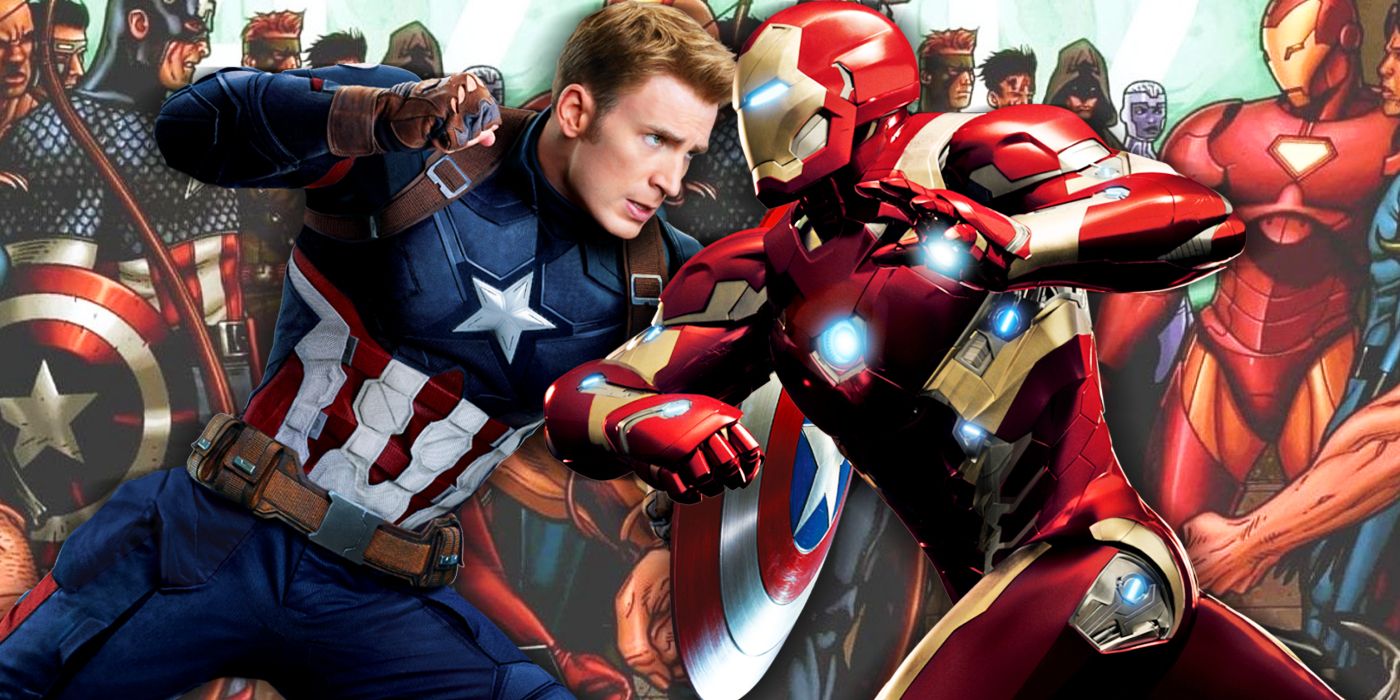
Captain America: Civil War is loosely based on Marvel Comics’ seven-issue event series, Civil War by Mark Millar and Steve McNiven. Much like the movie, the book sees Steve Rogers at odds with Tony Stark over the moral implications of the Superhuman Registration Act. The climax of the series features a massive brawl between both heroes and their teams that spills into the streets of New York City. While the film version of this battle is much smaller in scale when compared to the comics, the reasoning surrounding the fight makes the film’s version far better than the source material.
In the comics, Team Cap travels to Prison 42, a facility in the Negative Zone that houses super-powered heroes who operate outside the parameters of the SRA. Cap’s goal is to free his fellow heroes and escape before Tony notices. However, he is cornered by Iron Man and his own team, who aren’t afraid to put up a fight. Unfortunately, with no more room for negotiations, a fight is just what they get.

Compared to the comics, the film’s cause for the fight isn’t about a breakout, but rather stopping a larger threat. Steve and his team agree to get him and his best friend, Bucky Barnes, to a secret location where the film’s antagonist, Zemo, seemingly intends to release a squad of Winter Soldiers to destabilize countries. Before the fight even begins, it’s clear that the stakes that Steve is fighting for go far beyond the Marvel Cinematic Universe’s version of the SRA, the Sokovia Accords. Like the comics, Tony confronts Steve, but rather than acting on his own orders, Tony is under pressure from the government to apprehend Rogers before even worse people do it instead. There’s a desperation in his voice to protect his friends that isn’t felt in the source material.
However, from Steve’s perspective, he is finally choosing a side in an internal conflict he’s been struggling with since he was thawed out. Wrestling with balancing his past and present, he chooses to fight for Bucky, the same way Bucky fought for him nearly a century ago. But as a result of his choice, he sacrifices Tony’s friendship and the Avengers, the only family he’s known since his return.

In the book, there is no internal conflict with Steve or Tony. Instead, they act as two stubborn leaders who become so lost in their ideals they nearly kill each other in the process. A fight of that magnitude could work in comics after over five decades of stories, but it couldn’t be translated into live-action as these characters hadn’t even been around for a decade at the time of the film’s release. So instead, the movie goes for an emotional foundation that works wonders for the scene as a whole.
For Stark, his motivation to fight centers on his internal concerns of another invasion and his belief that the best way to stop it is the Avengers, the same team that he is struggling to keep together. For Steve, the same ideals that got him through World War II and led him to stand against Hydra are being called into question and considered criminal. This is happening while trying to help his best friend, who is just as much of a victim in the entire situation. While both versions of the story end in a scuffle, there’s no doubt that the emotional weight carried by the characters and driving the fight place the big face-off in Captain America: Civil War far above the comics version.
About The Author