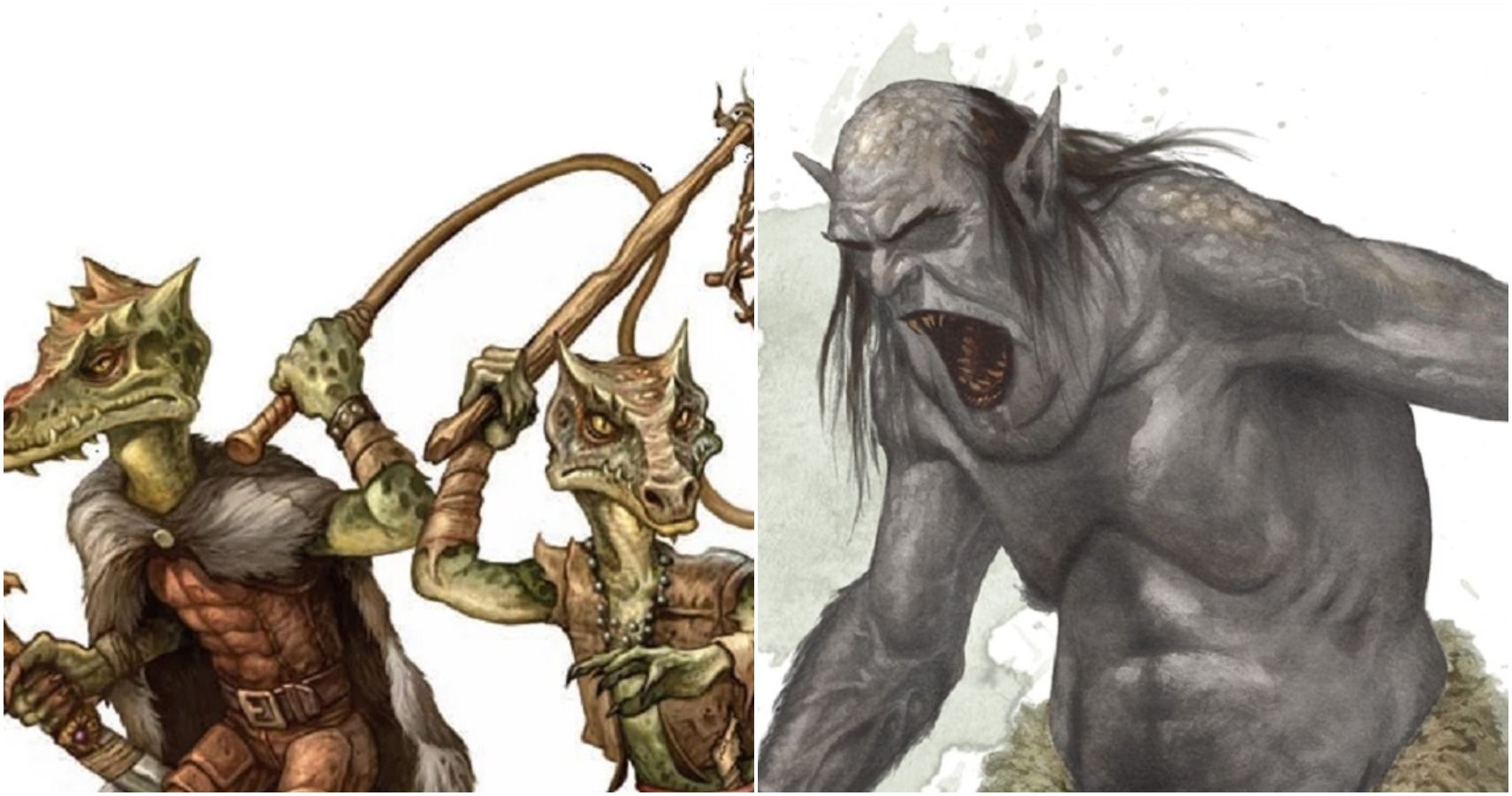
Every quest and grand adventure has to have a beginning, and part of most Dungeons & Dragons quests involve some form of combat. Choosing the appropriate type of foe for the players is important in setting the tone and making the players ask the right questions about what the DM is planning. Monster manuals and magical items will only take a character so far, and they need realistic encounters with authentic progression, quality rewards, and believable stakes.
The following not-so-intimidating foes are perfect practice for adventurers when it’s time to sharpen their skills and hone their battle prowess. These assailants are chosen for what they bring to a story, how easily you can ramp up or tone down their difficulty, and what thematic setting they best fit.
Updated by Kristy Ambrose on June 3rd, 2021: The D&D universe is always expanding. New modules, extra supplemental materials, and updates to the Player’s Handbook seem to come out every couple of months, and when you add homebrews to the mix, there are even more options for DMs who are trying to create fun and fantastic but also realistic experiences for their players. That’s why we’ve decided it was time to change our list accordingly to better show what a DM can offer a fledging adventuring party.
13 Goblins
This should be familiar to everyone. Even those who don’t play D&D have an idea of what these guys are. Green, nasty little things skulking in tunnels brandishing knives and eating whatever wanders in. That’s one interpretation of them. Goblins can be pretty much anything to anyone, a pack of nasty tunnel dwellers, an organized hit and run ambush force, or a clandestine group of city thieves.
They are versatile, have low HP, and move in packs. Furthermore, it can be decided that they employ poisons, tactics, and traps that turn a supposedly low-level encounter into a danger to even high-level heroes. They fit anywhere, can be easy or hard depending on how they’re played, and come in a surprising amount of variations like rock, city, or aquatic goblin variants.
12 Giant Rats
A lot of creatures on this list are smart enough that a good bard might be able to sing a tune or crack a joke to avoid combat altogether. That doesn’t work with giant rats. They’re always hungry, traveling in packs, hiding in shadows, scampering around, and flanking their soon-to-be meals. Giant rats pose a real threat through their numbers and ability to hide, effectively making for an excellent low-level challenge for adventurers.
They generally travel in packs. When a hero spots one, it means there are likely several more hiding nearby becoming bolder and more ravenous. Maybe whatever inn the heroes are resting at requests help with a rat problem in the cellar, and BOOM, instant quest.
11 Bandits
An average low-level street thug with a knife in their hand looking for a little extra coin. A refugee on the road hungry and starving forcing them to try their luck at stealing. A teenager holding a blade in an act of defiance, too stupid to back down, not bold enough to actually fight. The Bandit fits in anywhere, from the road to the alley, from forest to an ocean, always ready to deprive travelers of coins, treasure, or dignity.
Their real strength is in what your story makes of them, their background, and why they are bandits is what can lend weight to your setting. They can be a hard encounter when they come in numbers and have a reason to fight, or easy if they are all just cowards. The first one to fall may cause the rest to flee, or maybe the fifth one will, it all depends on how well the party is doing. Either way, they’re only a bland encounter if they’re made out to be.
10 Flying Snakes
In the world of D&D, one can’t always assume that the sound of an airborne creature is a bird or something similarly harmless. It could, in fact, be a flying snake. As if snakes on the ground weren’t already terrifying enough.
Nightmare fuel aside, flying snakes are a low-level challenge. Mobile creatures who have low damage melee bites with decent poison, and no one ever sees them coming. Well worth putting them in just to see the surprise on the party’s faces.
9 Grimlocks
When looking for something that’s actually evil, something that no party should have any qualms stabbing to death, the Grimlock is a good choice. Any underground environment with dark corners could hide these hideous and blind medium-sized creatures. Grimlocks are vicious and cruel but are vulnerable to light giving the low-level party an easy escape should the cramped tunnel combat with these creatures turn sour.
There are easy enough ways to insert them, but they are fantastic low-level enemies when on a quest in the Underdark. One could even put them in a tunnel at the bottom of a well just to shoehorn them in.
8 Zombies
These can be tougher monsters, but there’s only so much a creature this slow and compulsive can do. It’s one of the easiest types of undead for first-level heroes to deal with. They’re found in ancient crypts wandering halls protecting lost treasure, wandering through unkept graveyards, or in the basement of the town cobbler who just happens to moonlight as a necromancer.
DMs that have a sadistic streak, can have some fun with this. The lowbie variety is the type of mindless critter that infests graveyards or old tombs and is mostly harmless unless approached. Bear in mind, however, that these don’t necessarily have to be humanoid. A creative DM can do a lot with this concept in a haunted forest or a wizard’s tower, for example.
7 Skeletons
They are versatile, skeletons being quick and nimble with their dangerous damage-dealing blades. Zombies being slow and tanky, taking hit after hit and refusing to die. Regardless of which one you choose or where they are, you can always find a way to sneak them into a game.
These tend to be faster and better equipped than their undead counterparts. They aren’t generally sentient, although they certainly can be, and often move with purpose and are often under the control of a more powerful character.
6 A Dire Wolf
A singular hulking carnivore stalking the woodlands. Sneaking up close using the foliage to attack unwary adventurers at night, then breaking away into the bushes to attack again in a few short moments. These creatures excel as antagonists in wilderness environments. Nothing is quite as harrowing as hearing a mournful howl before the sun goes down and the party finds itself alone in the dark, in the woods.
Give some exposition of luminescent eyes in the bushes and rustling in the undergrowth, and your party will be on their toes in seconds. Just be warned, someone might try to catch it and make it a pet, and this generally ends badly.
5 Kobolds
Not to be confused with Goblins, these little dragon worshippers are a lot of fun as NPCs. They are excellent trap setters and absolute cowards. Having a party chase some screaming Kobolds through a maze of traps is a good way of introducing players to the concept of traps.
They aren’t necessarily evil, can be reasoned with, and won’t last long in a fight. However, these little guys know exactly what their limitations are and work around them. Kobolds stealing supplies from a local township and little trap maze makes for a great starter quest.
4 Ghouls
This is a step above the usual low-level undead but not quite as quick or dangerous as a skeleton. A corpse eater is a lanky and agile undead abomination that skulks across graveyards and burial sites. It’s easy enough to have one of these creatures plaguing a local town digging up their graveyard for food at night. They have multi-attack and poison which inflicts paralysis making them a good fight for first-level adventurers.
A little sneaking and ambushing action on the ghoul’s part followed by a fight can make a fantastic night encounter. It’s also worth mentioning that ghouls tend to create more ghouls. If the party kills the first one a little too easily, you can always have more ghouls show up.
3 Gnoll
Several of the more antagonist races in the D&D universe have different cultures and backgrounds but they serve the same role essentially. Gnolls fall under the category of raiders and ravagers looking for blood and combat.
Gnolls are some of the more craven of these groups, and they’re more likely to be a nuisance in the wild, along quiet roads and isolated rest stops, than in larger human settlements. Sentient and intelligent but heartless and deadly, these creatures use sniping and sneaking to catch their enemies off guard, so they’re still a challenge despite their low level.
2 Orc
The Orcs of D&D can be allies or antagonists depending on what kind of game you’re playing. A tribe of one of these groups is likely to show up in rural towns or cities, and residents near them will pay well to have them removed. Having two or three members of one of these groups accost the heroes or the area in which they are adventuring is a good first encounter.
These enemies are pretty much all brawn and muscle looking to overcome their foes with the strength of arms, making it a simple but classic encounter. There are magic users among Orcs but their skills are intuitive as opposed to learned.
1 Lizardfolk
Probably the most sophisticated race lower-level players will face, and like Orcs, the term “lizardfolk” can mean a lot to a creative DM. This might be the first time the adventuring party has faced melee weapons along with magic users, but their knowledge is still at a primitive level.
These creatures are often found in swamps or jungles and are fiercely protective of their own territory. They also have all of the advantages of water-dwelling animals, like being able to hold their breath and bonuses to movement in aquatic environments.
About The Author