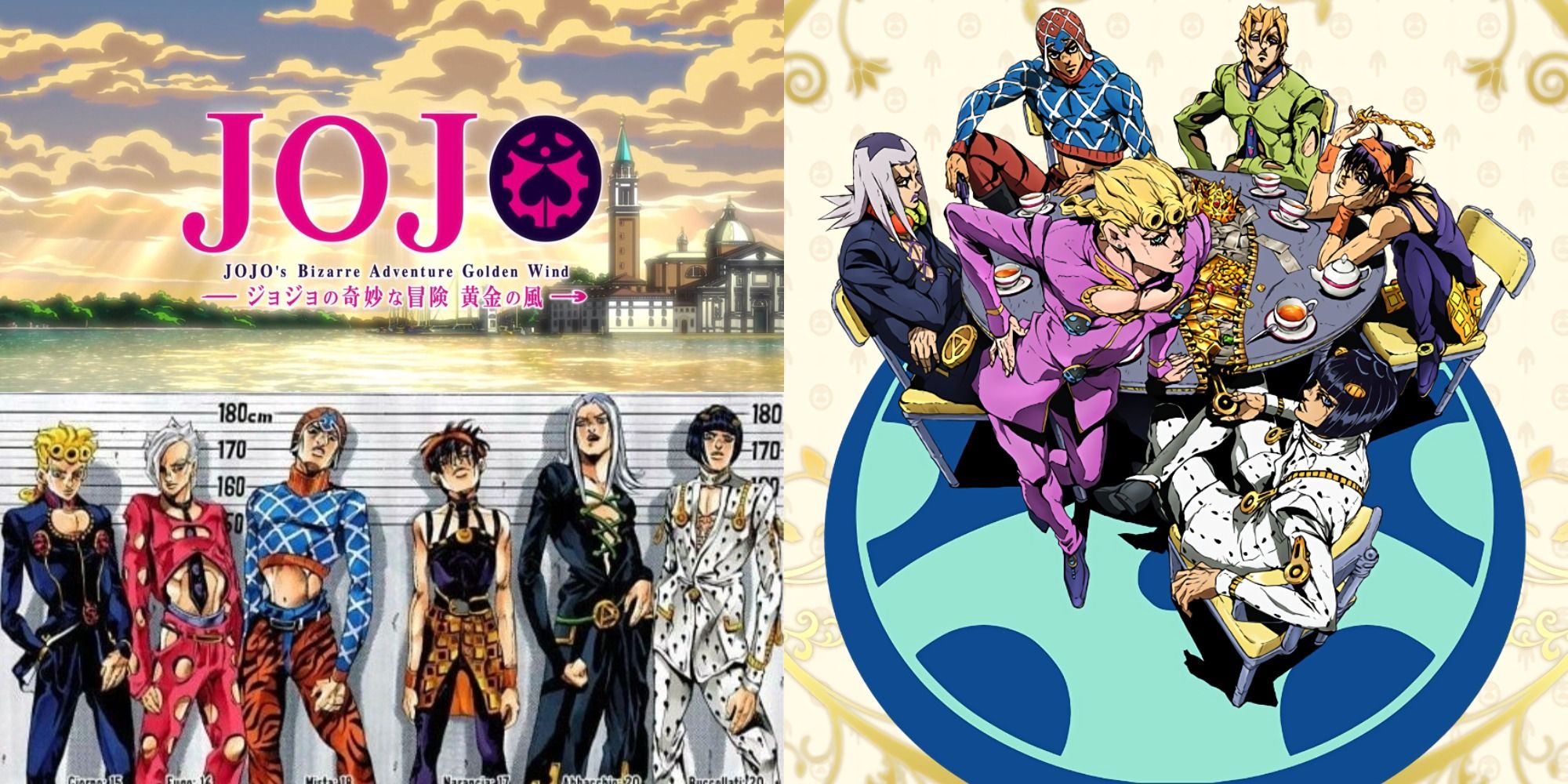
With any manga to anime adaptation, there are going to be inconsistencies. Some of them make sense in terms of adapting one form of media to the other. Some of them are a result of the anime getting too far ahead of the manga and making up its own ending.
Fortunately, JoJo’s Bizarre Adventure probably won’t have this issue until a few more years down the line. To date, all the parts that have been adapted were already complete in the manga. The most recently completed season, Golden Wind, focuses on Giorno Giovanna and his journey to become a Gang-Star. There’s a lot to unpack with Golden Wind between its philosophical ideation about fate and its mind-boggling Stands. Hirohiko Araki’s storytelling in Part 5 flourishes, and fans of the manga can see this carrying on through Parts 6, 7, and 8. But like all adaptations, Golden Wind has its ups and downs.
10 BETTER: The Style Of Italy Was Accurately Reflected In The Anime
The production team put blood, sweat, and tears into its portrayal of Italian locations. During the location scouting phase, the team actually replicated Giorno’s week-long trip around the country, proving that the Golden Wind route is doable but exhausting. With this knowledge, the team created some of the most stunning backgrounds of the series.
There is incredible attention to detail in every background and location Bucciarati’s team explores. Naples is Naples. Pompeii is Pompeii. Seriously, the dog mosaic exists and tourists can go see it. The travel times, by train or car, are accurate. All of these finer details help add authenticity to the experience and for many fans familiar with Italy, it really did so much for story immersion.
9 WORSE: There Were Minor Details That Led To Confusion
This falls into the realm of very nit-picky details, but they were enough to confuse some longtime fans. The worst offender is the DIO photo in Giorno’s wallet. The anime reused the image Joseph Joestar generated with Hermit Purple way back in Stardust Crusaders for the signed photo in Giorno’s wallet. This caused viewers a moderate amount of confusion, labeling it as another “Araki Forgot” moment. In reality, Araki used a different picture of DIO in the manga, so this wasn’t an issue for the manga readers.
Though incredibly small, these details can shake longtime fans’ suspension of disbelief and detracts focus from the story and characters. However, most anime-only viewers either didn’t notice or didn’t care, so it’s a relatively minor issue in the anime.
8 BETTER: Fugo’s Character Is Given More Of A Backstory
In the manga, Fugo didn’t have much of a backstory. In the midst of every other gang member having their backstories revealed, he felt out of place and hard to sympathize over. This may have been done intentionally as originally, Araki planned on having Fugo betray the team. However, due to a rough patch in his life, Araki ultimately decided against it and had Fugo quit instead.
By the time the anime was in production, the animation team knew how Fugo’s story would end. This allowed them to shape his character more, giving him the young genius backstory as well as including a short scene of him when Narancia died in the final battle.
7 WORSE: The Color Palette Change Did Not Suit Certain Characters
Giorno’s color change from the navy suit to the fuchsia one makes a lot of sense since Narancia and Abbacchio have a dark color as their base. The fuschia helps Giorno pop out from literally everyone, which is important for the protagonist to do.
However, the most hotly contested color palette change is Fugo’s. The white and red may have confused the eye for any scenes with Fugo and Bucciarati in the same frame, but the green and purple chosen for the anime seems almost too tame for Fugo’s character. At the very least, his hair could’ve stayed white.
6 BETTER: Giorno’s Gelato Moment Establishes His Duality
In the first episode, Giorno buys a child some gelato with money he stole from two tourists. The anime team decided to add this in to make Giorno a more compassionate character, considering he just stole money from people. While this scene doesn’t exist in the manga, it’s a nice indication of the nuance in Giorno’s character. Throughout Part 5, he wavers between Dio’s ruthlessness and Jonathan’s compassion. Establishing this duality in the first 10 minutes of the first episode is genius.
5 WORSE: Haruno Shiobana’s Design Is A Lot Creepier In The Anime
To many, anime Haruno looks almost creepy and it’s unclear whether or not this is intentional. Maybe it’s due to the transition from manga to anime, with this version of Haruno being the easiest to keep consistent across the different artists working on the project. Whatever the reason, Haruno somehow looks much cuter in the manga than in the anime.
4 BETTER: The Torture Dance Was An Iconic JoJo’s Moment
The highlight of Part 5 has to be the Torture Dance. The manga only dedicated four panels to the dance and for some glorious reason, the anime turned it into a psychedelic dance sequence. It’s both exactly what fans expect and still extremely bizarre to include. However, the underlying implication that Narancia, Fugo, and Mista grew so close as friends to create an entire Torture Dance is grotesquely adorable.
3 WORSE: The Anime Makes Giorno Giovanna Look Too Old For 15
Tying back to Haruno Shiobana, Giorno Giovanna really doesn’t look like a teenager in the anime. Though the anime remains loyal to Araki’s style, manga Giorno definitely has more of a baby face than anime Giorno. Most likely, this is due to the more angular shapes in the anime whereas the manga version of Giorno seems to have much rounder, softer features.
2 BETTER: It’s Easier To Make Sense Of How King Crimson Works
King Crimson is still a very broken Stand, but it makes much more sense in the anime than it does in the manga. This is where the anime has the biggest advantage, utilizing both audio and visual cues to get the point across. The skipping frames and loud noise associated with King Crimson really help the audience understand its time-erasing power.
In the manga, time is really the one constant throughout the story. The panels have a set flow, so skipping a panel causes mass confusion for all involved. King Crimson breaks the fundamentals of how to read manga, so its transition to an animated format makes its power far more understandable.
1 WORSE: The Sleeping Slaves Arc Needed More Time
To be entirely fair to the anime, the Sleeping Slaves arc confused many fans. It’s very intentionally placed at the end of Part 5 for a reason, but it takes some thinking to figure out why. While the production team definitely understood that meaning, it didn’t make the transition any less jarring.
This arc is probably where the manga has the biggest advantage since, at the time of release, it’s much easier to go back to the manga than it is the anime. The manga also has the luxury of taking its time. The story ends when Araki wants it to end. On the other hand, the anime has a budget that it needs to stick to. While JoJo’s is allowed more episodes per season than most – usually 39 compared to the typical 17 to 26 episode season – it still has to tell the full manga story in a given amount of time. While the Sleeping Slaves arc was well-paced for the anime, there are story beats from early in Part 5 that would have contributed toward the arc more and really pulled the story together.
About The Author