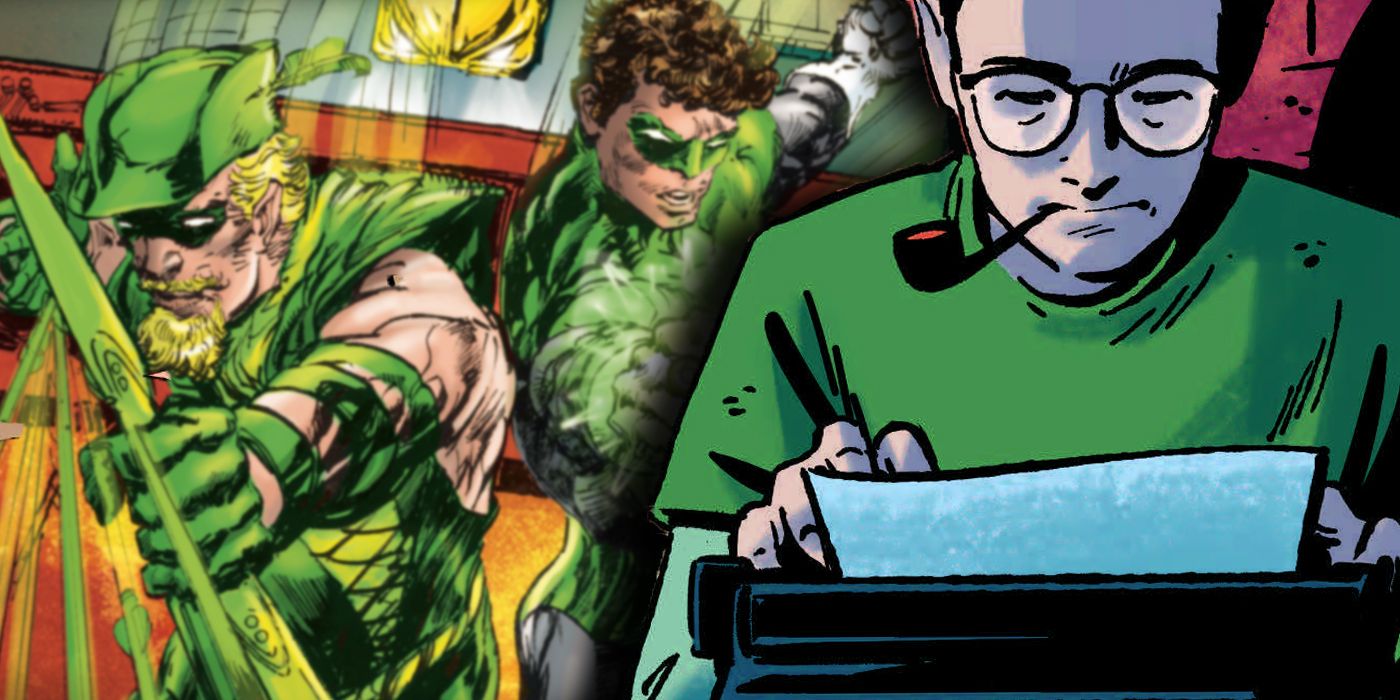
Later this month, DC will be releasing Green Arrow 80th Anniversary 100-Page Super Spectacular #1, featuring various stories celebrating 80 years of the famed archer superhero. One of the stories in the volume, “Tap Tap Tap,” by Larry O’Neil, Jorge Furnes and Dave Stewart, is a wordless tribute by O’Neil (a writer and director who has written professionally for HBO, Warner Brothers, Fox, MGM, Lion’s Gate, and Artisan) to his father, the comic book legend Denny O’Neil, who famously revamped Green Arrow in the late 1960s with artist Neal Adams before launching the character into an iconic series of team-ups with Green Lantern in the early 1970s.
“Tap Tap Tap” follows the life of O’Neil’s father from his childhood through his passing last summer at the age of 81, showing the evolution of O’Neil’s legacy as comic book superheroes went from the niche fringes to being the centerpieces of yearly billion-dollar blockbusters and how O’Neil’s involvement in that history impacted his life. CBR spoke to O’Neil about his touching tribute to his father.
CBR: Right off the bat, now that I have the chance, I wanted to give you my condolences on the loss of your father.
Larry O’Neil: Thank you.
He was such a great man and such a great part of our comic book history.
Yes, indeed. Thank you for saying that. It’s weird, I just saw a fan-made video about his time on Batman and it was quite detailed and long and really good.
Oh, excellent. I was lucky enough over the years to correspond with your dad a little bit over the years, although it’s interesting that, for what I write about with comic book history, your dad, while very friendly and approachable, was a bit like Stan Lee in that he was quite open with the fact that he couldn’t remember most of the small details about his work in the past. Was he like that about other stuff growing up?
It’s interesting. He had quite good recall for stories that he had written, but yes, he wasn’t really a historian in particular. We’d always talk about how a fan would say, “There was this issue in 1977 when a villain had this detail, but that doesn’t really resolve with this issue from 1997” and he would always say, “Because it was a different writer?” He didn’t really care about that sort of continuity. He cared a great deal about continuity within a story or an arc, though.
I was just recently doing articles about the 50th anniversaries of Talia and Ra’s al Ghul the last couple of months and it was interesting reading your dad’s various interviews about the stories of those characters’ creations and they’re almost identical, with some of the different interviews being many years apart.
Yes. It’s funny, as this was the kind of writer he was. He didn’t tend to think in terms of essays, but if there was a narrative to describe the birth of a character or the creation of a story, he would remember it like it was a story, so that makes sense that he would tell the story the same way each time. It reminds me of a strange anecdote. He had a massive heart attack in September of 2002. He was actually clinically dead in a restaurant. Luckily, it was right next to a firehouse and they brought over a defibrillator that shocked him back to life and he got another almost 20 years, so that was great. But right after the defibrillation, it was like the movie, Memento, where his short term memory was completely gone after a couple of minutes. So I rushed up to the hospital and I would explain to him, “Okay, pops, this is what happened to you at lunch in this restaurant” and every time, he would get this look of astonishment and make a joke and the joke was never the same each time. And then two minutes later, he would ask me, “Okay, level with me, what am I doing here?”
That’s hilarious. Now obviously, this was a very personal, very touching story for you. I love the title of the story, “Tap Tap Tap,” as obviously that must be a sound that you remember a lot growing up with your dad.
Yeah, the sound of tapping was definitely a sound I grew up with in my childhood.
I like the sense memory aspect of it all. I imagine if you heard someone tapping on a typewriter right now it would bring you right back to that era.
I think so. It was one of the earliest sounds I can recall. We were on East 6th Street between C and D for my first memories. That apartment actually was used in a Samuel R. Delany experimental Super 8 movie, “The Orchid,” so I actually got to see a little bit of my childhood apartment not too long ago when I watched this old, interesting film by Delany.
That’s fascinating. Jorge did such a marvelous job on this story. How much photo references did you have to give him, because he put so much different details of your father’s life in here.
Yeah, I gave him a ton. I went back and scanned a lot of old photographs. There’s a lot of actually good pictures of my father out there on the internet, but I did dig deep into the boxes and, like, “Okay, this around 1986. This one is around 1992” and so on. I think Jorge not only got my father’s likeness well, but also the clothes and the backgrounds and my father’s wife, Marifran, and different periods in their lives perfectly. So yeah, I provided him with a lot.
It’s funny, now that you mention it, a lot of those shirts that he wears in the story actually do look like what I’ve seen him wear in photos of him from over the years.
I also gave him references for me, as I appear in the story twice, once as a little baby and once as a 10 or 11 year old. Jorge put so much interesting actual details into the story. My father actually did have a dummy in his bedroom near the spot where he died. He had been fascinated by magic as a kid and ventriloquism and so a month or so before he died he asked to have a dummy so I bought him one. He was thinking about a routine or something that he could do with it. It was nice to see these subtle Easter Eggs in the comic for people who knew him.
Here’s an odd question that occurred to me. Early on, when you show your dad’s naval service, he’s reading a detective comic strip. Obviously, you had to keep it vague for the characters that DC does not own the rights to, but who was that intended to be? Rip Kirby? Dick Tracy? Possibly even The Spirit?
Oh, it’s funny, that was just supposed to be a generic detective character. I was not specific at all, I just said a detective crashing through a window. For the cowboy, I said somebody like Lash Larue or like the Lone Ranger.
It’s interesting how this story gets across the different ways people of your father experienced pop culture, which was through the radio.
Yeah, I specifically recall my father talking about those radio shows. He liked Roy Rogers and the Lone Ranger. He also specifically mentioned enjoying the movie cowboy, Lash Larue, who was famous for his whip skills.
Did you talk at all with your dad about doing a tribute to him after his passing?
No, I wasn’t thinking about doing a tribute at all, to be honest. I mean, I’ve always been interested in the comic book guys of his era, because to hear my father describe it, comic book writing was this interesting thing in that it wasn’t a glamourous way to be a writer. There was this push and pull, where it was a little bit shameful, the sort of thing that you wouldn’t want to admit at a cocktail party that you wrote comic books. I don’t know if everyone from that era would agree with that, but that was certainly something that my father struggled with a little bit during his life. On some level, he liked that comic books were a sort of counter-cultural, hip and strange thing that was inter-generational and at the same time, he struggled a bit with, “But does my mother-in-law disapprove of this?” So I’ve always found it interesting in what it was like to be a comic book writer in the 1950s, 60s and 70s, but I had no particular idea that I was going to write this until the lovely, generous editors at DC contacted me to see if I wanted to do something, perhaps a two-pager, for this special.
I pitched them two ideas. One of them was this one and the other one was actually very dialogue-heavy, a totally different approach than this one. Neither of the ideas, though, was ever going to be two pages. So they read them both and while they liked them both, they particularly liked this one and they said I could do six pages and I said, “Great!” So no, these are stories that I heard from my father my whole life but I never talked to him about writing it before he died. I wish that I could have talked to him about it.
I think that you really capture, in the progression, how your dad’s view changed over the years from, “Would anyone care about this?” to “Okay, this is clearly art and I appreciate it, but will it ever be mainstream?” to the end of his life, where he got to see just how mainstream superhero comics have gotten with the proliferation of comic book movies.
I’m glad that that came across.
As you noted, that was such a weird thing for these guys. Like, in 1966, when your dad first started writing comics, that was before Stan Lee was even doing those college lectures that saw comic books (Marvel in particular) be embraced by the college crowd or articles in the Village Voice about how hip comic books were. So when he started, it really wasn’t even slightly glamorous of a job. While by the early 1970s, your dad got to see some sort of acknowledgement of their work.
Yeah, those were heady days for my father. “Comics go relevant” and Village Voice articles about comics.
I was just reading a piece that your dad wrote for the Village Voice.
Oh, did he? I didn’t even know that.
Yeah, it was a little bit later, in 1980. When he passed away, they reprinted it. It was a book review of a then-new satirical superhero novel, Superfolks. It must have been a kick for him, since the Village Voice was obviously such a major influence for him during the time, that you noted, about “the age of relevance.”
It’s funny, it was Bob Dylan’s 80th birthday the other day and for his 80th I collected 80 references to Dylan in comic books over the years and your dad popped up more than a few times.
Yeah, that doesn’t surprise me. He was a huge fan of Bob Dylan.
It definitely fit into the “age of relevance” to go from a Bob Dylan quote right into a “relevant” story topic.
What’s interesting is that I had never written anything in comic book form before this, and while it came to me fairly easily as it is so similar to writing screenplays and I have had experience with writing screenplays before, but somebody asked me whether I gained any insight into my father from writing a comic book story and I thought about it, and while I knew all of these stories about his life and he was so open about it all that I didn’t uncover anything new about him from that angle, but I did get to viscerally feel something that made me think, “Oh, this is how my father must have felt” and that was when I first saw the pages drawn by Jorge. My father often complained about when an artist didn’t get the story across as well as he would have liked, that they were emphasizing pretty pictures over the nuts and the bolts of the story, but at the same time, he also talked about the opposite, where he felt that an artist really elevated his story, finding an emotional beat in the story that he didn’t see the same way and I really felt like I had that experience with Jorge’s art, when you finally get to see the inks and you’re like, “Oh my god. Oh my god, this person took my word and elevated it and emphasized things and told it in an incredibly beautiful way” and I thought, “This must be what Denny felt when he saw Neal Adams or Michael Kaluta draw his scripts.”
What’s striking is that when your dad was working at DC in the early 1970s, he was working full script and literally did not know who would be drawing any given script most of the time, and in fact, in the famous first issue of Green Lantern and Green Arrow teaming up, he actively assumed that Gil Kane was going to draw it, as Kane was the regular artist on Green Lantern at the time, so imagine how he felt when he saw Neal Adams draw that issue instead! It was must have been quite the experience for your dad.
Yeah, I bet that it was. I think that human beings tend to focus on the negative more. You know, bad things hurt more than good things feel good, so while he would often get caught up on the artists who screwed up his stories, I know he appreciated the great artists he worked with, as well, like Neal. I remember there was one specific panel he talked about from a Batman story where there were two panels, a punch and an emotional catharsis moment and Denny imagined the punch being the big panel and the emotional reaction the smaller one and Neal reversed it and Denny noted, “Oh my god, he got it exactly right.” The emotion was more important than the action.
That’s what was so interesting about your father’s work on Batman. When he passed away, I wrote something like six or seven spotlights on his various works and one of the things that stood out that I wrote about was how much he made a point to make Batman feel like a human. The more you break him down, the better you can build him up. The more vulnerable you make him, the more relatable he can become and that was a big part of your father’s early Batman work with Neal Adams (and other artists of the era, of course, like Irv Novick and Bob Brown) and it made the character more realistic than people were expecting of the era.
Yeah, without a doubt, I think Batman was a character that my favorite could emotionally relate to.
Speaking of his Batman run, your dad had an interesting statement when discussing his Batman run and how he never really felt like he DID have a Batman “run.” He would recall, “All those Batman stories I wrote I was never the Batman writer, and I never had a contract, even an informal agreement. It was just that I would show up on Thursday morning and go to Julie Schwartz’s office and he would give me a job that was often Batman.”
That’s interesting. I never thought of it from that perspective. I would see his name on Batman, Detective Comics or Batman Family, but perhaps he never had a consistent run on any of them.
Well, I mean, he more often than not ended up writing a Batman comic pretty regularly, but mostly because, if you had the option of having a Denny O’Neil story, you were going to get a Denny O’Neil story if you could.
That’s nice to hear. Was that always the case?
Well, at least in the early 1970s it certainly was.
Yeah, Denny always spoke very fondly of his working relationship with Julie Schwartz. He thought super highly of him.
I appreciated how your story didn’t gloss over your father’s alcoholism, as that had such a major impact in his life. It was obviously something that your dad never shied away from talking about, but it was still notable to see it worked into this narrative of his life here.
Yeah, there’s nothing in this that Denny wasn’t quite public about. He was pretty open about his vulnerabilities.
And he clearly brought some of those vulnerabilities right into the comics themselves, like his famous run on Iron Man in the 1980s where he felt that Tony Stark’s alcoholism should be given a more serious depiction than its initial “sober in one issue” depiction.
Yeah, for sure.
That panel that you have of him taking you to kung fu movies when you were a kid and he was obviously writing kung fu stories at the time, so when you were a kid, was it cool that your father was writing kung fu novels and comic books?
It was. It was interesting. I mean, I quite liked that my father was a storyteller and he passed on that love of telling stories to me. That shot of us coming out of the 42nd street movie theater was very realistic as to what was happening at that point in time. I saw him on Wednesdays and Saturdays and we would go to the movies. And often, we would see some sort of exploitation film in Times Square or the Village. I saw a lot of stuff I was probably a little too young to see at the time, but it was all okay, I came out all right in the end.
As to whether it was “cool,” at every school there would always be, like, three kids who would just tell me, “Your father is Denny O’Neil? Your father writes comics?” and were really into it, but it wasn’t like having a really famous person as a parent. It was a parent who, for a very small sliver of the population it would be as if your father was like Jimmy Page, but for most people, it wasn’t a big deal and it was just, “Oh, your dad is in media somehow.”
What’s funny, though, as you sort of point out in the story, is that if you tell someone Denny O’Neil is your dad in, say, 1978, is one thing, and now that everyone knows everything about comic books, telling someone that Denny O’Neil is your dad in 2018 has a much different impact.
Yeah, exactly. Like telling someone, “Oh, you’ve seen the Christopher Nolan Batman films? Well, my dad created the character that Liam Neeson plays.” “Oh. Oh! Wow, okay.” It’s a whole different reaction.
You mention your father’s love of storytelling passing on to you. Did he foster your career as a writer or was he hesitant about you going into a similar field as him? Was he pro you becoming a writer?
Yeah. I mean, I went to a arts high school, so it wasn’t a surprise. Honestly, we didn’t talk about it that much. He knew that I was interested in art. At first I wanted to be an artist. I guess I imagined that I would dabble in comics when I was really young. It certainly wasn’t a problem for him, at least. My father had to deal with a lot of emotional baggage, like his parents thinking, “This isn’t the career of a man. This isn’t what a man does.” The idea of him going to New York to become a writer was seen as sort of kinky and unreliable. So I think that he grew up feeling that the things that he was good at were things that were not valued by his culture. “I can’t hit a baseball. I can’t organize my desk. But the the things that I am really good at were just seen as ‘cute.'” His parents certainly appreciated him writing plays in high school or poetry, but they didn’t respect it as a career trajectory. So I think that he always had to overcome a little bit of the sense of “Do people really value what I do? Do they value my choices? Am I doing the right thing?” Because he grew up in this culture that did not value the things that he was good at, he grew up a little isolated, a little bit different from everyone around him. He certainly felt like that while he was in the Navy. It’s not really an accident that he became associated with a character who felt so lonely and abandoned. I don’t think that’s saying anything that Denny hasn’t said himself about how he related to characters like Batman.
Definitely.
An interesting thing about the end of “Tap Tap Tap,” is that I had written in a few characters that DC no longer had the rights to, like the Shadow and Fafhrd and the Gray Mouser. It was still a crowded room, though, of course.
Yeah, that final panel was a powerful image and that’s what you imagine any creator hopes for, that you left behind this legacy of work that will last well beyond your time.
Thank you, that’s very well said.
Green Arrow 80th Anniversary 100-Page Super Spectacular #1, including “Tap Tap Tap,” goes on sale June 29 from DC.
About The Author
