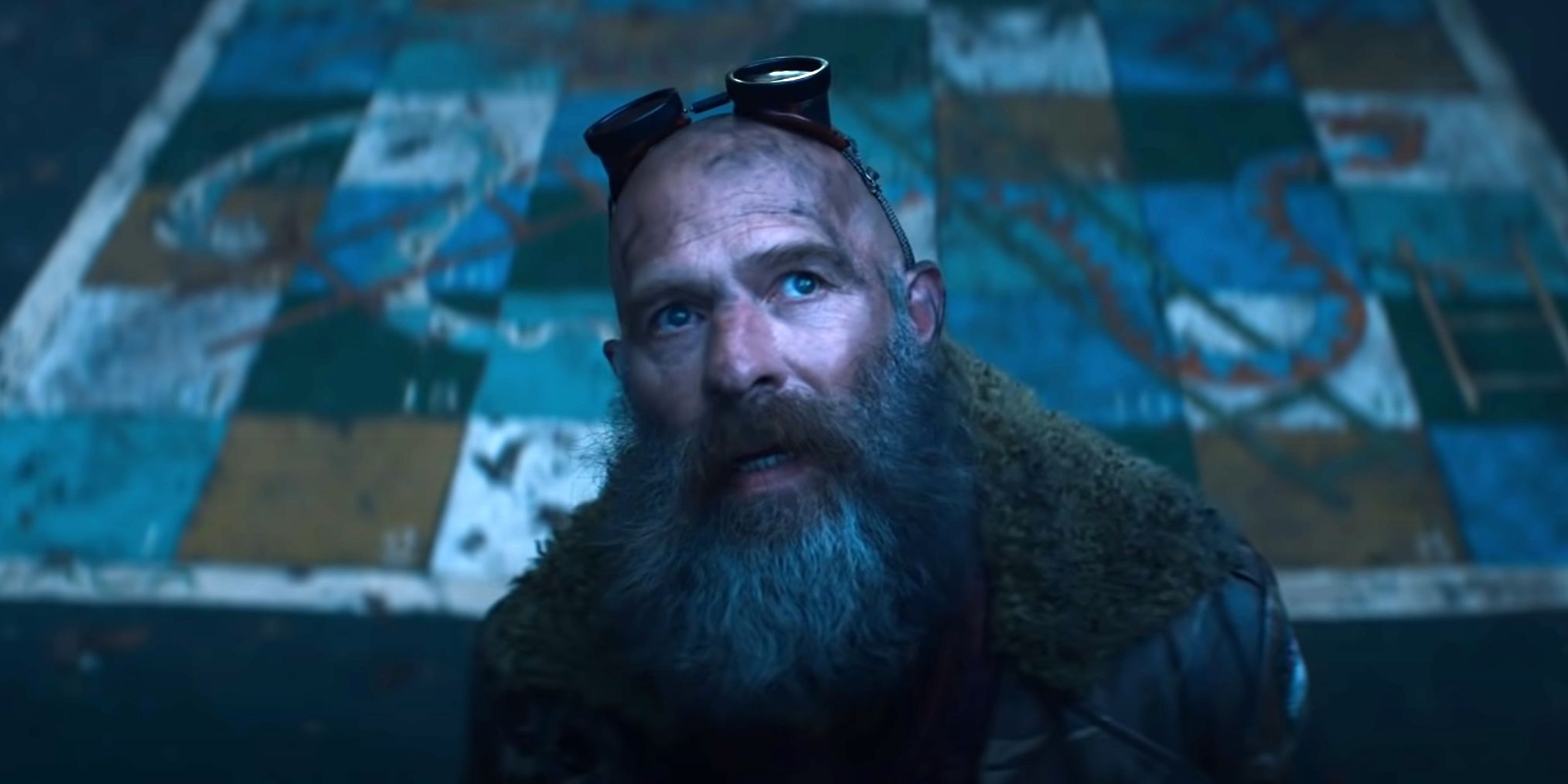
Created by Jeff Lemire, Sweet Tooth saw its two protagonists, the young human/animal hybrid Gus and the older Jepperd, working their way through a post-apocalyptic world that was hostile to the former character. Among those threats with whom Jepperd and Gus were forced to contend was Abbot, a militia leader who was willing to use whatever means necessary in his quest to save humanity. Netflix‘s upcoming adaptation of Sweet Tooth will present a new twist on the villain, where he’ll be played by Neil Sandilands.
CBR talked with Sandilands, who is known for such roles on The Flash and The 100, about why he was interested in playing General Steven Abbot and bringing the villain to life on the screen.
What drew you to Sweet Tooth as a project?
I was very fortunate in that I have worked with [Sweet Tooth co-showrunner] Jim Mickle before. Six years ago, I met Jim in Louisiana, where he was directing a project for then Sundance and AMC — Hap and Leonard. He was my director, and he was also script writer. It’s based on the novels of Joe R. Lansdale. And that was my first encounter with Jim Mickle and Linda Moran. Now, many years later, I was given the audition by my agency, and I was invited to audition for Sweet Tooth. And then I heard from Jim. and he said, you know, we call each other Bubba. I call him Bubba. He calls me Bubba. And he basically said, “Dude, I love what you’re doing,” and then we started jumping through the hoops, you know, because it’s not down to just Jim.
But having done a fair amount of work for The CW, I think what America has presented to me is the opportunity to work in genres that I otherwise would not have had the opportunity to work in had I been in South Africa. And I think it’s a mechanism thing. I think it’s part of the cultural fiber. I think it’s the economics of creating projects like Sweet Tooth. It needs a real good financial backbone in order to bring it to life. With the dynamics that we have in South Africa, especially in the Afrikaans community, it’s a very, very small demographic. So we don’t often get the opportunity to be involved with projects such as Sweet Tooth. So there’s a tremendous amount of gratitude for being able to audition for such pieces, and then apply oneself to fit the medium. I think my American stint had given me the opportunity to be way more imaginative in what it is that I can bring in presentation. So I would say that is the allure.
How familiar were you with Sweet Tooth when you auditioned for the role?
At that time? Not at all. Not at all. We’ve known about the project. It was a very sought after role, and I did the amount of due diligence that one can do before going into an audition. But as you can see, there was very, very little on Sweet Tooth, per se, for public scrutiny, or that I found helpful. So for me, it was more understanding of archetypical value, and I tried to bring that to the audition. And yes, well, here we are. We have completed production during the time of COVID in New Zealand, and we are premiering on June 4, can you believe it?
What was it like filming in New Zealand with the COVID pandemic going on?
I mean, it has been a crazy time for all of us […]. So there was like a low level uncertainty that I carried with me the whole time, because we had to jump through so many hoops. Not only, you know, the audition process, but then there’s a lot of people that need to approve participation. And that’s dependent on so many variables.
And then we had COVID. I mean, it’s difficult enough as it is to manifest a production in an ordinary economy under ordinary conditions. So here we are in New Zealand, which, incidentally, they were set on shooting there well before — they shot the pilot there. And the pilot happened way before any one of us knew anything about COVID-19.
So to get the entire team there, and with international protocols, because all the nation states seem to have different approaches to how they they dealing with the pandemic, you needed to adhere to all those international loopholes. So I had to fly from South Africa to Dubai, had a layover there, had to go do the COVID tests again, go to New Zealand, do the quarantine for 14 days. So you were never relaxed, really, before we started shooting the first frame. There was a part of me that was constantly thinking, “Is this going to happen?” It’s an enormous undertaking, and the fact that it’s there, for me certainly, is almost miraculous.
What can you tell me about the TV version of Abbot?
He certainly has archetypical value. In order to make any show like that work, you need to have a balancing presence. The counterweight. What it is that our protagonists must overcome. The enemy, the bad guy. Now, what I particularly liked about Jim’s approach to this is that there is the fantastical element. Certainly that’s there. But it was a very real, slightly understated approach to… I think it can very easily slip into the realm of twirling mustache. But bringing it back so that there’s an element of real happening.
I love the one write up that I saw. “Sweet Tooth is a sort of a mix between Bambi and Mad Max.” And I’d like to suggest that Jim and the team got it right. So playing the TV version of him [was a] challenge I loved. What the production brought to the character, the costumes, their ideas of how they envisioned it. And it’s a beautiful synergy. You know, you bring what you have as persona. You bring to that, and it’s informed by the other disciplines: What Jim wants, what the scriptwriter wants, what the cinematographer wants. It’s an entire team of people bringing a character like that to life.
What particular aspects of the character did you find yourself relating to and why?
When I take on a character, it’s uncanny how certain concepts start infiltrating your headspace. You inform the character a little bit, and the character certainly informs you. So I can almost think about these things in political, philosophical concepts. I started wondering about what is the core of that evil and what does Abbott represent here? And then when I intellectually think about it, it always comes down to that… It’s a weird thing, but it’s fundamentalist thinking, right? An absolutist point of view, to the extent that he goes, like, “What I am doing, and the position that I hold is good for all of us.”
So yeah, that’s the thing, but the problem in and of itself is that it is fundamentalist thinking. So for me, that was the interesting and the curious part when I started playing that kind of character. And I know, incidentally, and I think we all know, those archetypical values exist. I was thinking of individuals. People. And I’m not gonna be saying any names. I was trying to think what makes them tick. What makes them so absolutely certain about their own position and trying to take those attributes and bring that into a performance. Where for me, as Neil moving in the world, it’s not always that self evident. I sometimes find it very difficult to convince myself of anything. It’s rather complex. I’m not that that certain moving in the world.
That kind of reminds me of the Thinker, who you played on The Flash. He’s also a person who is very, very certain of what the right solution is, And so it’s interesting to me that in these two comic book roles that you’re playing people who are driven by the same thing. Is this a thing that’s happening accidentally? Is there something specifically drawing you to those roles?
[…] With the Thinker, it’s a hell of a thing, because you have to be the sharpest, fastest mind at any given time. Now that can be a little bit overwhelming. And I remember the day when we started shooting on The Flash. I had a completely different idea about how I wanted to approach it. I wanted to make it as light as possible. And then the showrunner and I had a conversation, and they went like, “No, absolutely not.” We want you to inhabit Big Bad. What I mean with that is, when they see my face on screen, you’ve got to almost imagine, “Okay, we have the strings, the cello going. It’s dark, it’s broody, it’s ominous.” So, sometimes the show and what the show needs and what I want to bring to it is not always the same thing. But in this instance, you are working with a bunch of collaborators. And you try and bring your best to what they want as well.
So I think there’s something to be said for tried and tested. You can’t go too far with what it is that you as an actor want to bring, especially to network shows. I mean, it’s not a film. It’s a different medium that we’re working in. So I was happy to make those adjustments, and I worked very closely with the showrunner. And I said like, “This is not what I envisioned at all. So help me. Literally hold my hand. And let’s go take after take, are you happy with that? Is that what you want?” And we started building the character like that.
Now, having said that, I often find that going on to set that there’s a very objective involvement that you have prior to shooting that first frame. You’ve got ideas, you inform yourself with whatever data input you can get from your surroundings. It could be a piece of music. It could be a piece of writing. And that informs you, and you think about that character as broad as you possibly can. Then, when you get on set, the moment you start shooting that first frame, you are subjectively involved. You now put something down. You need to pick a direction, and we’re going that way. And then you slowly but surely start building that puzzle or the tapestry of it. That also informs the process.
I guess what I’m trying to say is, whilst you may have very strong ideas about what you want to bring to a certain character — oh, this is interesting! Because we can we can relay that back to fundamentalism and thinking. You cannot be fundamentalist in your approach. So you can’t say, “This is the way that I’m going to do it and everyone else must abide.” You need to find the synergy between your co-collaborators and what serves the show.
Okay, now I can bounce to Sweet Tooth. Now what is magnificent about that process is Jim and I had worked together before. So I think implicitly that there is a mutual respect and a willingness to collaborate and we find it together. As an actor, by this point in time, you must certainly know what your parameters are, what you can and what you cannot [do]. So it’s bringing your vehicle to the production to see what serves the production best. So, I guess the word that comes to mind is being malleable. Pliable. But certainly having having a strong presence as well. I guess it’s being like water, you know, a strong force, but that can flow.
Is there anything that you’re really looking forward to people seeing in Sweet Tooth?
I communicate with Jim quite often. From my perspective, I’m 46 years old now. And to be involved in a production where everything — and you can clearly see it. I mean, you just need to look at it. It doesn’t require my interpretation You can look at it and go like, “Everything is considered.” I know I’m speaking as a craftsman here, but you look at the performances, you look at the prosthetics, you look at the way that it is shot, you look at the consideration put into creating a score for it, the way that it’s put together, the entire duration of the presentation. And I’m particularly proud to be a part of it at this point in my career. And I think that is what I’d like people to see, is to look at something and it’s evidently good all around. So I’m super excited. And then that’s not even bringing into account the subject matter and what that is all about. It’s going to be very interesting to see how people respond to the work, because it’s so close to our own lived experience.
Did that real world context in COVID-19 affect your performance at all?
How can it not? I cannot tell you precisely how, but I think we were all on a cellular level aware of what was going on in the world. How that would alter behavior, I’m not too sure. But we could look all around us, how our conditions have affected people, families, economies, I think it would be a far stretch for me to say that I was shooting this series and not be affected by what was going on in the external world. I think, you know, it’s a it’s a shared consciousness thing. I was very aware of what was going on.
Is there anything you’d like to add just as we wrap up?
I tend to get a little bit cerebral on the other side. I like to unpack things and I think in terms of concepts, etc. But you could discard everything that I just said. […] But you have to see the show, because it’s enchanting. It is so enchanting. When I saw the pilot episode that Jim had sent me, and I read the script, it was the first time in my life where I read the script — and then obviously your imagination goes — and I imagined it to be a particular way. And then I had the opportunity to see the pilot. And not only was it as good as I imagined it to be, it surpassed that. That is true to the case. I can honestly say that. And I think that people are going to see [it] the exact same. It’s even better than it was in its scripted version.
Sweet Tooth stars Christian Convery, Nonso Anozie, Adeel Akhtar, Aliza Vellani, Stefania LaVie Owen, Dania Ramirez and Neil Sandilands, with Will Forte and James Brolin. The series premieres June 4 on Netflix.
About The Author