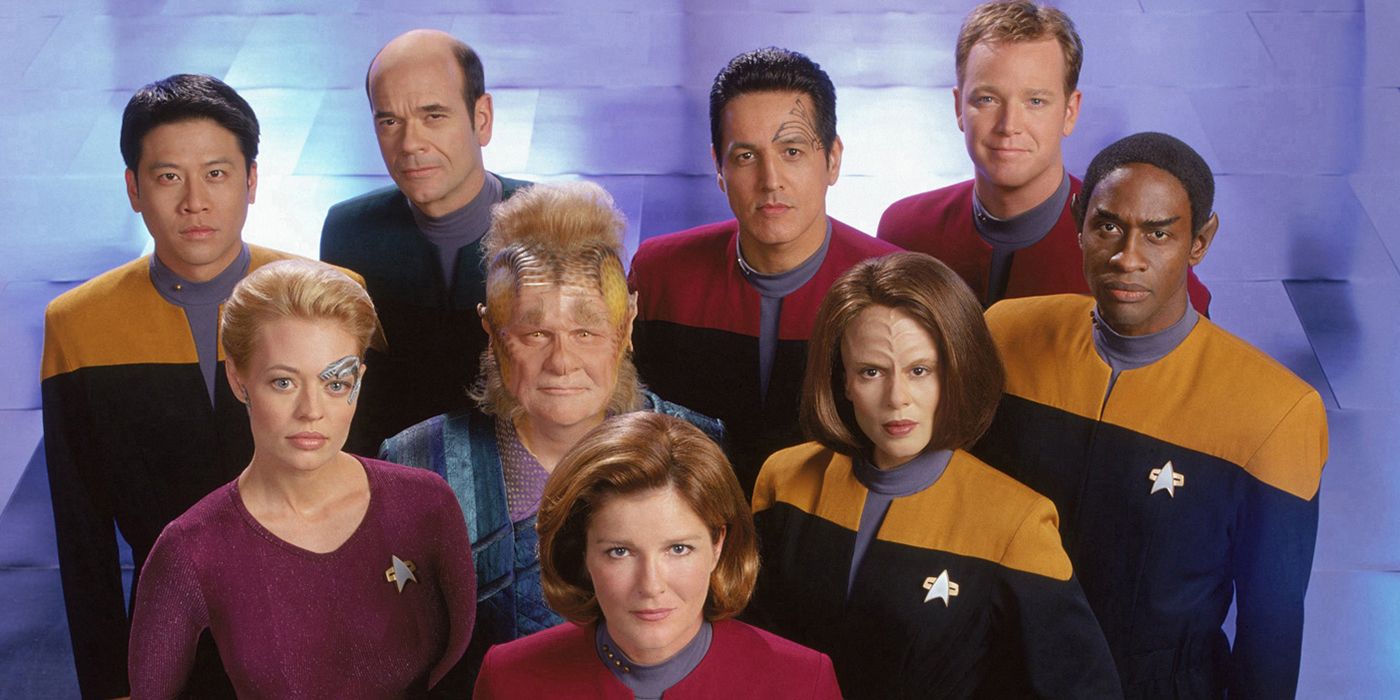
Star Trek: Voyager was one of the most ambitious Star Trek series yet conceived. It proffered a return to the “five-year mission” format of the original series, but with a twist: the ship would be trapped on the other side of the galaxy, with no ready way to return to Federation space. The crew was forced to contend with whatever the writers had planned on their own, with only their ship and their ideals to guide them.
It was a bold move from a franchise already enjoying a Renaissance on the backs of Star Trek: The Next Generation and Star Trek: Deep Space Nine. And what started as a slightly more formalized take on the original series soon gave the showrunners license to shoot for the moon every week. That led to a lot of ups and downs, with brilliant, gutsy moral meditations and succeed-or-die crisis episodes contrasted with dreadful misfires and good ideas that never got off the ground. Through it all, another stalwart cast created another crew full of memorable characters worth tuning into through good episodes and bad. Below is a list of Voyager’s seven seasons, ranked in order from worst to first.
Click the button below to start this article in quick view.
Star Trek: Voyager, Season 1
First seasons have rarely been kind to Star Trek series, and Voyager was saddled with a potential disaster right off the bat. Star Catherine Deneuve left the series shortly after shooting began and was replaced at the last minute by Kate Mulgrew as Captain Janeway. The new lead proved more than up to the challenge, but the show evinced other problems that wouldn’t be vanquished so easily. It expressed a timidity in its storylines, and often strayed into the ridiculous.
It also showed early shades of Gilligan’s Island syndrome: the ship was unable to resolve its central dilemma lest the series end, and thus any efforts to return home would end in failure by default, robbing the episode of any tension. Perhaps worst of all, its fascinating premise of a mixed Starfleet/Maquis crew was never explored, rendering of its strongest concepts inert from the start. Despite that, the first season scored its share of decent episodes, along with an intriguing early villain in the organ-hunting Vidiians. As with other Trek shows, better things lay ahead.
Star Trek: Voyager, Season 2
The second season applied what it had learned from the mistakes of the first, and the result was an improved series that took better advantage of its opportunities. The strongest entries came late. Episode 23, “The Thaw,” featured Michael McKean as a psychotic clown in a VR world eternally tormenting the hapless aliens connected to it. The very next episode, “Tuvix,” is widely cited as one of the best of the series, as a transporter accident fuses Tuvok and Neelix into a single entity. Both featured what became a series hallmark: Janeway doggedly finding a third path to resolve a seemingly impossible situation.
Sadly, the doldrums from the first season continued to dog Voyager in the second. A new villain, the Kazon, generated little excitement, and other episodes intended to evoke the best of the original series felt aimless and bland. The low point was Episode 15, “Threshold,” which turned Paris and Janeway into salamanders. It’s widely regarded as one of the worst Star Trek episodes of all time, and easily marks Voyager’s nadir.
Star Trek: Voyager, Season 6
If Season 5 found Voyager hitting its marks, Season 6 started missing what could have been terrific concepts. The ambition was there to take full advantage of the show’s grandest conceits, as the crew increased their efforts to get home and individual episodes explored all manner of novel sci-fi concepts. Not all of them lived up to their potential, and more then a few ended up falling flat or otherwise disappointing.
Despite that, its high points were present and strong. Reg Barclay returned to Trek in a pair of episodes that helped the character come into his own. The season delivered an intriguing coda to Kes’ story, bringing the aging Ocampan back for one of the series’ most emotionally intense episodes. There was even a cameo from The Rock in Episode 15, “Tsunkatse,” an otherwise uninspired outing that let Dwayne Johnson take an early step away from wrestling.
Star Trek: Voyager, Season 3
Voyager found its rhythm in Season 3, focusing on high-minded stories evocative of Gene Roddenberry and exploration-based episodes involving new phenomena and civilizations. They didn’t always hit, but their ambition was limitless, and entries like Episode 19, “Rise,” deployed reliable sci-fi concepts in new and interesting ways. The end of the season brought the dramatic return of the Borg in “Scorpion, Part 1” along with Species 8472.
The season’s principal shortcoming came from the shadows it still worked to get out of. Its Borg reveal arrived after Star Trek: First Contact had reached theaters, and with Deep Space Nine accelerating into the Dominion War, Voyager felt a like an outcast. Season 3’s greatest achievement may have been elegantly taking up the Borg after First Contact; a sign of better things to come.
Star Trek: Voyager, Season 7
Season 7 finished stronger for Voyager than the previous seventh seasons for either The Next Generation or Deep Space Nine. Unlike TNG, it didn’t yet feel complete, and its single central plotline developed with a great deal more clarity than the Byzantine storylines of Deep Space Nine. With the end growing near, the writers could throw themselves into the question of getting Voyager home without treating failure as a foregone conclusion.
The results felt well-balanced and dramatic without stretching the bounds of Trek technology, as well as delivering a smash-bang face-off between Janeway and the Borg Queen as the series’ climax. The cast had more chances to play with their characters, along with moments like Neelix’s goodbye to the crew and the birth of Paris and Torres’ child. It was a strong ending that ironically left the whole of Star Trek momentarily searching for a way forward.
Star Trek: Voyager, Season 4
Season 4 is best known for the introduction of Seven of Nine, and the simultaneous departure of Kes. The Borg came into their own with Seven’s arrival, and Voyager used the opportunity to develop what being separated from the Collective might be like. The seeds it planted came to full fruition with Season 1 of Picard, with Jeri Ryan already defying conventions about how an ex-Borg might behave.
Beyond that, the show finally realized some of its long-dormant concepts, such as Episodes 8 and 9, “Year of Hell,” which put the ship through the kind of wear and tear only hinted at in earlier seasons. When the Borg weren’t around, the more mundane Hirogen stepped in, forming a nice counterbalance to the well-traveled Collective. And for the first time, the crew made contact with the Alpha Quadrant, signaling that while they might not get home right away, they were still making progress toward their goal. The pieces all worked, and the odd misfire was easily forgiven for the strong material surrounding it.
Star Trek: Voyager, Season 5
Season 5 found Voyager handling a variety of plot threads with confidence and aplomb. With Seven firmly ensconced in the crew, Ryan set about proving that the character was far more than a catsuit in fascinating Borg-centric entries like Episode 7, “Infinite Regress,” and Episodes 15/16, “Dark Frontier.” Her partnership with Robert Picardo’s Doctor quickly became one of the big reasons to tune every week. The remainder of the crew got some refreshing doses of humanity as well, as Paris and B’Elanna got married and Neelix bonded with young Naomi Wildman.
The Borg’s appearances felt measured and justified – giving the writers unexpected venues to take the vaunted space zombies – and other episodes took chances on big concepts that often paid off. Episode 3, “In the Flesh,” involved a training ground for an invasion of Earth, and Episode 1, “Night,” sent the ship through a dark region of space. It even had fun with its goofier side, getting Janeway in a 30s space queen costume for Episode 12, “Bride of Chaotica!” and it concluded with the shocking sight of two Federation vessels turning on each other in the season finale, “Equinox.” It was the season that Voyager became everything it wanted to be, and the show reveled in the opportunity.
About The Author
