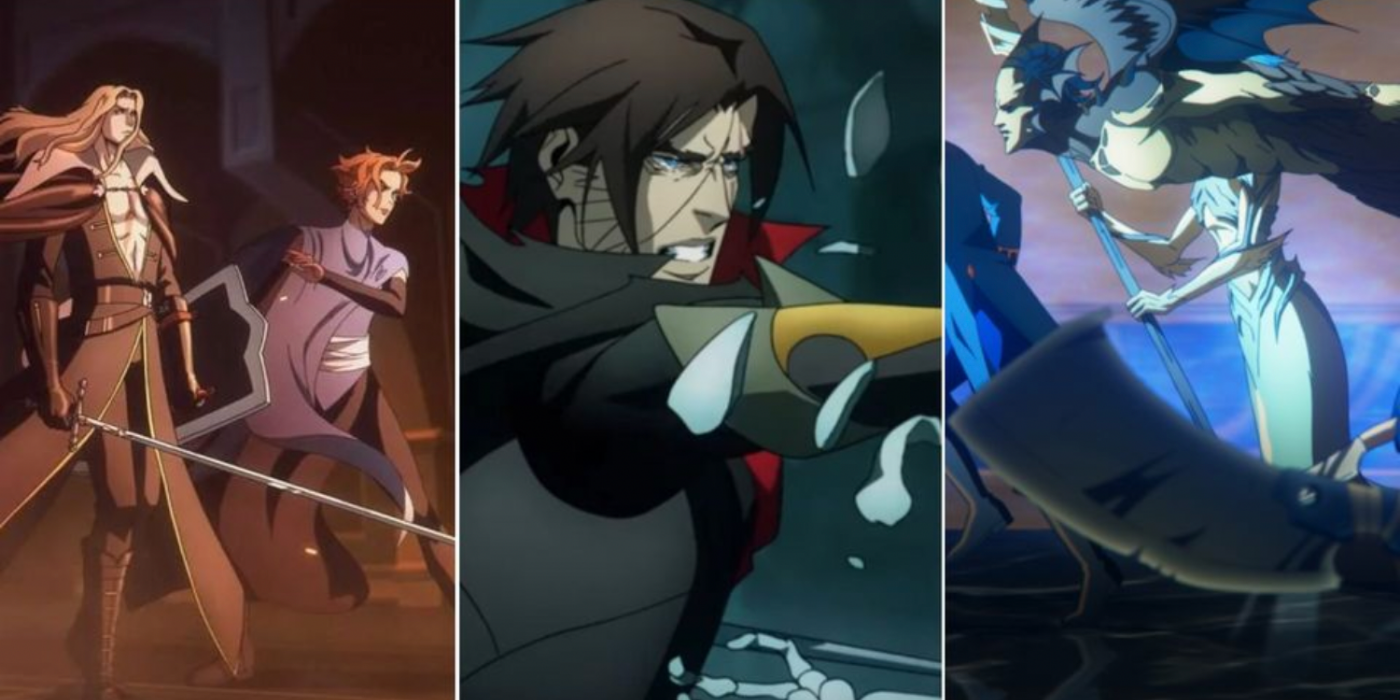
Netflix has started to produce some remarkable animated programs, but Castlevania has surprisingly become one of the streaming service’s most acclaimed efforts. Castlevania pulls from Konami’s legendary video game series and the level of respect and passion that it applies to this series is exactly why it’s helped break the “video game curse” when it comes to game adaptations.
The animated series is full of loving Easter eggs from the games and the series’ fourth and final season truly goes for the gold. Castlevania tries to go out on top and stick the landing. These final episodes represent the series at its best and they shouldn’t disappoint longtime fans, but they’re also not perfect and there are certain areas where things could be improved.
10 Ways It Was Perfect: The Animation & Fight Choreography were Astounding
Netflix’s Castlevania has been considered such a success because there’s such artistry and design that’s put into the animated series’ look. Castlevania has looked beautiful right from its debut, but this final season goes for broke, and ups the quality of both the animation and battle sequences in every regard.
Each episode has a sublime action set piece that showcases Trevor, Sypha, or Alucard’s work as individuals or as a team. The creative use of unique environments, monsters, and abilities helps every battle to beautifully come to life.
9 Ways It Wasn’t: The Heavy Use Of Cyclical Plotting
It’s appreciated that Castlevania’s narrative is well defined, even from its earliest seasons. The series can effectively be split into two halves, which focus on Dracula’s rule and the chaos that erupts after his death. Castlevania’s final season does feel somewhat repetitive to season three in the sense that they both focus on Trevor and Sypha’s efforts to maintain the peace and police this new and unpredictable world.
The actions of these characters are consistently entertaining, but it does fall into a pattern as Trevor and Sypha travel through villages to slay demons, while Alucard hesitantly offers to protect others.
8 Ways It Was Perfect: Signature Weapons Are Obtained
Castlevania is a series that gets a lot of love for its main characters and its signature monsters, but it’s also a franchise where there’s nearly just as much love for the iconic weapons. Castlevania’s previous three seasons feature satisfying weapons and pieces of armor from the lore of the games, such as Trevor’s trademark whip or Alucard’s Symphony of the Night shield.
Castlevania’s final season finally equips Trevor with the exaggerated Ruler Sword and it’s incredible to see it in action. These final episodes don’t waste their opportunity to fulfill these final weapon and artillery details.
7 Ways It Wasn’t: There are Too Split Of Focus
Castlevania’s final season grows surprisingly complex at times and it features the most disparate plot threads and characters from out of the entire series. All of these characters have strong motivations on their own, but they’re slightly weakened when there’s so much content to move between.
The missions of some characters, like the Council of Sisters, Hector, and Alucard can lose their impact when it’s divided between so much other content. It’s impressive that Castlevania can successfully juggle so many balls at once, but there are times when a simpler scope and more characters together would be beneficial.
6 Ways It Was Perfect: Trevor & Sypha’s Romance & Teamwork
Castlevania is first and foremost an action series with gothic horror influences, which is always so surprising when the series’ excellent sense of humor presents itself. Much of the series’ comedy comes from the Odd Couple-like teamwork between Trevor and Sypha.
The two go through a whole gamut of emotions in this final season, but the two are finally willing to embrace their feelings for each other and take things to the next level. Castlevania is a series that absolutely doesn’t need romance, but this relationship develops so naturally and becomes the heart of the final episodes.
5 Ways It Wasn’t: The Lack Of Dracula
This is tricky territory since this final season explicitly revolves around the loss of Dracula, but there’s still no denying that the absence of the character is most certainly felt. It’s appreciated how Castlevania sticks to its guns and doesn’t needlessly exploit Dracula, but there’s still a middle ground that could be reached between these two extremes.
Additionally, the limited use of Dracula goes in quite a different direction with the character. It’s ultimately touching that Vlad and Lisa can achieve some sort of happy ending, but the series still struggles with how to fill Dracula’s void.
4 Ways It Was Perfect: Death Is The One Who Pulls The Strings Behind Dracula’s Revival
The major antagonist during Castlevania’s first two seasons is none other than Dracula, but the final two seasons explore the fight for supremacy that’s ignited during his absence. Varney is new to Castlevania’s final season and plays a vital role in Dracula’s resurrection.
It’s revealed that Varney is just a cover for the villain’s true identity, Death. This twist is deeply satisfying and makes sense, both in the scope of the animated series and the video games. The final fight between Trevor and Death is among the very best from the series and longtime fans will cherish this villain’s debut.
3 Ways It Wasn’t: Unnecessary New Characters
The first three seasons of Castlevania work very hard to develop Trevor, Sypha, and Alucard, three of the more cherished characters to come out of the Castlevania series. Season four throws a handful of new rogue individuals into the mix, which isn’t inherently a bad thing, but in this case, no one really stands out and they only muddle the picture.
So many wicked souls want to usurp Dracula’s position and it leads to characters like Ratko, Dragan, Greta, and Zamfir. None of these individuals get enough time and, at worst, come across as crude caricatures.
2 Ways It Was Perfect: The World Building & Spin-Off Potential
Four seasons isn’t an exceptionally long run for a television series, but Castlevania confidently tells a full story in this time and effectively closes the book on this corner of the series. There’s closure provided for many characters, but many threads are left hanging and there’s already been discussion over a continuation or spin-off to the Castlevania universe, albeit with new characters and during a different time period.
Castlevania’s final season doesn’t bend over backward to set up these connections, but it does continue to expand its boundaries in a way where this world feels fertile for more stories.
1 Ways It Wasn’t: It’s Too Short
Less can often be more and many Netflix series suffer from padded seasons that are longer than they need to be. Castlevania has operated with brief seasons and season four, like its predecessor, is only ten entries long. Ten episodes cover what they need to, but considering that this was announced as the final season, it’d be appreciated if they could get a little more.
Even just a double-length series finale would have gone a long way. It’s of course beneficial that Castlevania doesn’t overstay its welcome, but there’s also no need to rush this final piece of the puzzle.
About The Author