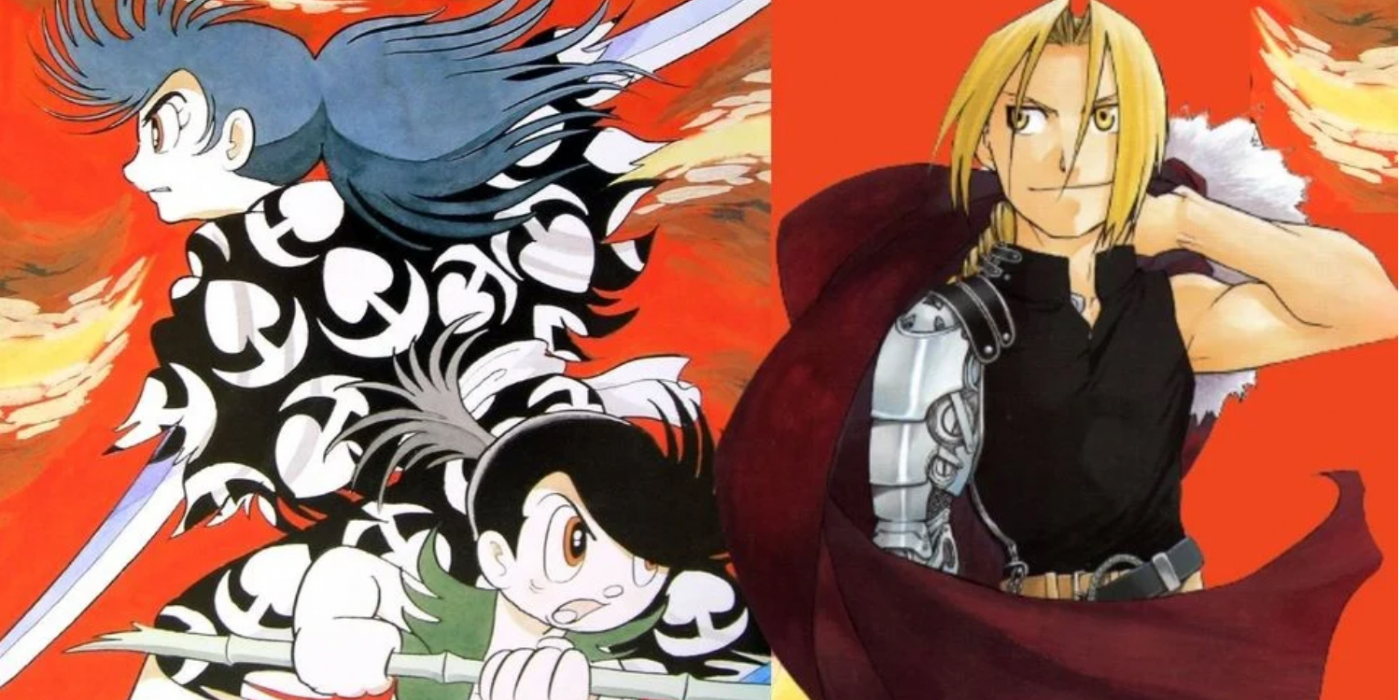
Reboots are par for the course when it comes to anime. But while many reboots take a new approach to telling a famous story, there is a fair share of adaptations that attempt to adapt the exact same material or story twice or several times over, for better or for worse.
Whether it’s because the source material has finally been completed, or because nostalgia and a new budget have inspired creators to recreate a favorite, or because a series is just too successful not to, some stories get more than one moment in the limelight.
10 Fullmetal Alchemist & Studio Bones Shattered World Records… Twice
There were certainly fans who felt that a Fullmetal Alchemist reboot was premature. After all, the 2003 anime was a groundbreaking and international success, considered one of the greatest shonen series of all time. When news broke that the same studio was tackling the material once again just six years later, skepticism seemed justified. Why fix what isn’t broken?
Studio Bones was right on the money, however. The manga was drawing to a close but the series’ popularity was still peaking, so the timing could not have been better for Brotherhood after all. As if by magic or alchemy, Brotherhood surpassed its predecessor.
9 Hunter x Hunter Has Two Great But Sadly Unfinished Anime Adaptations
Fans will argue about which Hunter x Hunter anime they prefer until the cows come home, and make valid cases for each. But most fans can agree that it is veritable torture being a devout Hunter x Hunter fan.
The series creator, Yoshihiro Togashi, is notorious for taking long and frequent hiatuses, and many otaku doubt the manga will ever have a proper ending. Given this predicament, both anime versions are also unfinished, left hanging at different points in the story.
8 Fate/Stay Night Was Rebooted Less Than A Decade Later
When the first iteration of Fate/Stay Night was released in 2006, it developed a small cult fandom. For years, anime aficionados would recommend the series to others as though it were a hidden gem.
But over time, Type-Moon and their visual novels became hugely successful, boosted by further releases and Ufotable’s acclaimed production of Fate/Zero. Adapting Fate/Stay Night a second time was a no-brainer.
7 Nostalgia Seems To Have Brought When They Cry Back To Life, Alas
When They Cry (2006) is a curiosity. Respected and loathed in equal measure, the original adaptation, helmed by controversial anime director Chiaki Kon, divided fans down the middle. While some admired how effectively the garish moe art style belied a deeply violent, horrifying story, others found the contrast jarring and even distasteful. Whatever else it is, few will disagree that When They Cry is memorable.
Yet, When They Cry was rebooted last year, the new anime made hardly a splash. This isn’t a surprise. While the animation and direction have arguably improved, the elements of unease and surprise are no longer a novelty in the modern, significantly more mature anime mainstream landscape. The shock has entirely worn off.
6 Every Evangelion Is Canon Evangelion
In theory, Evangelion‘s story has, at last, come to the end. The final film, Evangelion: 3.0+1.0 Thrice Upon a Time, was released this spring and serves as a canonical culmination of the film series. But when a franchise this successful is fuelled almost singled-mindedly by one creator, in this case director Hideaki Anno, it’s hard to ever be certain that another adaptation isn’t coming.
Auteurs tend to get stuck on specific projects. This is why Miyazaki can’t retire and George Lucas couldn’t leave Star Wars alone. Evangelion is so universally successful, despite its strangeness, that if this should happen, and another reboot is announced yet again, fans would still line up to see this story retold a dozen times more.
5 Fruits Basket Finally Has The Show It Always Deserved
The original Furuba anime is hard to recommend or sit through today. Not because it’s devoid of charms —the cast of characters remains endearing, and the central premise is shojo gold. But the 2001 anime was very much a product of its time, hampered by a limited budget, an excess of clichés, and an unfinished storyline.
In the case of Fruits Basket, the reboot is a real gift. The classic manga has finally been given an adaptation worthy of its story: beautiful animation, heartbreaking pathos, deeply nuanced characters, and core themes that question the foundations of a traditional society.
4 Kino’s Journey Received a Reboot It Didn’t Need
Often compared with Mushishi due to its haunting episodic nature and stories that feel like unique folktales, Kino’s Journey, directed by Ryutaro Nakamura of Serial Experiments Lain fame, is still held in high regard. The color palette is moody, the atmosphere is unnerving, and what the story lacks in animation, it makes up for with atmosphere and thought-provoking moments.
The new iteration is certainly prettier on the surface. Adapted by a new studio and featuring better animation, Kino’s Journey (2019) isn’t hard to watch. But the wind and wisdom seem to have gone out of it, and the loss is deeply felt.
3 JoJo’s Phantom Blood Has Been An OVA, Feature Film, & TV Anime
Speaking to JJTBA fans, it’s clear that the consensus is as follows: more JoJo is always a good thing. And yet this fandom, once an undercurrent, is now a roaring river that seems to know no bounds.
While the manga began in the ’80s and has received OVAs and films ever since, it took Phantom Blood, the first story arc, multiple attempts to stick the landing. In 2012, the franchise finally achieved the status it so richly deserved.
2 GeGeGe No Kitaro Has Seven Anime Adaptations & Counting
There are some stories that are, apparently, timeless. For Japan, among those is certainly GeGeGe no Kitaro, which has seen no fewer than 7 anime adaptations since the 1960s.
Yokai are now commonplace in anime, and paranormal series constitute a beloved subgenre, but it was truly Kitaro who made such stories mainstream for Japanese audiences. The 2018 adaptation has its flaws but proves that even sixty years later, there’s an audience for these stories.
1 Dororo’s First Iteration Aired Decades Ago
Dororo‘s second coming took too long to arrive, but the wait proved entirely worth it. The Osamu Tezuka classic was always somewhat hampered during its production. The manga was canceled not once, but twice, even though the original anime reached 26 episodes.
When MAPPA announced an anniversary reboot, the timing could not have been better. Ronin stories are always popular, but in a world where themes of disparity and morality are more relevant than ever, disabled characters are finally starting to get the representation they deserve, and gender is being thrown out the conventional window, characters like Hyakkimaru and Dororo are priceless and so timely.
About The Author
