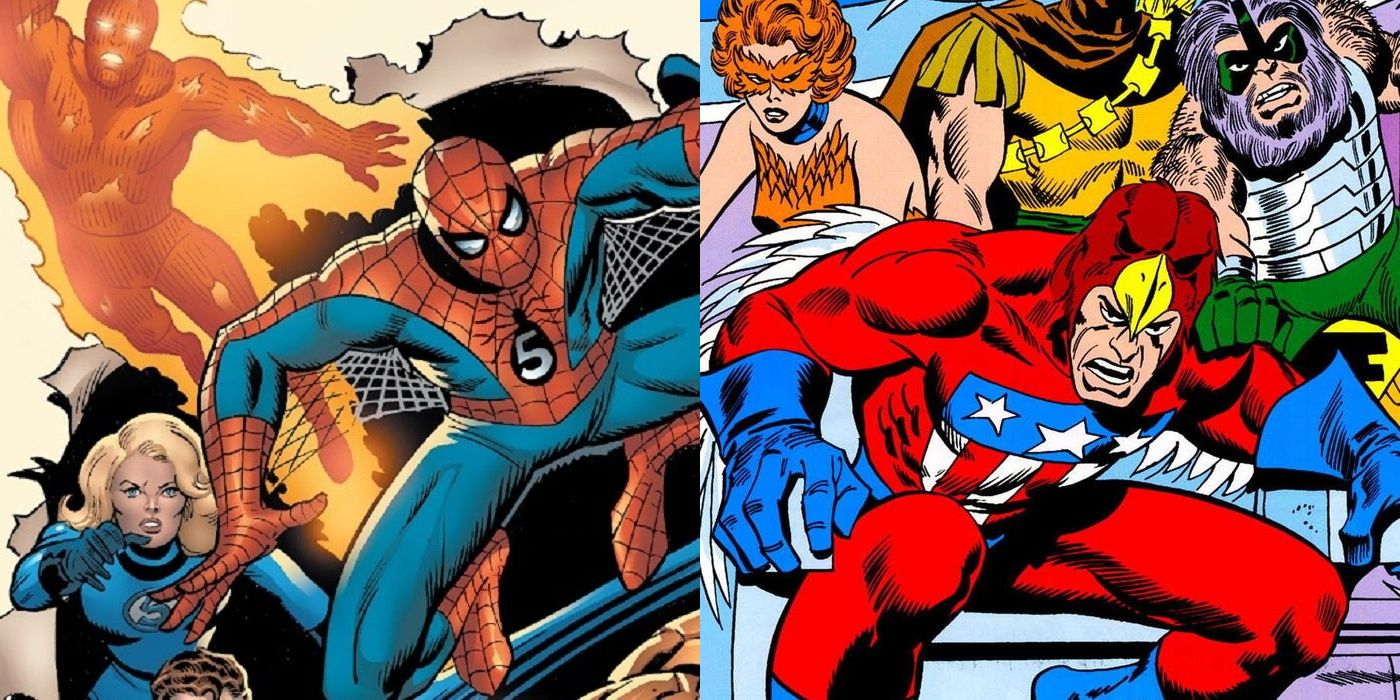
With “What If ?“ on the horizon of Marvel Studios’ slate of Disney+ releases, a lot of attention is getting drawn to Marvel’s wide variety of worlds in their Multiverse. Of course, the concept of alternate realities didn’t start with What If, as other comics featured an alternate Earth or two.
Marvel tends to have their alternate realities hinge on a specific event going differently. This helps engage fan speculation about other ideas for alternate realities. Also, many of their future stories have elements of current Marvel comics that change, and eventually, those futures get retconned as an alternate reality.
10 The Earth Where Hulk Kept Bruce Banner’s Mind (What If? #2, 1977)
One of the defining elements of the Hulk through the 1970s was the Hulk and Bruce Banner were separate personalities that hated each other. In this reality, Bruce Banner kept his intellect and personality from the very beginning. This changes the destiny of the hero, giving him a peaceful marriage with Betty Ross, and a good relationship with her father, General Thunderbolt Ross.
Banner’s efforts result in the Fantastic Four disbanding after Ben Grimm is cured, and the Avengers never forming without a mistaken threat from the Hulk. Professor X, Reed Richards, and Bruce Banner combine into one powerful form to drive off Galactus, costing them their powers. Unfortunately, Ben Grimm is caught in the energy of their transformation and becomes the Thing again, only without a separate savage personality, like the Hulk in the “main” reality.
9 Home of The Fantastic Five (What If? #1, 1977)
The very first issue of What If hinged around one of the earliest moments in Marvel Comics: Spider-Man trying to join the Fantastic Four. Instead of being rebuffed, the Fantastic Four welcome him in, adding one more to their ranks. He’s a very effective member of the team, but Sue Storm starts to feel pushed to the sidelines.
This reality came back in What If #21 which explored what happened after Sue Storm chose to leave the Fantastic Four and marry Namor. The tensions caused by Sue leaving drives the team apart. Reed Richards tries to win Sue back by battling Namor and killing Atlantis, but realizes its futility— and Sue eventually gives birth to Namor’s son.
8 The Reality Where the Nazis Won World War II Until The Fantastic Four Helped The Invaders (Fantastic Four Annual #11, 1976)
When Vibranium is accidentally sent back in time into Nazi Germany, it gives the Third Reich technology they need to win World War II. The Fantastic Four go back and help the Invaders stop an initial missile attack on London. They manage to retrieve half of the Vibranium before returning home.
The Thing goes back a second time to 1946, teaming with the Liberty Legion to get the other half of Vibranium. This further prevented the “main” Marvel Earth from being rewritten. Of course, that explanation goes against how time travel works in the Marvel Multiverse, but time travel logic always tends to fall apart under scrutiny anyway.
7 Machus, Home of Mahkizmo (Fantastic Four #151, 1974)
Thundra came from an alternate future where women warriors ruled. The opposite of that was an alternate future where men ruled harshly and kept women as slaves. When the worlds began to merge, Thundra was sent back to ensure her future survived. Mahkismo came back to stop her.
Reed Richards and the Fantastic Four stopped Mahkismo and successfully merged Machus and the Femizons’ world. The two worlds merged in peace until their warrior nature reasserted itself in disagreements elevated into combat. Tragically, Thundra could not stay in this world and came back to the present with the Fantastic Four.
6 The Alternate Future Where Almost Everyone Is A Wizard (Marvel Premiere #13, 1974)
This Doctor Strange story features the Sorcerer Supreme traveling back to 18th century Paris to confront Cogliostro whose book of magic told sorcerers how to travel in time. He discovers that Cogliostro is from an alternate 31st century. Three-fourths of the population can use magic, limiting the power the traveler could amass.
This is an alternate future because another future around this period has already been shown in Marvel comics, specifically the future of the Guardians of the Galaxy. Of course, the rules for time travel mean that any time traveler arriving in the present would come from an alternate future.
5 Duckworld, the Home of Howard the Duck (Fear #19)
Before the multiverse getting more fully explored in What If, writer Steve Gerber introduced into the world of the Man-Thing the Nexus of All Realities. This helps cement the multiverse into the Marvel universe. It linked all dimensions and alternate realities. It would be revisited in Marvel Zombies decades later.
Duckworld is identical to Earth except that the dominant lifeform evolved from waterfowl. Howard the Duck and his companion Beverly would return to Duckworld, and it would reappear over the years introducing new natives including Ducktor Strange and Deadpool the Duck.
4 Reed Richards Became The Thing (Fantastic Four #118, 1972)
The Thing and Lockjaw accidentally traveled to this alternate world. Here, the fateful fight that created the Fantastic Four only consisted of Ben Grimm and Reed Richards. Reed Richards became the Thing and lived in seclusion. Ben Grimm became Mr. Fantastic and married Sue Storm.
Instead of Ben Grimm being the tragic figure, it’s Reed. He insisted on the space flight, and in return paid the price with his humanity and the love of his life. To amuse himself, he secluded himself away on an island filled with themed robots.
3 The Home of Thundra and the Femizons (Savage Tales #1, 1971)
As with Mahkizmo, Thundra comes from an alternate future where women rule and keep men as slaves. The women took over after men led Earth into wars of ever-escalating destruction, and they left 90% of boys to perish in the wild. Of course, some survived to become tribes, usually raging on the citadel of the Femizons.
Thundra would not show up for over a year, traveling to the past to face the greatest champion of men. She intended to humiliate him and stop the encroachment of the parallel universe called Machus. She eventually helped peacefully merge the two worlds but found herself stranded.
2 The World of the Squadron Supreme (Avengers #85, 1971)
After returning with Thor from another dimension, the Avengers Vision, Scarlet Witch, Quicksilver, and Goliath saw the immediate future of an alternate Earth where the sun incinerated the planet. Going back in time, they found that they were on a parallel Earth, belonging to super-heroes called the Squadron Supreme. Adding to the confusion, four of the members resembled villains the Avengers had battled as the Squadron Sinister.
The Squadron is intended to be thinly-veiled copies of the Justice League. When the proper Squadron showed up, the new members were versions of Green Arrow, Black Canary, Hawkman, and the Atom. It started a tradition that followed the Squadron in the years to come.
1 The Avengers Wiped Out All Opposition (Avengers Annual #2, 1968)
In this reality, the time-traveling Scarlet Centurion manipulated the newly formed Avengers into eliminating all super-humans that could oppose him. When the Avengers of 1968 inadvertently come to this reality, they are likewise targeted. Fortunately, they defeat the Centurion by reassembling Dr. Doom‘s time machine.
The Watcher then explains that the Scarlet Centurion is another version of Kang the Conqueror, but wipes the memory of their trip to an alternate reality from their minds. Later writers build on this exposition by placing Kang in a multitude of alternate realities. Even another version of the Scarlet Centurion becomes a regular foe of the Squadron Supreme in their corner of the Multiverse. Each time, Kang, the Centurion, or their ultimate role as Immortus shows up, it adds to the rich tapestry of the Marvel Multiverse.
About The Author
