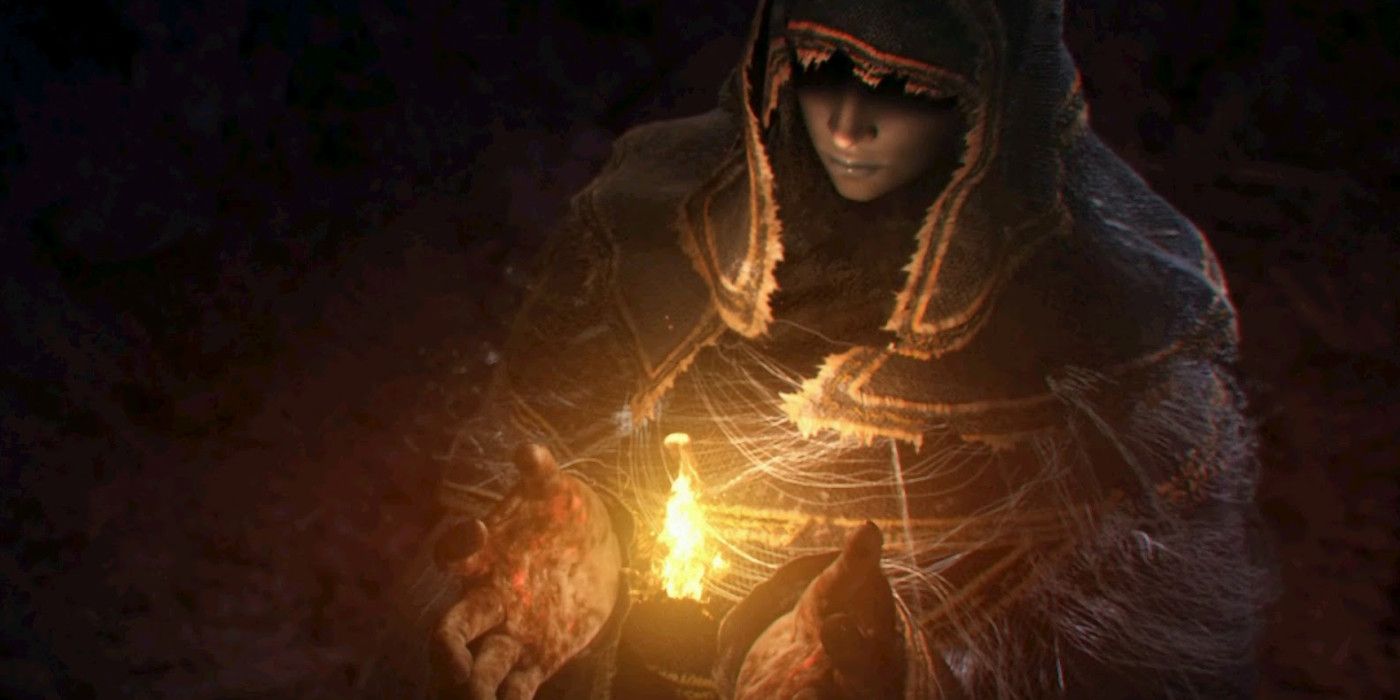
Dark Souls II features several callbacks to the first game, linking specific bosses from both — such as the Lost Sinner and the Witch of Izalith, better known by gamers as the Bed of Chaos. The storytelling in the Dark Souls series has always been rather subtle, which leaves the question of whether the two are linked somehow and if that link is more thematic than based on lore.
Dark Souls II is a much-contested sequel, with merits and failings that are an often debated topic among the Dark Souls fandom, making the question a tricky one. There is an amount of lore supporting the theory that there is a direct link between the Lost Sinner and the Witch of Izalith. Still, with the Dark Souls series being what it is, it takes players getting to their first New Game+ play-through before they begin to see any direct evidence.
Click the button below to start this article in quick view.
The Bed of Chaos has a lot of lore behind it, being widely accepted as the cursed form of the Witch of Izalith, one of the Lords from the opening cinematic who tried to kindle a new flame to circumvent the cycle of light and dark the setting is built on. However, her attempts only succeeded in creating the Chaos Flame, the source of all demons. In fact, if one looks at the structure of Izalith, where the Bed of Chaos lies, it does seem to be shaped similarly to the Kiln of the First Flame.
When playing through Dark Souls II a second time, upon defeating the Lost Sinner, she drops the “Old Witch Soul,” explicitly described as the soul of the Witch of Izalith, which is so potent that it persists even after eons have made the landscape unrecognizable. The item descriptions relating to the Lost Sinner boss also stated that she is punishing herself for a great sin – for attempting to light the First Flame. Whether this is a slight translation error or not is unknown, but it sounds remarkably similar to the Witch’s attempts at creating a new First Flame, only to birth the Chaos Flame instead. Of course, the Lost Sinner is also similar to the Bed of Chaos in that it has been called one of the worst fights of the game, being able to break lock-on unless the player goes out of their way to alter the boss arena in the proceeding area, without ever being explicitly told in-game what to do.
Many of the major bosses in the sequel drop boss souls from the first game in New Game+, which ties into the series’ continuing theme of cycles. The world of Dark Souls seems to go through an Age of Fire, followed by the age of Dark, followed by another Age of Fire and so on. The same mistakes are repeated, followed by the same acts of heroism. And whilst only two named NPCs appear in more than one game in the Dark Souls trilogy, the archetypes of others persist in new forms – or not so new forms in the case of the Knights of Catarina.
Nothing is ever simple in a Dark Souls game, however, and the lack of certainty has birthed many fan theories. Some believe that the Lost Sinner is the spiritual reincarnation of the Witch, a Queen who once again tried to light the First Flame, this time in the Old Iron Keep, bringing that to ruin and turning its King into a raging demon. This is a popular take, as it builds upon the theme of Queens and ruined Kingdoms, which is a theme throughout Dark Souls II and its DLCs. It also doesn’t quite fit as the Lost Sinner is never implied to be a shard of Manus like Elana, Nashandra and Mytha.
It’s equally possible that the Witch is the chaos bug that burrows into the Lost Sinners flesh in the cinematic at the start of the fight. Alternatively, the Lost Sinner could be another pyromancer instead, someone who inherited the soul and was driven mad by memories not their own.
Ultimately, there is a lot of hinting in the lore at a connection between the Lost Sinner and the Witch of Izalith. But in typical Dark Souls fashion, nothing is ever stated outright, and fans will never know for sure. But that’s what makes Dark Souls such a great series, frustrating bosses and all – the story is whatever you make of it.
About The Author
