In 1986, DC Comics firmly addressed the issue of its expansive multiverse in Crisis on Infinite Earths. Over the years, the Multiverse came back in Infinite Crisis. Grant Morrison defined the Multiverse in Multiversity, celebrating Elseworlds’ most popular characters with fans. Convergence further expanded it before the Dark Multiverse began to threaten everything.
The concept of a Multiverse in comics goes back farther than many fans realize. DC Comics embraced it in the Silver Age to explain their World War II-era characters, specifically Batman, Superman, and Wonder Woman, who carried over almost unchanged. Over time, alternate Earths have been retconned to have existed back into the Golden Age, but these are the ones that were defined as alternate Earths or “imaginary stories” when they appeared.
10 Magic-Land, Where Science Is Replaced By Magic (Justice League of America #2 By Gardner Fox & Mike Sekowsky 1962)
In their second issue, the JLA found all science not working and magic suddenly real. The culprits were three villains from an alternate Earth where magic ruled instead of science. They had switched the physical laws of the two dimensions so they could take over with stolen technology.
While it wasn’t described as another Earth, it’s obvious from a map that it’s a duplicate Earth. The map shows the continents are identical and one of the villains remarks that the worlds are in “the same sector in space” but in different dimensions. This is definitely an Alternate Earth.
9 The Earth With the Super-Family From Krypton (Superboy #95 By Jerry Coleman & George Papp, 1962)
In this imaginary tale, Superman’s mother invents an enlarging ray at the last moment to enlarge baby Kal-El’s rocket to carry the entire family to Earth. On Earth, they meet hostility until they begin performing acts of heroism. Before long, they begin changing events that shaped Superman’s life in the “main” continuity.
Lex Luthor’s hair is restored, preventing him from becoming a villain, and Mr. Mxyzptlyk is banned from entering Earth’s dimension. The biggest change comes from the Super-Family capturing Brainiac and restoring the bottled cities, including Kandor. The Super-family resettles to New Krypton after giving super-powers to the Kent family’s new adopted son Clark so he can operate as the new Superboy.
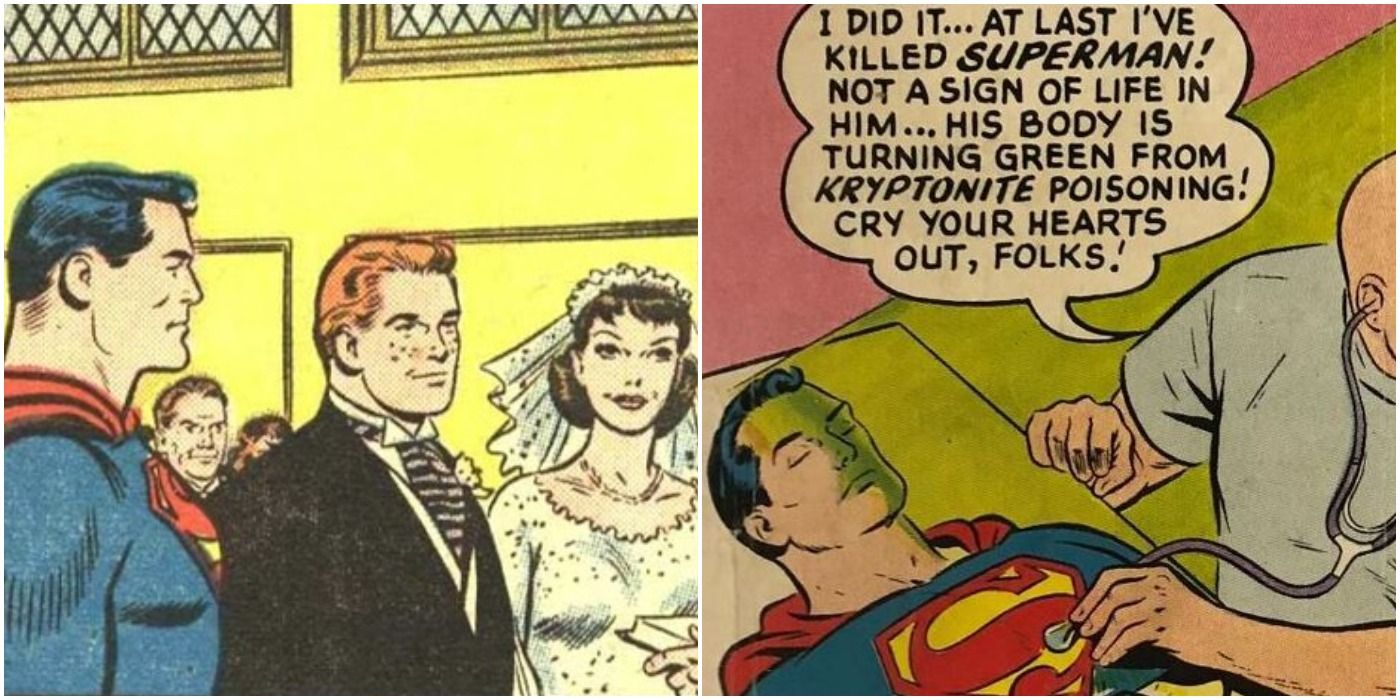
8 The Earth Where Jimmy Olsen Married Supergirl (Superman’s Pal Jimmy Olsen #57 By Jerry Siegel & Curt Swan, 1961)
This imaginary story features an Earth where Supergirl, in her Linda Danvers identity, gets exposed to Jimmy Olsen’s memento piece of red kryptonite and completely forgets her role as Supergirl. She and Jimmy fall in love and get married. When she regains her memory, she wonders how the truth will affect Jimmy.
She concocts a plan to see if Jimmy will fall in love with Supergirl, and proceeds to throw herself at Jimmy as Supergirl. Two adventures, one in outer space and another under the Earth, lead Jimmy to “break up” with Supergirl. He then confesses the ended relationship to his wife Linda, who then reveals her secret identity as Supergirl and they live together happily ever after.
7 The Earth Where Lex Luthor Killed Superman (Superman #149 By Jerry Siegel & Curt Swan, 1961)
In another “imaginary story,” Lex Luthor pretends to reform his evil ways to gain Superman’s confidence and trust. He then betrays that trust to lure the Man of Steel into a fatal Kryptonite ray. He does this with Jimmy Olsen, Perry White, and Lois Lane as captive witnesses.
Supergirl captures Luthor and puts him on trial in the bottle city of Kandor. Despite Luthor promising to enlarge the city for his freedom, Kandor convicts him of Superman’s murder, sentencing him to the Phantom Zone. Supergirl takes over Superman’s legacy.
6 Jay Garrick’s Earth-Two (Flash #123 By Gardner Fox & Carmine Infantino, 1961)
When Barry Allen met Jay Garrick in the classic “Flash of Two Worlds,” the Earth Barry traveled to was christened Earth-Two. Given that the superheroes of Earth-Two came first, why list it second? It’s just a matter of the perspective of the hero who did the traveling.
Barry Allen’s Earth would be listed first, as Jay Garrick didn’t travel to Barry’s Earth. The heroes of Earth-Two wouldn’t helm a series again for over a decade. It makes more sense if the stories that readers are be following are referred to as the premier Earth.
5 The “Main” DC Earth, Earth-One (Flash #123 By Gardner Fox & Carmine Infantino, 1961)
While Earth-One was considered the “main” DC Earth for a quarter-century, it wasn’t until “Flash of Two Worlds” that it was described as its own Earth. It should also not be confused with the current line of graphic novels giving alternate takes on DC’s most popular heroes. This is the pre-Crisis Earth-One, what would be known today as “Prime Earth,” which should not be confused with Earth-Prime. The Multiverse can get confusing.
There’s deliberation about where the adventures of Superman, Batman, and Wonder Woman switch from Earth-One to Earth-Two. It’s no surprise then that the majority of the Justice League was familiar with the idea of parallel realities when it came time to travel to one. It also shows that any source citing “Flash of Two Worlds” as the first parallel story in comics is horribly mistaken.
4 The Earth Where Superman Changed History, Saving Atlantis & Krypton (Superman #146 By Otto Binder & Al Plastino, 1961)
At the request of Lori Lemaris, Superman goes back in time to prevent the sinking of Atlantis. He’s failed before at changing the past but succeeds this time. He goes on to make several other changes, realizing that when he traveled back, he went into the past of a parallel universe. His first clue is when he observes himself as a baby emerging from a Kryptonian ark.
He made such drastic changes to that Earth’s timeline that it began a series of cosmic upheavals. Only Superman’s return to his own Earth prevents catastrophe. While this could demonstrate an alternate timeline, it’s depicted as a parallel universe, making full use of the “many worlds” concept from science fiction.
3 The Anti-Matter Universe of Qward (Green Lantern #2 By John Broome & Gil Kane, 1960)
Green Lantern Hal Jordan encountered and traveled to an Alternate Earth before Barry Allen did. He was asked for help by an outlaw from the Anti-Matter world of Qward, occupying the same space as Earth, but in another dimension made entirely out of Anti-Matter. Qward outlawed benevolent behavior, making this man a refugee.
When the visitor was killed by a Weaponeer, Green Lantern journeyed to Qward to help the visitor’s friends. He assists them in escaping, sealing the “bridge” between the two worlds with his power ring. Qward would later go on to be a threat, especially once the Anti-Monitor awakens.
2 The Earth That Visited An Undestroyed Krypton & Its Hero, Futuro (Superman #132 By Otto Binder & Wayne Boring, 1959)
This Alternate Earth is more speculative since Superman, Batman, and Robin viewed it through Superman’s supercomputer. Krypton was saved by another scientist stopping the chain reaction that would have destroyed the planet. Kal-El grows up to be a dispatcher with the Space Patrol and his professor Xan-Du has an accident which gives him super-powers he uses as the champion Futuro.
When lost NASA astronauts make it to Krypton, Futuro discovers Lois Lane as a stowaway. During her time on Krypton, she falls in love with Futuro and convinces her to come to Earth with her. Futuro gives Kal-El superpowers that he uses to protect Krypton as Superman.
1 The Earth Of Wonder Woman Tera Terruna (Wonder Woman #59 By Robert Kanigher & Harry G. Peter, 1953)
The very first DC hero who went to a parallel Earth was Wonder Woman. Lightning striking her magic lasso takes her to the Earth of Tera Terruna, the Wonder Woman of that reality. After assisting her to dethrone a despot, Wonder Woman goes home in a similar manner.
The story comes from Robert Kanigher, who wrote Diana’s adventures for nearly a quarter-century. He introduced this idea to comics almost a decade before the often-cited “Flash of Two Worlds.” While credit for developing the idea goes to other science fiction stories like Murray Leinster’s “Sidewise in Time,” credit for the start of DC’s Multiverse goes to Kanigher.
About The Author
