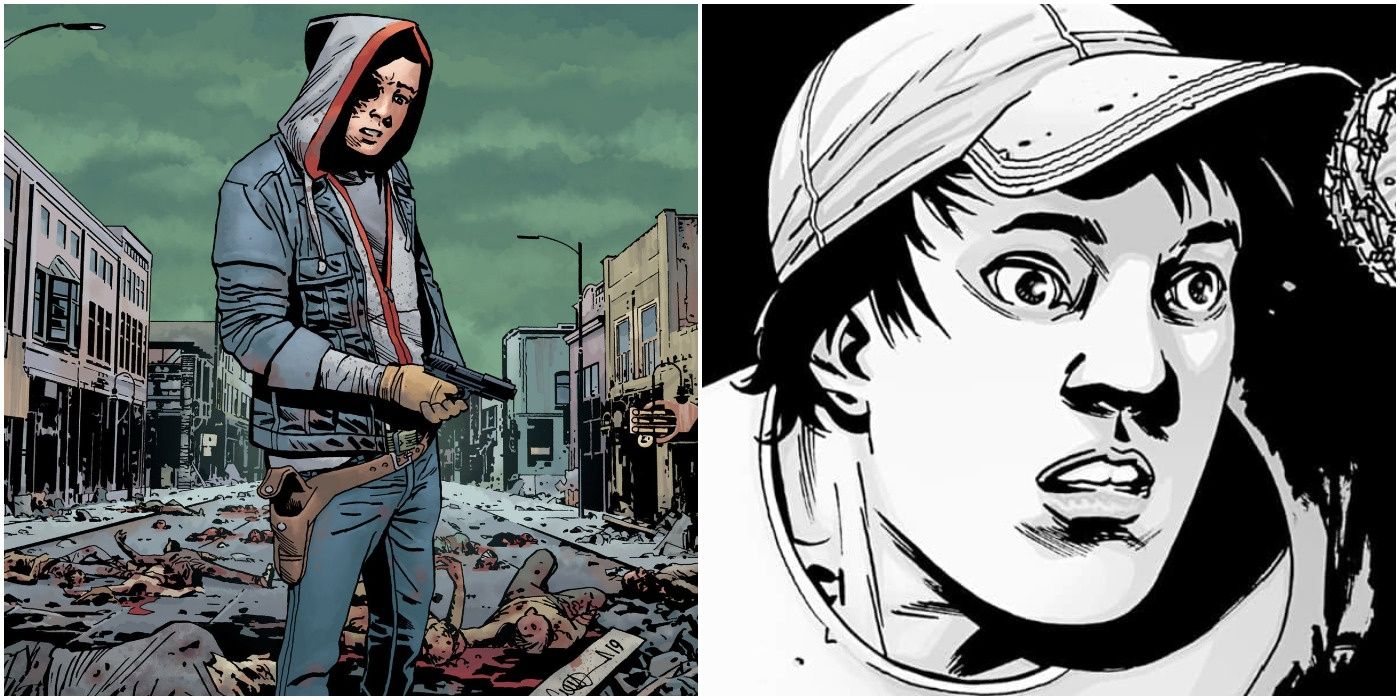
Any series that lasted as long as The Walking Dead comic did is bound to have some changes throughout its run. Characters end up growing in different directions, and the world as a whole starts to get fleshed out more as it gets explored. In some cases, the story can get a lot darker as well.
All of those end up being the case with The Walking Dead as the series continued to grow in scope the longer it went on, phasing out certain aspects of the story in favor of others.
10 The Story Becomes Less About Zombies & More About Awful Humans
For a series called The Walking Dead, you’d think the focus would always be on the zombie apocalypse surrounding the main characters. For a good chunk of the first half of the series, that’s the case.
There are human plots spread throughout, but most of the focus is still on the flesh-eating walkers. It’s with the introduction of the saviors and Negan that things start to shift dramatically towards human against human conflict, walkers taking a firm backseat.
9 Surviving The Apocalyptic World Becomes Less Of A Priority
At the start of the series, survival is king, and it feels like the characters are in danger constantly in this new and foreign world. If there’s one thing Robert Kirkman did exceptionally well, it’s driving home the fact that no one was ever safe as even fan favorites died.
That said, survival began to be replaced by the mental effects of surviving. It’s a shift from what was presented earlier but did provide very interesting characters like Negan and even Alpha.
8 Deaths Started To Have Less Impact With How Many Characters There Were
The amount of death in the comic never really changed, with characters getting taken out left and right with ease. It kept the tension of the series up for the most part, but it suffered from the law of diminishing returns.
If people constantly die, the readers are bound to grow less of a connection to the characters, as was the case when Alpha wiped out a swath of survivors. None of them felt all that important, each of them easily replaced later on.
7 The World Continued To Get Larger & Larger
Naturally, the world had to continue to grow the longer the series went on. It couldn’t continue to just be small bands of survivors trying to get by. It started with The Governor’s town, soon expanding into Alexandria and beyond.
The capper is when the Commonwealth was brought in during the final arc, showing a rebuilt military and society that was thriving in the new world. It was all necessary as the book always had to end with the world starting over again.
6 The Story Grew Less Intimate As More & More Characters Were Introduced
In the first volume or two, the story is very intimate, focusing on a small group of people just trying to make their way. It remained that way through Hershel’s farm and the prison arc.
It started to turn after dealing with the Governor, as more and more people starting to assimilate into Rick’s group. Sure, plenty of folks got killed off, but the story started to get stripped of the more intimate moments with anyone that wasn’t Rick.
5 Carl Grimes Started To Become More Of A Main Character
Carl was always present in the series, but at the start he was more of a side character at best. Someone whose presence was only there to help Rick from completely going over the deep end.
As the apocalypse started to change him, Carl became a more intricate and interesting character. He got plotlines that were all his own, and his interactions with Negan were all pretty great, as was the fact he executed someone that no one else in the group was willing to.
4 Rick Grimes Started To Show Why He Deserved To Be A Leader
Rick was always just kind of handed his leadership role as he had the strongest voice in the group. Very rarely was he ever challenged by anyone, even though he should have been.
Rick was flying by the seat of his pants during his initial run as a leader, as shown by his infamous “we are the walking dead” speech. As the story went on, he started to grow into the role far better, deserving the spot. By the time they hit the Commonwealth, Rick’s status was legendary for a reason.
3 The Brutality Of The Deaths Increased
The deaths have never been that tame in the Walking Dead, plenty of heads were blown off, and bodies were torn apart, but things progressively got more and more brutal as things went on. The stand out of that is Glenn getting his head brutally bashed in by a bat.
The death was so visceral and shocking for more than just who it was. It marked the end of the days when you’d just shoot someone in the head to kill them.
2 The Story Took A Far Darker Turn, Resembling The Road More Than Most Zombie Stories
While a zombie apocalypse is a rather bleak setting, it paled in comparison to what The Walking Dead ended up becoming. Once more of the human villains got introduced, their depravity became worse and worse. The Hunters are a prime example of that, openly admitting that they ate their children.
A crime so horrible that Rick and his group brutally tortured them. The same goes for the scavengers who threatened to physically abuse Carl.
1 Morality Got Thrown Out The Window As Everything Became A Shade Of Grey
For a lot of the series, Rick Grimes was painted as the good guy, the one the reader is always meant to pull for, and for the most part, he was. The difference is that the lens he was viewed through changed from the black and white one present with The Governor to one that was entirely grey.
By the end of the series, Rick had done awful things, just as any villain had. The reverse could be said of Negan, who grew into more of an anti-hero by the end of it all.