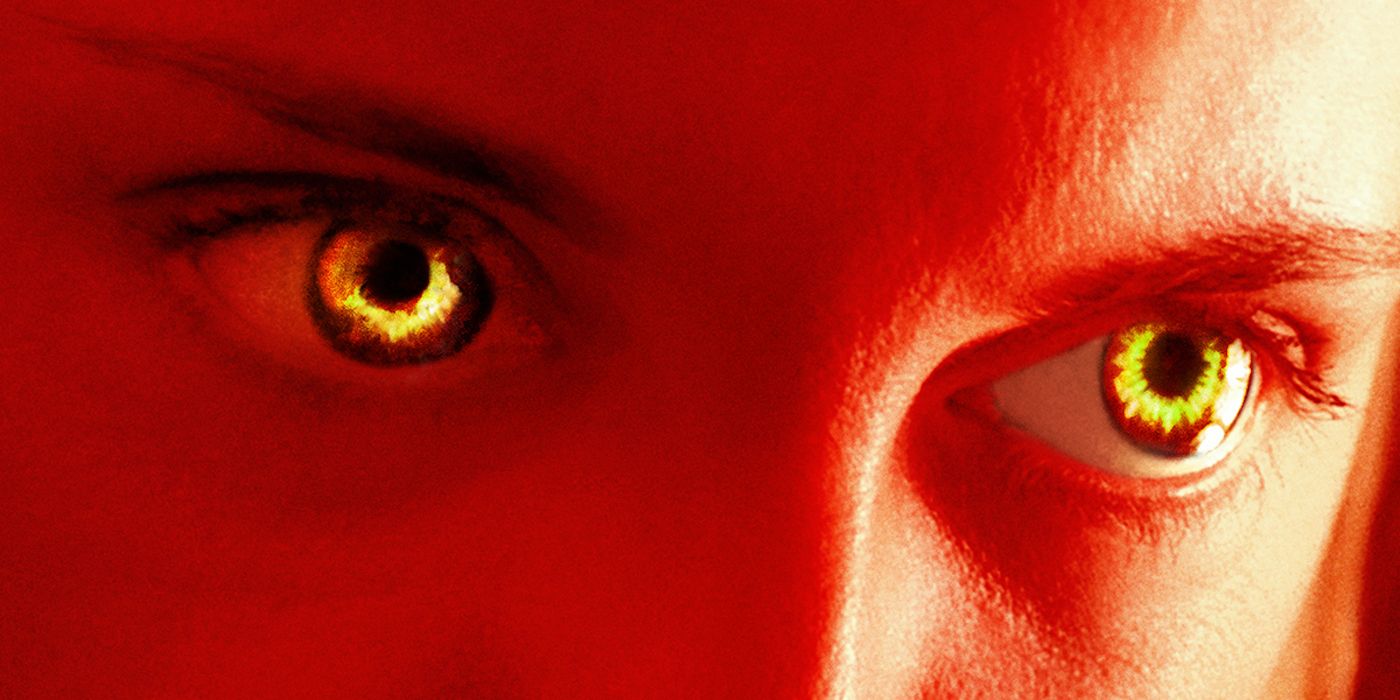
WARNING: The following contains spoilers for Bloodthirsty, which is currently available in select theaters and on demand.
Mother-daughter writing team Lowell and Wendy Hill-Tout found the perfect metaphor for the creative process in the horror movie Bloodthirsty: becoming a werewolf. Their film dramatizes the challenges singer-songwriter Grey (Lauren Beatty) encounters as she attempts to write her second album, and the increasing success she finds as her mysterious producer, Vaughn (Greg Bryk), encourages her to give into her primal urges. Yet, being a great artist isn’t the only thing Vaughn is grooming Grey for; he’s also preparing her to become a werewolf. It’s a uniquely haunting film that arose out of Lowell’s own struggles as a singer-songwriter, a personal connection that can be felt in the film’s visceral depiction of creativity.
In an interview with CBR, Lowell and Hill-Tout discussed how they came to collaborate on Bloodthirsty, the benefits of the film’s all-female production team and the complex personal experiences that are represented in the film.
CBR: How did the idea for Bloodthirsty come about?
Lowell: So I’m an artist, a music artist. I’m more working in songwriting now, but at the time, when we first started writing this, I was working on my second album, which turned out to be a really difficult feat. So a lot of the inspiration [for] this film was my own writer’s block. Then, funny enough, writing a film instead of writing an album at the time to get me out of it. But definitely, all the battles of the pressure from my team, from myself, success of my last album, non-success of my last album was driving me mad. So this was kind of like a capture of that.
Wendy Hill-Tout: It was definitely Lowell’s concept. I mean, the original concept never changed. It was always about a young, female songwriter who goes to work with a famous music producer at his mansion in the woods, and it turns into a horror film. And what did change was we started as a ghost story, believe it or not, and we struggled with the script. I mean, the characters remained the same. It was Vaughn and Grey and everything, but, I don’t know, it just wasn’t working. And somehow, when we came up with a werewolf idea, about a woman who’s half-werewolf and half-human and her struggles as she tries to find herself and who she really is — and then this artist going through the same thing — somehow the two melded together perfectly for us when we were writing it.
Were there other supernatural creatures that you considered? Vampires or things like that?
Lowell: Yeah. We did talk about all of the options. [Laughs.] I mean, I was writing an album called “Lone Wolf” at the time, and so we had already incorporated a little bit of a wolf parallel, but we just had never taken it so literally until closer to the time when we completed the script. But yeah, we talked about vampires. We thought it’s kind of been done a lot recently and in a modern space. So we thought it would be more fun to do something a little less popular, I would say, outside of a niche environment.
And whose idea was it to collaborate on a film?
Lowell: I think that was my mom’s idea. [Laughs.]
Hill-Tout: It was mine. At the time, again, [Lowell] was working on her second album, and it was called “Lone Wolf,” and so the film was originally called Lone Wolf. But, again, that was sort of a different take. Lowell’s name actually in French means “wolf,” so she’s always had an affinity. And even the werewolves we created, well, maybe they’re a more female version of werewolves than the hairy version that’s been created in werewolf lore and films. And we wanted to make them, I guess, more beautiful and more wolf-like, and less hairy. And I think [it was] a little bit revolutionary to create the werewolves that we did that were in this film.
Lowell: Yeah. Basically, we had been talking about my writer’s block and how everything was really difficult for me at the time. And she had been wanting to do an art film for a while. And so that’s kind of how we decided to start writing something together.
What was the collaboration process like?
Lowell: Mostly, we would write and then send a completed kind of thing. And then the other person would wipe all that and rewrite it and then send it back. We did all [the collaboration] from across the country that way.
Hill-Tout: And Lowell, really, I think, because she knows the world, she’s been in a recording studio, she’s worked with a lot of male producers, and she knew that world and we trusted her to know that world, and so that was really, really important. One of my favorite lines is when she says something like, “Would you like to be a predator or would you like to be prey?” Well, the music industry can be like that. And I think part of what she was writing about — not to speak for Lowell — was that world, as well, and what she was also facing as an artist.
Both the film industry and music industry are very cutthroat, but in different ways. The time frame is different. Did that feed into the way you thought about this film?
Lowell: I’ll tell you one thing. It fed into how hard it was to do this film. I said to my mom at one point, “I could not work in film. I can’t believe how fast everything moves and how demanding everything is.” It’s like, “I thought my job was hard.” But yeah, I think that I’m a slow thinker. I’m meticulous and I love everything to be perfect. And often when I’m working on a song, I’ll go in on a song for two weeks if you want it to be a hit. And that’s two minutes of music. So I think that that’s unfathomable to somebody that works in film, where a two-minute piece of work in a film, it’s just done.
But yeah, I think that there’s so many parallels with songwriting and film writing. I think that just in general, it’s all the same. It’s just about telling a story and a story that you know and being honest and speaking through honesty. And as women collaborating together, we’re really able to be honest and create an honest female character, which I think is rare. We didn’t have any push-back from maybe a male saying like, “Oh, well, a woman’s not supposed to be like that,” or something.
Bloodthirsty was female-written, female-produced, female-starring and directed. Did it help to have a production team that was predominantly women?
Lowell: Definitely. I mean, Grey’s character is so complex. She’s innocent, she’s evil, she struggles, she’s in control, she’s not in control. I think that as women, we were able to create this really complicated character. And I do think that often it is usually men who are creating and they do tend to simplify the female characters because they don’t understand the complexity of women, as they might even say, so having an all-female team just really opens us up for that.
Hill-Tout: And I think when Lowell speaks about honesty, I think there was a lot of honesty in writing a female empowerment movie from females and directed by Amelia Moses, a female. I think that was really important. And we didn’t have to hold back, we could just write and film what we thought was the truth.
I still have the songs from the movie stuck in my head. Were they written specially for the film?
Lowell: Yeah, most of the songs in the film were written for the film. There’s a few earlier on that were just already written. But yeah, most of it was catered to the film.
Hill-Tout: It was so important to show the progression of Grey’s character, which also was the progression of her development as an artist. And so it was pretty tricky. Lowell and I spent a lot of time thinking, “Okay, what is the progression? What do we start with?” And it was interesting because we started with some of the songs on [Lowell’s] earlier album. And then even [the song] “God Is a Fascist” is some of her later writing, so you can see it’s very autobiographical in a way; the film, too.
But also I think personally it represents Lowell’s progress as a songwriter. And we definitely figured out those songs as we wrote because it was so integral to the script. It had to work, [Grey’s] progression as an artist. Her music couldn’t become more haunting or whatever if we didn’t succeed in that. We had to succeed in that because we wanted the audience to believe that she progressed as an artist just as she progressed in terms of an animal coming to know herself.
In the movie, the character of Vaughn grooms Grey to become this artist and this werewolf. Was that based on personal experience?
Lowell: Yeah, absolutely. I mean, as a young female getting into the music industry, I met a lot of different characters that I wrote about in this film. We obviously talk about the MeToo movement and there’s Harvey Weinstein or something, or those picture — I don’t want to say perfect — but the easy, simple stories of MeToo where it’s just like a man did this awful thing to this woman. But I actually experienced some really complex power dynamics being like 18, 19 working in studios that aren’t that simple. Where there is a bit of grooming and then also them giving you a lot and helping you find who you are but sometimes in really out-of-line ways. And then these questions that I had to ask myself like, “Is it worth it? And where do I draw the line?” A lot of that was really incorporated in the film.
Hill-Tout: I wanted to add one little thing, […] Lowell’s coming out with an EP for the songs in the film […]. So that’s being released and it’s going to have the “Bloodthirsty” song, Greta’s Song, “Loving You to Death,” and “God is A Fascist” and “Lemonade.” Because a lot of people have said, “Oh, you should do a soundtrack,” or, “We love the song,” so we are coming out with an EP […].
RELATED: Boys From County Hell Stakes Ireland’s Claim to the Modern Vampire
Do you have any additional collaborations planned? What’s next for both of you?
Hill-Tout: Well, I did get some funding to do something more with werewolves probably — either a sequel or possibly a series. So we’re working on a concept for that and we’ll see where that goes. It probably will be another year — we’ll be developing it over the next year. So I’m hoping to do certainly another horror film and hopefully in collaboration with Lowell.
Lowell: Yeah, we did overall have a lot of fun working on this. So if we could have any opportunity as a mother-daughter team to do that again, I would love to.
Bloodthirsty, directed by Amelia Moses and starring Lauren Beatty, Greg Bryk, Katharine King So, Judith Buchan and Michael Ironside, is available now in Canada through Raver Banner Releasing and in America in select theaters and On Demand.
About The Author