With just over 130 full-length episodes across seven seasons, the animated series Star Wars: The Clone Wars is an indispensable piece of the official Star Wars canon, the ramifications of which are still being felt. In contrast, its non-canon predecessor — Genndy Tartakovsky’s Star Wars: Clone Wars — is much smaller in scale, running just over two hours in total across 25 short episodes.
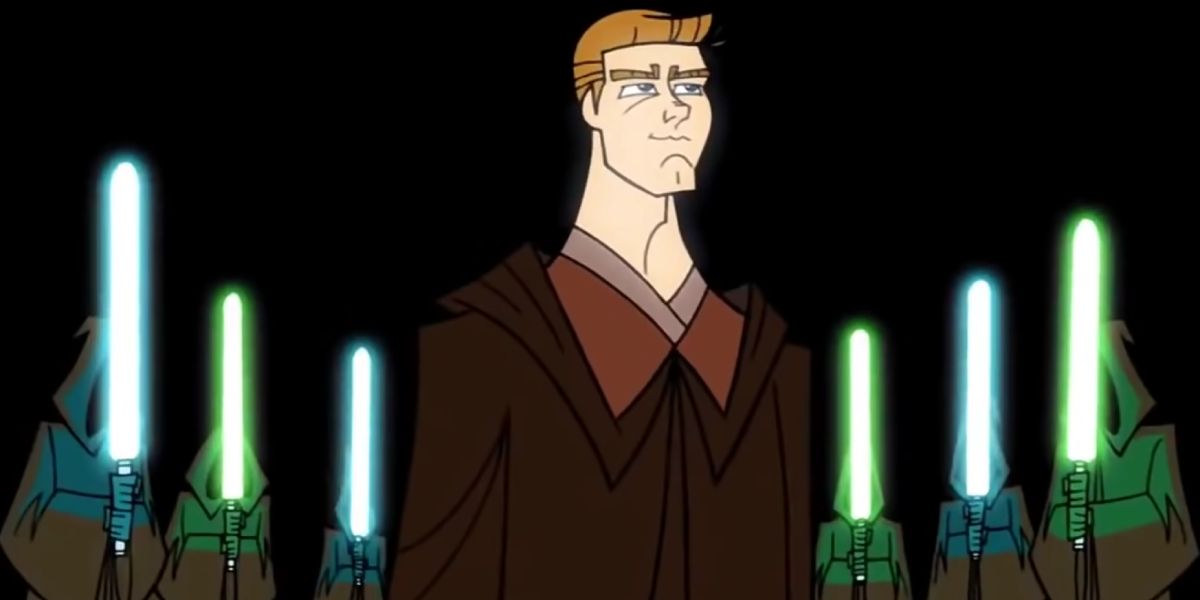
As undeniably awesome as Tartakovsky’s Clone Wars is, the 2D micro-series was mainly made to complement the Star Wars prequel film trilogy, rather than be a definitive, status quo-altering work in its own right. As such, it doesn’t cover nearly as much ground as its 3D successor. That being said, Tartakovsky’s Star Wars cartoon does feature one very important moment from Anakin Skywalker’s career that even the canon Clone Wars series neglected to show: his promotion to Jedi Knight.
Click the button below to start this article in quick view.
Throughout the entire first volume (i.e. the first 20 episodes) of Tartakovsky’s Clone Wars, Anakin and his master, Obi-Wan Kenobi, look exactly as they do in Attack of the Clones. Obi-Wan has his long hair and beard, while Anakin is still rocking the short hair/Padawan braid combo (which Obi-Wan himself wore back in The Phantom Menace), meaning the so-called Chosen One had still yet to be granted the rank of Jedi Knight at this point.
Clone Wars Volume II kicks off with Obi-Wan trying to convince the rest of the Jedi Council that it’s time to promote Anakin, citing the need for more Knights amid the ongoing conflict. He also suggests forgoing the traditional Jedi Trials, noting that Anakin already faced far more difficult trials of his own — such as his victory over Asajj Ventress on Yavin 4 and the loss of his right arm at the hands of Count Dooku. Some of the other Jedi are reluctant to endorse Anakin as a candidate for knighthood, though Master Yoda ultimately sides with Obi-Wan.
Anakin is summoned before the Council, but is a bit late on account of a secret meet-up with his wife, Padmé Amidala. When he finally arrives, he is scolded by Obi-Wan for his tardiness. An argument (naturally) ensues, though they manage to diffuse the situation rather quickly, at which point Obi-Wan tells Anakin that they can no longer be master and student, and must now become “brothers.” Anakin is initially confused by this, but realizes what’s happening once he enters the Council’s chamber.
Anakin kneels before Yoda, who places his lightsaber over each of Anakin’s shoulders while reciting the words, “By the right of the Council, by the will of the Force.” He then declares Anakin a Jedi Knight of the Republic, slicing off his Padawan braid in the process. This medieval-inspired interpretation of the Jedi Order’s knighting ceremony eventually made its way into canon, making notable appearances in the animated series Star Wars Rebels and the video game Jedi: Fallen Order — but not the 3D Clone Wars series.
In Tartakovsky’s Clone Wars, the next time Obi-Wan and Anakin are seen following the latter’s promotion, they appear as they do in Revenge of the Sith, with Obi-Wan cutting his hair short and Anakin growing his long. Conversely, the 2008 film Star Wars: The Clone Wars — which serves as a pilot for the canon animated series of the same name — opens with Obi-Wan and Anakin already rocking their Episode III looks, implying the latter was promoted off-screen. The film drives this point home by giving Anakin a Padawan learner of his own: Ahsoka Tano.
Obi-Wan was promoted to Jedi Knight at the end of The Phantom Menace, albeit without all the pomp and circumstance. The iconic Star Wars knighting ceremony as it is known today, however, was first experienced on-screen by Anakin in Tartakovsky’s Clone Wars, paving the way for Kanan Jarras‘ promotion in Rebels and Cal Kestis‘ promotion in Fallen Order. Despite this, it’s not an honor the audience has actually seen Anakin receive in canon.
About The Author
